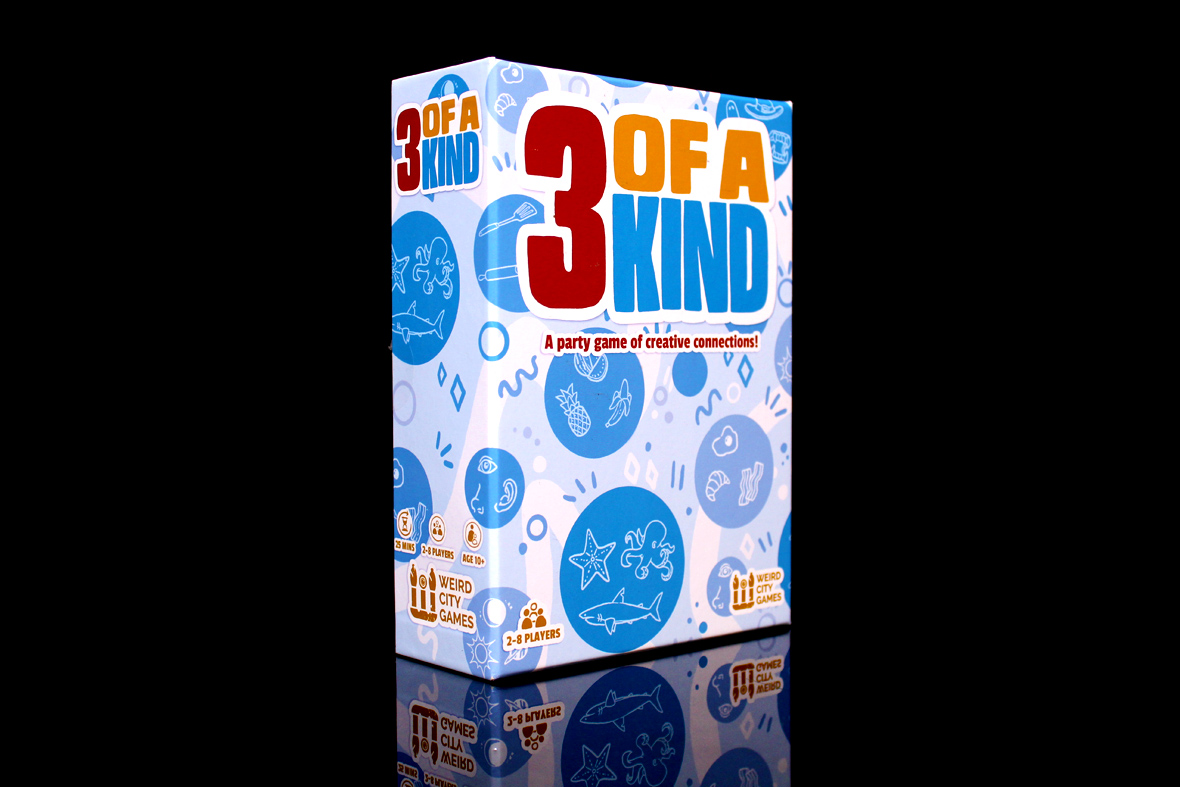
Base price: $20.
2 – 8 players.
Play time: ~25 minutes.
BGG Link
Buy on Amazon (via What’s Eric Playing?)
Logged plays: 1, but a lengthy set of rounds because everyone was having fun
Full disclosure: A review copy of 3 of a Kind was provided by Weird City Games.
I do think that the alternating effect of “I only had one friend to game with” and “I had a little game night at my house and we played a bunch of party games” does make my review cycle a bit odd, but them’s the breaks. There are enough party games that I can’t play with two people that I’m always excited by and thankful for the opportunity to play them with more folks. I suppose that I should be a bit more social at conventions to grease the wheel on that front, but I love sleeping too much. We’ll see how things turn out at PAX Unplugged. In the meantime let’s check out 3 of a Kind!
In 3 of a Kind, you’re tasked with answering the most challenging questions of our time. These questions challenge how you think about the world and your place in it. What’s the juiciest item in a junk drawer? Which mode of transportation is the funkiest? What is the quietest breakfast? If you can crack the code on this, you might find yourself more enlightened. That said, it’s actually a lot better if you can crack the code with somebody else, since it’s much better to find that enlightenment together. And you score points. Points are good. Will you be able to solve these mysteries?
Contents
Setup
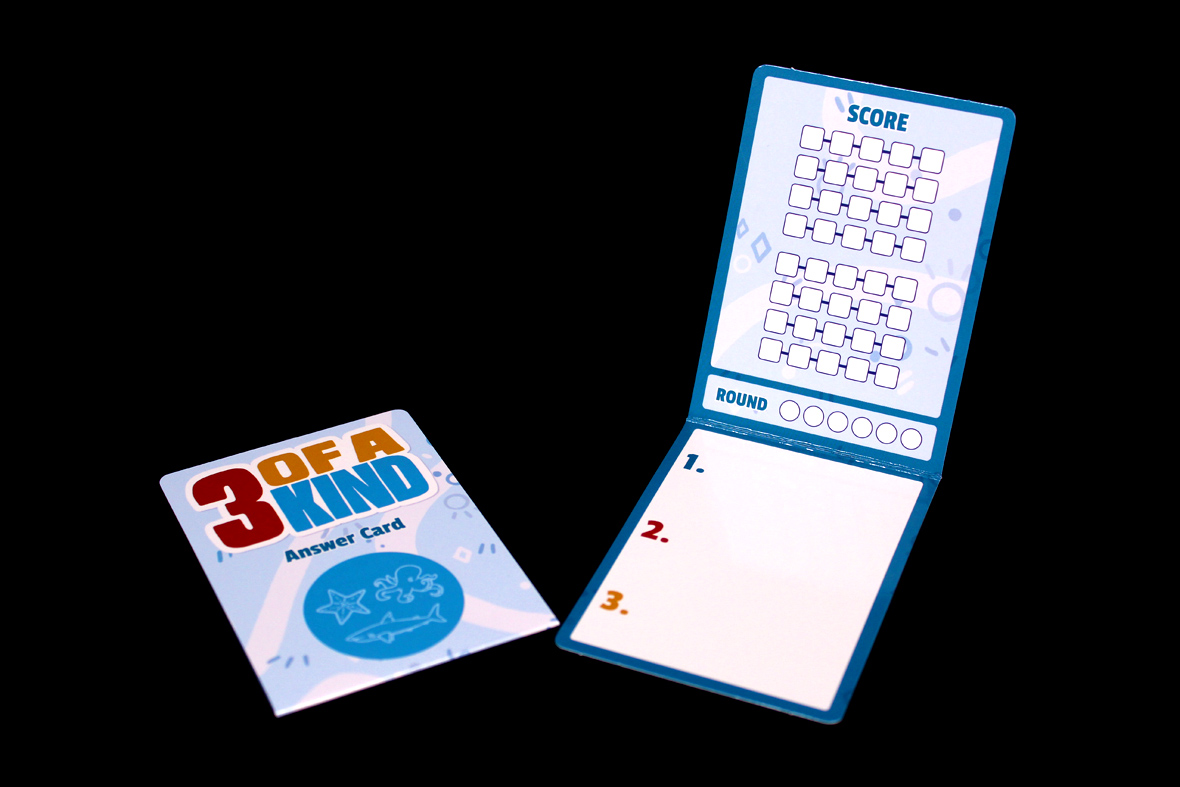
Setup isn’t too complicated! Each player gets an Answer Card first, along with a pen:
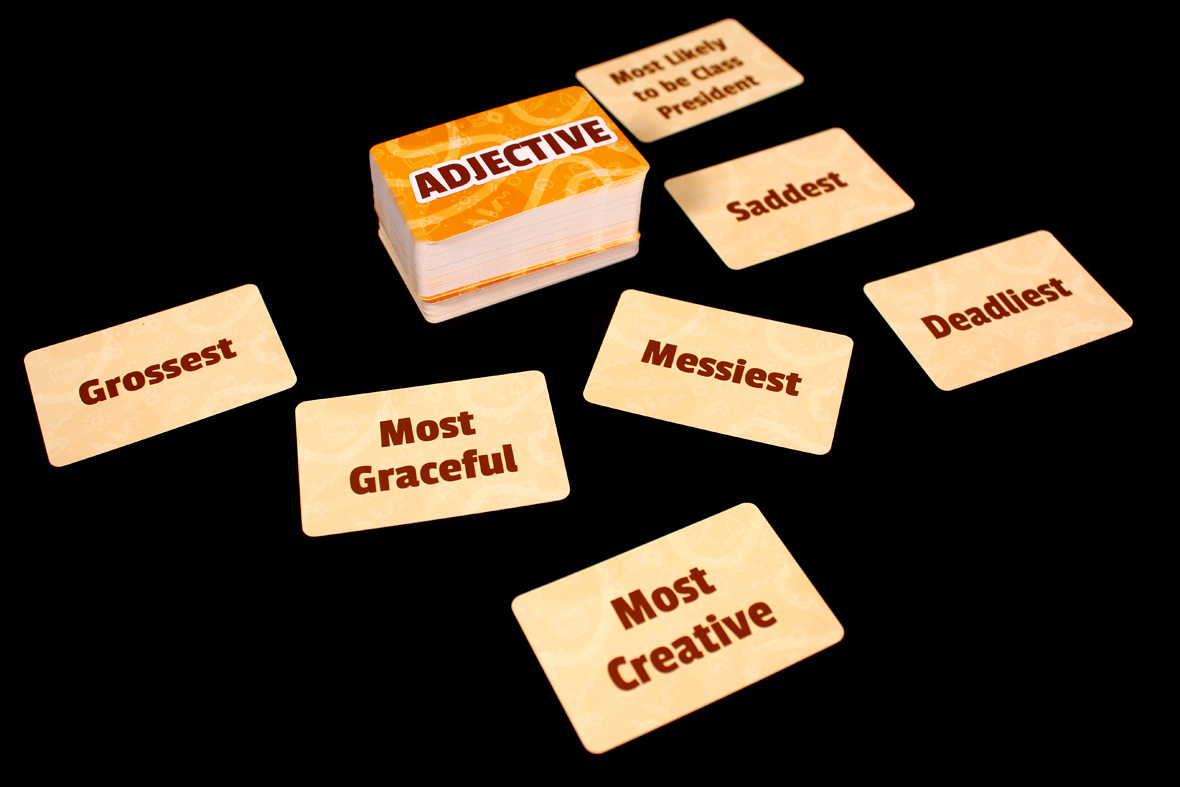
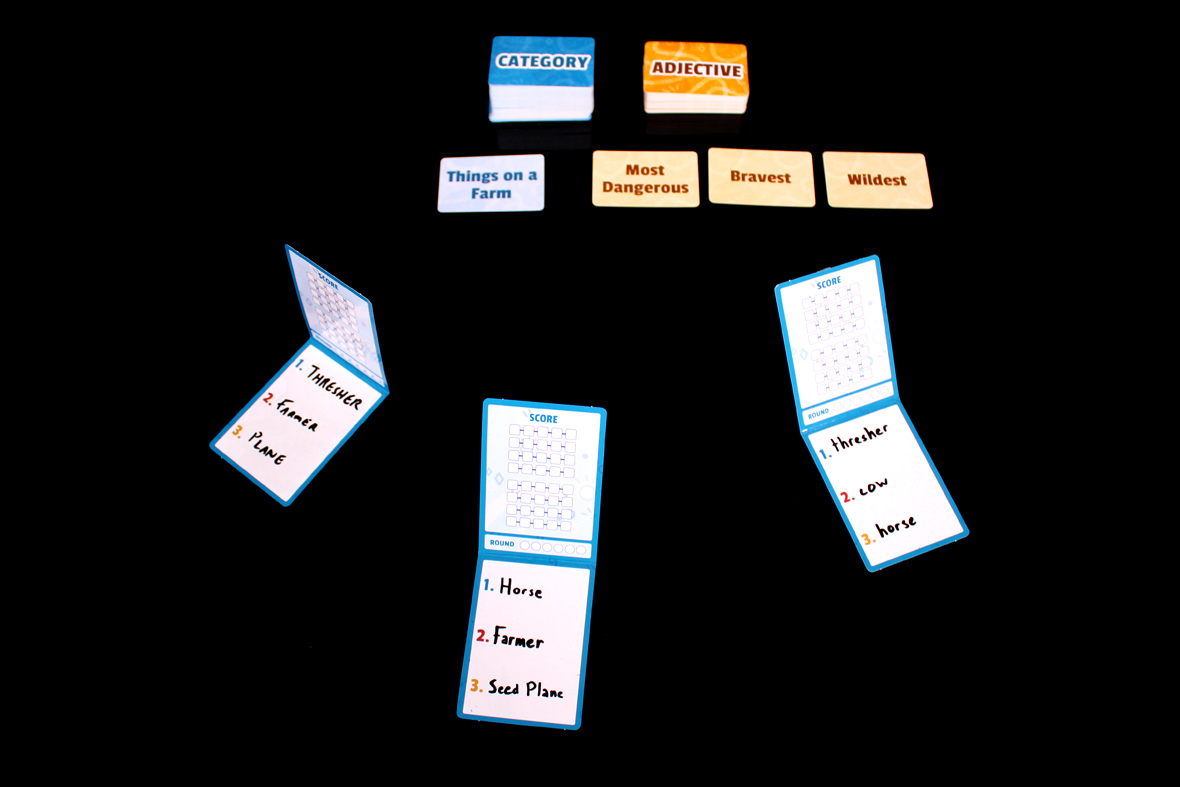
One player starts as the first Dealer. They’ll draw two Category Cards and choose one to play for the first round:

Once that’s revealed, the three subsequent players each get two Adjective Cards and choose one to play:
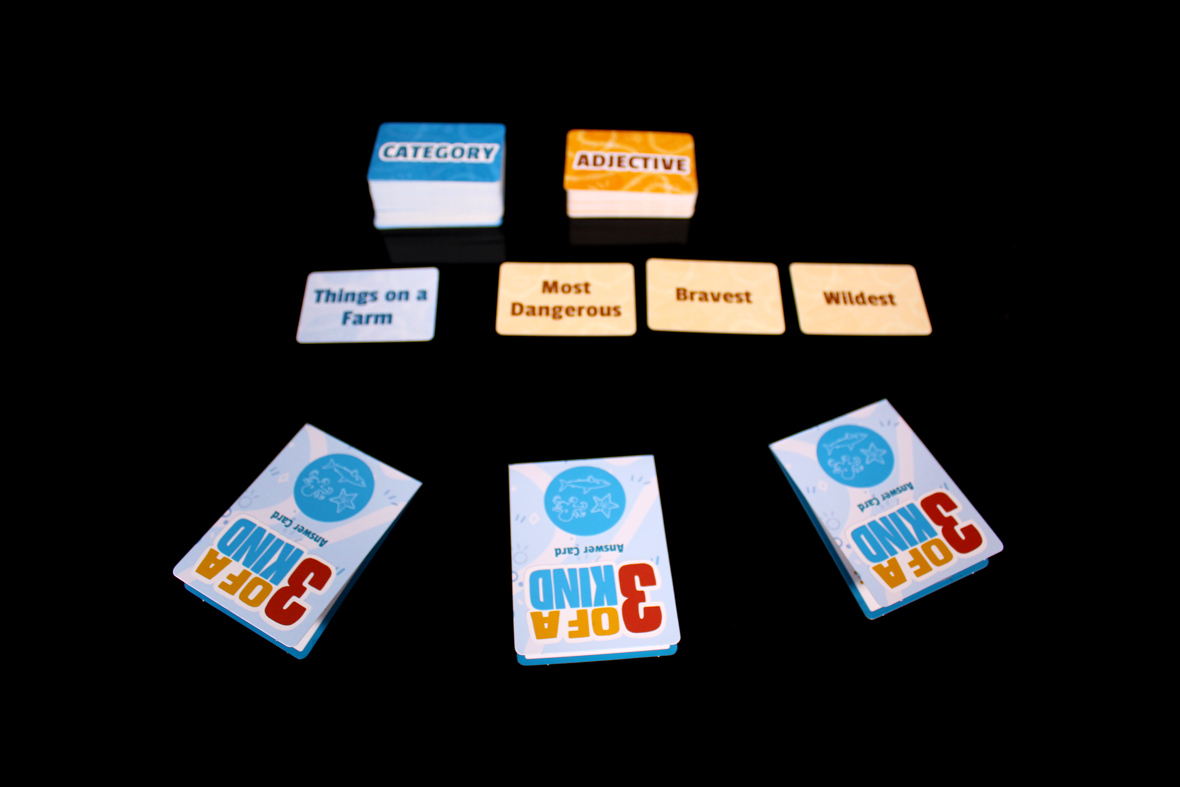
You’ve got a Category and three Adjectives; you’re ready to start!
Gameplay

The core of the game is really straightforward! All you have to do is answer three questions, each round. So for a given round, you’ll have that Category and the three Adjectives. For each pair of adjective + category, you’ll write an example down on your answer sheet. This might be the “silliest method of cooking an egg” or the “legless creature most likely to cheat on a test”; things like that. Normal things like that.
Once everyone has filled out their answer sheet, players compare answers! For each adjective, the player who chose it starts off and shares their answer. If your answer matches other players’, you will score points! You score 1 point for each player who matched your answer (including you). This means if three people wrote down that “poaching” is the silliest method of cooking an egg, you all get three points. If two other players wrote down “spinning it in a sock and hard-boiling it”, which, fair, they’d both get two points. If nobody wrote down a matching answer for an adjective, the player who played it can give out a single Style Point to their favorite answer that isn’t theirs. Which is fair.
After all three adjectives have been scored, set up a new round with the next player choosing a category and the three players after them each picking an adjective, like in Setup. Play continues for six rounds total, and the player with the most points wins!
There are some variants for some play differences, like awarding Style Points whenever at least two players don’t match or letting players draw three cards instead of two for Adjectives to make the game a bit easier.
Player Count Differences

A few but the major one comes at two players. At two players, you can see how the competitive element of the game doesn’t work. As a result, you play cooperatively at two players. One player picks the Category, and then you alternate picking Adjectives until you have three selected. Once you do, try to get matches! You score 3 points per match, and the best score possible is 54!
For the competitive element, more players just means that you’ll have fewer chances to choose the Adjective or Category yourself. That might be a bummer for you if you really like being the one to pick things, so if that’s the case, just play with fewer players. One more thing worth noting is that at three players, the Dealer who picks the Category will also choose one Adjective each round. Beyond that, go nuts.
Strategy

- Go high-level. Yes, you might know every kind of dolphin in the world, but how likely are other players to match with you? It’s similar to Medium when you’re trying to align with another player. You could write “Gandalf”, yes, but writing “Wizard” might lead to overall better results. Here, though, you might catch some flak from players for being too vague. You can’t just write “people who can do magic” when you mean wizards or witches, for instance.
- It’s really a rising-tide-lifts-all-boats kind of game. You shouldn’t necessarily try to pick Categories or Adjectives that lock players out or confuse them; you really want things to be simple if you’re trying to score points. That said, sometimes you just get a really fun idea in your head that you can’t shake out, so just do what feels funnest. That’s kind of the general principle for party games. Winning is nice, but games should be fun.
- In general: don’t be a jerk. I find that it’s easier to get players to agree with you later if you agree with them now. Just generally a good idea.
It’s a party game about categories, though, so at a certain point you should just answer with your heart and try to make the whole thing fun for yourself. There’s only so serious you can be about the shyest hat or whatever.
Pros, Mehs, and Cons

Pros
- I love category games. I just find they’re always a good time, either sorting things into arbitrary categories or making the case for why something should be in a category; it always hits. Thing Thing remains one of my overall favorites in the genre just for pure and unfiltered silliness, but it’s nice to branch out sometimes as well.
- I appreciate how flexible the rules are. They cover a lot of edge cases, though we had an interesting one where someone wrote cetaceans, someone else wrote whales, and someone else wrote dolphins for a particular answer. Cetaceans is still a specific word; it just happens to be a superset of both “whales” and “dolphins”. We ended up having to rule that cetaceans matched whales and dolphins, but whales and dolphins don’t match each other, which felt fair and within the spirit of the game. The game presented enough structure for why that made sense and everyone was fine with the decision, which is nice. It’s a well-written rulebook when an edge case can avoid starting an argument.
- The two-player variant makes perfect sense, which is nice. The two-player variant made me raise an eyebrow at first until I realized it was cooperative, and that’s a perfect way to still make the game fun and available for players. I’d still probably say this is a 3+ player game with a two-player variant, but that’s just going back to my long-standing frustration with games that say that they play 2+ players but the two-player mode is always a variant.
- A good thing for a party game to shoot for is to inspire conversation and discussion, and this certainly does that. I particularly like that it’s not contentious discussion; it’s just people explaining why they picked what they picked. The game is also structured specifically to help group players who agree with each other, so if someone matches with you, they are almost certainly going to agree with your reasoning from the jump.
- I actually appreciate that there’s a round tracker on the Answer Cards. A lot of games don’t give you any way to explicitly track rounds and sometimes that can lead to some confusion. A little odd they didn’t include a 40+ box on there for points, but hey, one thing at a time I guess.
Mehs
- The Answer Cards are lovely but they can make the box hard to close. Since they’re folded they kinda want to pop open, so they take up a little more space than just two cards generically. It’s probably not going to keep the box stuck open but you might have to be a bit particular about how you put cards away.
Cons
- The game’s a bit generic to the point of being mildly forgettable. I think this is a particular shame because there are a lot of fun elements here, but the game lacks a compelling hook to distinguish it from other similar games in its genre. Wavelength has that big wheel, for instance, and that gets a lot of people very excited. Having more theme or taking bigger risks from a design standpoint I think would have helped it land with more of a splash.
Overall: 7 / 10
3 of a Kind is good! It goes back to what I’ve said before about what a game aspires towards and what it delivers on, and while I don’t think it’s the most ambitious party game I’ve played, I think it competently delivers on what it’s trying to do, which is a fun party game of categories that inspires a lot of discussion. In my plays there’s usually some sage nodding and players agreeing or challenging each other or, the best option, wishing that they had put down what someone else wrote. Like, I do agree that an octopus is the most likely sea creature to start a pillow fight, but you can see how pufferfish, which is what I wrote, is a valid answer. It’s just not a particularly popular one. I think I’ve said as much on this site before, but people really love category games. Just the arbitrary act of assigning things to things really makes people happy. I think it’s part of why people like arguing about what is and isn’t a sandwich, but it’s even more abstract. Some folks just want to know what the flirtiest hot dog topping is. Some people crave that knowledge. I do think that this game probably would have done better and sold more maybe ten years ago? It’s got the same timeless feeling as a Scattergories-type game, but it doesn’t quite make the same long-term impression since there are a lot of games competing for space in this spot. It makes the game a lot of fun, but not always especially memorable in the long-term, which is a shame. I think a lot of people can enjoy 3 of a Kind, but I think it also needs a more distinguishing hook to boost why it’s so fun. Honestly, tying it to an IP of some kind would help, or going all-in on making the weirdest possible combinations. Both would help, I think. Regardless, the game’s certainly worth a play, as it helps players look at things in a different way and justify their sillier stances to their friends, which is always good. If you’re looking for a good simple category game or you just like aligning with your friends on silly concepts, you’ll likely enjoy 3 of a Kind quite a lot!
If you enjoyed this review and would like to support What’s Eric Playing? in the future, please check out my Patreon. Thanks for reading!
Discover more from What's Eric Playing?
Subscribe to get the latest posts sent to your email.