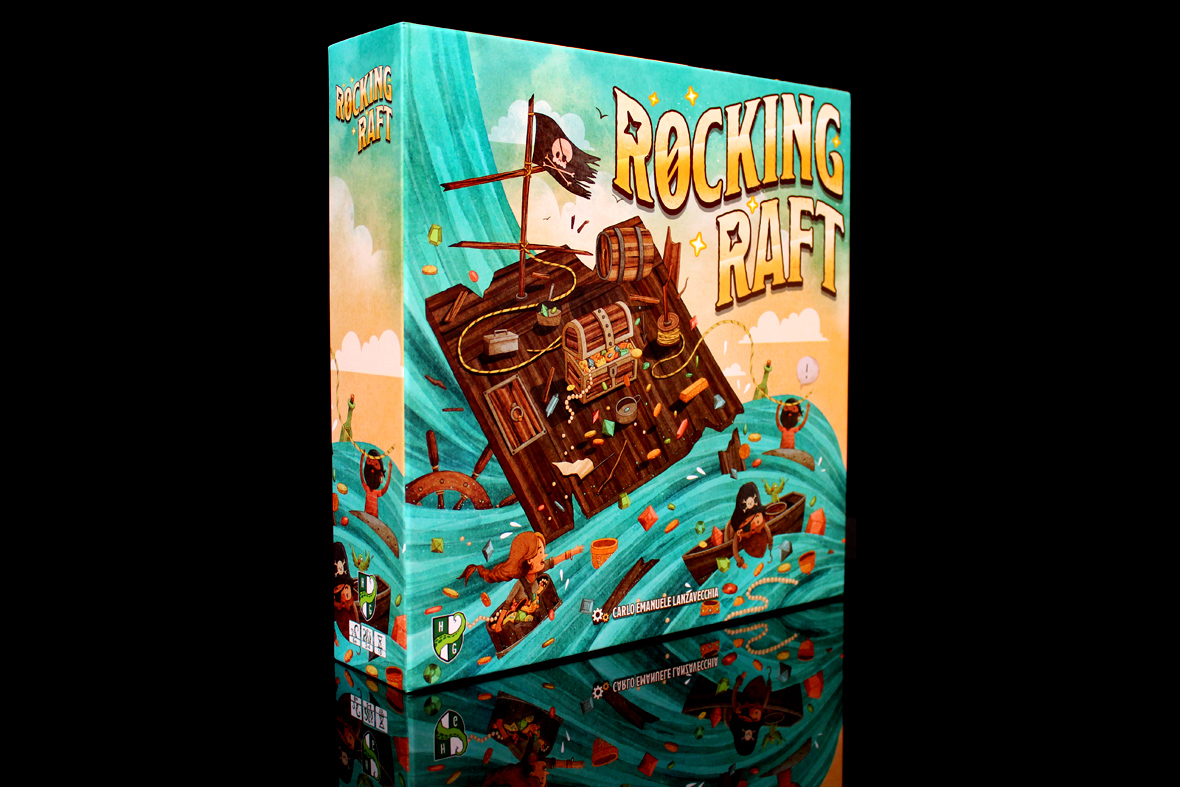
Base price: $25.
2 – 4 players.
Play time: ~15 minutes.
BGG Link
Buy on Amazon (via What’s Eric Playing?)
Logged plays: 2
Full disclosure: A review copy of Rocking Raft was provided by Horrible Guild.
They really need to stop making 100+ hour games. I’m 60 hours into Fire Emblem: Fortune’s Weave and I’m not even through the second route in Part 1. This is wild. I haven’t had time for any of the other games I want to play, and that’s saying something. Usually Fire Emblem games lose me after I beat the first route, but since they made the four routes all lead into the endgame, I’m compelled by the different storylines and characters and opportunities to test out other skills. I got to play as a character riding an elephant. But I digress; that’s what I’m doing when I’m not writing up reviews, and I managed to get a couple games played today. I’ll have more to say about The Phantom of the Opera game later (wild), but I do want to talk about a new title from Horrible Guild: Rocking Raft!
In Rocking Raft, players are pirates adrift with their stolen treasure when one realizes that they don’t need to share if they can get away with enough. As the raft heaves to and fro on the water, you can load up treasure into your lifeboat to try and get away with it before the whole thing sinks. Just keep in mind that unattentive theft can embolden other players to get some of the loot you’d otherwise lose. It pays to be careful! So rock, roll, and score your way to victory, if you can! Will you end up with the most treasure?
Contents
Setup
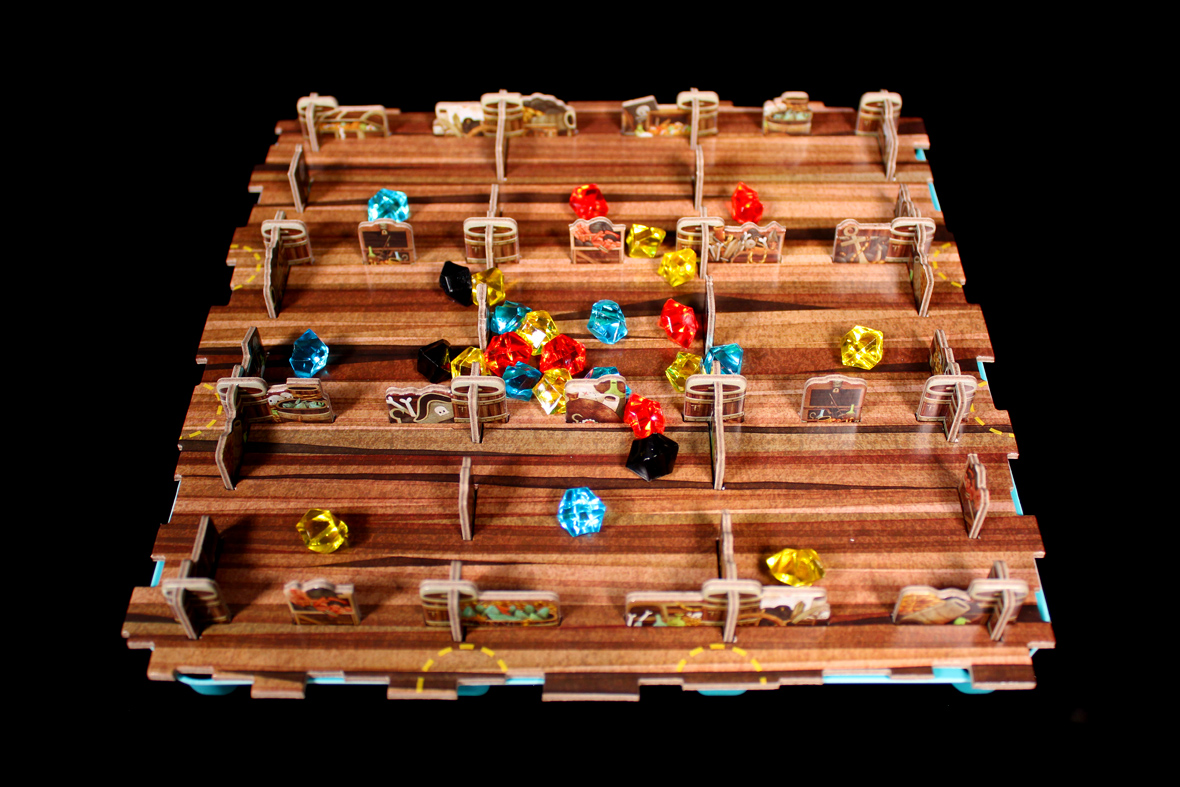
It’s a family game, so the setup isn’t too complicated. Set the Raft in the center, on top of the blue rocking part:
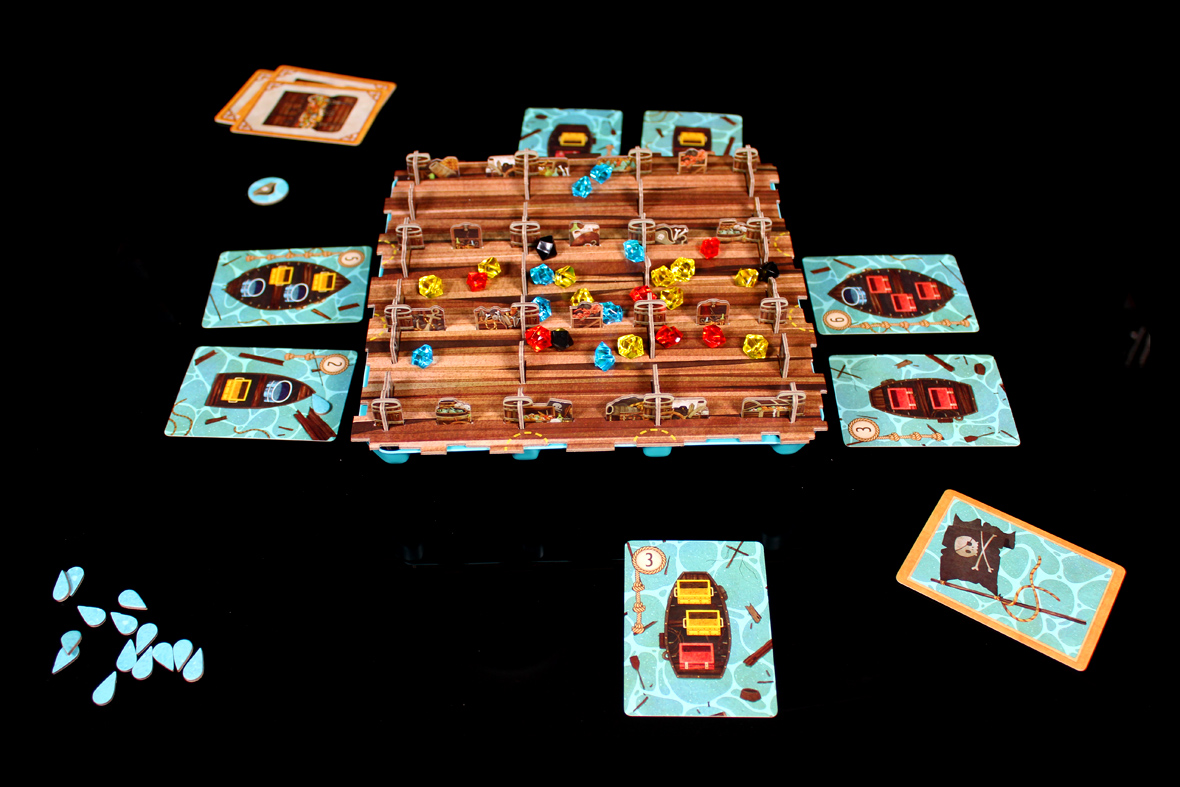
GIve each player two Lifeboat Cards, shuffling them up before dealing:
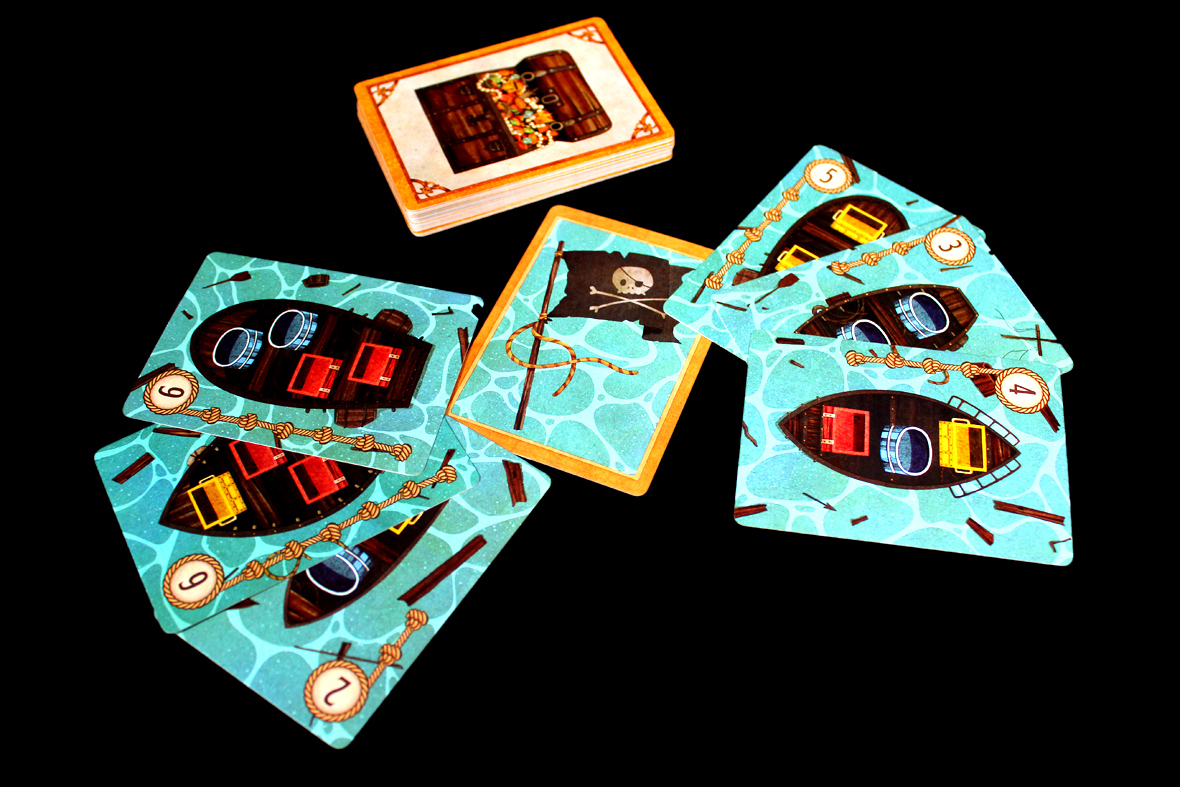
Place the Pirate Flag Card into the deck based on player count:
- 2 players: 10 cards from the top
- 3 players: 15 cards from the top
- 4 players: 20 cards from the top.
Gather the gems, removing two of each color (except black) for a two-player game and one of each color (except black for a three-player game):

Drop one randomly into each of the surrounding eight squares and drop the rest in the center. Set aside the droplet tokens if you’re not playing with the Advanced Variant, and give the start player the First Player token:

You’re ready to start!
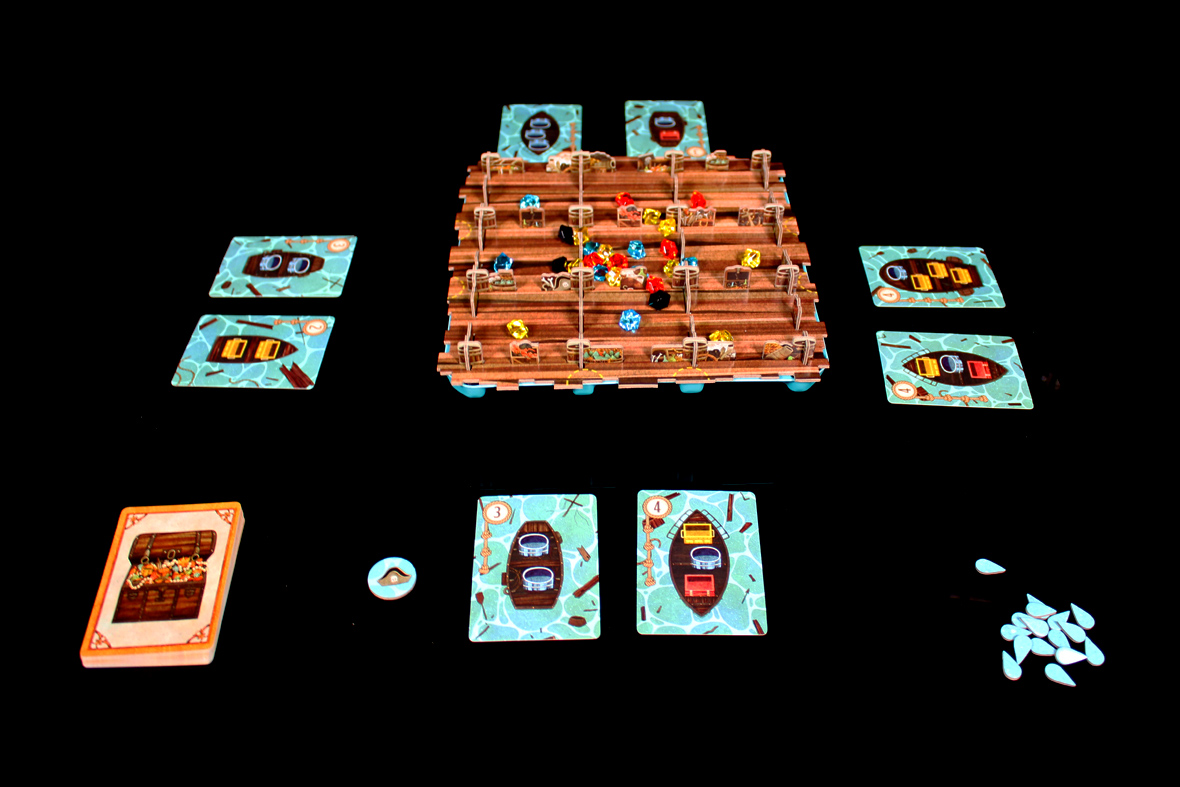
Gameplay

Rocking Raft! Your goal? Get the most treasure. Easier said than done, unfortunately, as the raft is rickety and your opponent pirates are possibly even greedier than you are.
On your turn, you’ll do a simple thing: take a finger and place it on the dotted spot on any side of the raft. You can rotate the raft if you want, just don’t spin any gems out! Then, push down as hard as you’d like and hold for as long as you’d like. Some gems will hopefully come spilling out of the open doors on the sides of the raft, and you get to keep any that do! Once you’re ready, release your finger and let the raft rock backwards at its own pace.

Now for the gems. You get to keep any that fall, but there’s a problem: your lifeboat can only hold specific gems in specific colors! Each gem can be placed on a Lifeboat Card in the bucket matching that gem’s color, or you can place a black gem anywhere; they’re wild. Any leftovers? Well, you’re the sharing type; pass any non-black gems to your neighbor on the left, who can place them as they’d like. Black gems get dropped back into the center of the raft. Any they can’t place get passed on until every player has gotten a chance to look, and then the remaining ones are dropped into the center of the raft.
At the end of your turn, if any of your Lifeboat Cards are filled up, clear their gems and drop them back into the center and then place the complete Lifeboat Card(s) face-down next to your scoring area. They’ll score points at the end of the game. If other players scored from leftover gems being passed to them, they do the same thing. Then, in turn order, everyone draws back up to two Lifeboat Cards in front of them.

Play continues until one player draws and reveals the Pirate Flag Card. Once that happens, it’s the endgame. They draw a replacement Lifeboat and play continues until the player to the right of the Start Player has taken their turn. Then, the game’s over! Tally up your points on your completed Lifeboat Cards and the player with the most points wins!

For more challenge, add in the droplet tokens! Each turn, each player adds two droplet tokens to their Lifeboat Cards; one on each Lifeboat. If, at the end of your turn, one of your incomplete lifeboats has two droplet tokens on it, it sinks! You lose the gems back to the center and discard the Lifeboat Card. Better play efficiently!
Player Count Differences

Higher player counts are where Rocking Raft really starts to shine, in my opinion, for two reasons. One, the number of gems doesn’t quite scale with player count. Two, who you sit by when you play starts to matter a lot. If your neighbor on your right tends to overpush the raft, you’re getting a windfall! You also can see how certain colors start to become less frequent on the raft as they get stuck on players’ incomplete Lifeboat Cards over the course of the game. I saw a player who once needed seven yellow gems to complete their cards. There are only ten in the game; that wouldn’t exactly leave a lot for anyone else. As a result, at higher player counts, the black gems are going to be your friend in a pinch. I think the variability of higher player counts makes it more interesting, but at two it’s a very tense game of trying to get without having to give, which is also fun. I prefer it with four, but I’ll happily play at two.
Strategy

- Don’t over-rock the raft! You can leak a few gems here and there, but you don’t want to launch them all out. Ideally, nobody should be scoring point on your turn except for you. Let the other players hit the raft too hard if they want.
- Be strategic with your placements. Wild gems are great to get, but they’re not great to place. You should only be placing them on your Lifeboat Cards if you have to. Otherwise, place normal gems. The reason for this is simple: black gems can’t be passed on. So if you have to decide to place a gem and you’re full, if you placed a black gem, you might be passing a red or yellow gem to someone who needs it. If you placed the red or yellow instead, you have a black gem you can’t place, so it goes back to the center and your opponent doesn’t get it.
- I think it’s a little better to get slightly too many gems instead of slightly too few. You gotta remember that you’re fundamentally rate-limited on your turn: you can only score two cards at most, so if you get too far behind by playing too conservatively, you’re not going to catch up.
- Turning the raft can be useful. Sometimes you want certain gem colors that aren’t popping up or everything isn’t in the right spot.
- It pays to fill up cards quickly. I tend to leave cards that are a bit easier to complete in my play area, though, in the hopes that someone else will pass me those gems easily. I tend to get a lot of gems on my turn already, so that’s less of an immediate problem.
- When playing with the variant. prioritize your about-to-sink Lifeboat Cards. If they sink, the game advances and you don’t get any points. Even if you’re not earning a ton from that card (it’s 2 points or something), it might be better to push a little harder and give another player a gem so that you score 2 instead of 0.
Pros, Mehs, and Cons

Pros
- Love a weird dexterity game. This is definitely weird! The rocking and the pushing and the gem-dumping are all very entertaining.
- I particularly like the rockback on the raft. Letting it go and having the raft rock backwards to re-center the gems in their particular rooms feels great and works perfectly from a gameplay standpoint.
- As a product, I think the game is fantastically produced. It works exactly how you’d expect and perfectly how you want it to, up to and including gems getting stuck in the tiny doorways.
- I love how you have to pass any extra gems to your opponents. It perfectly works to create both the challenge and the desired behavior. The game clearly wants players to try and get the exact right amount of gems, so letting any extra help their opponents and any too few hurt their scoring rhythm makes for the right amount of player tension. It’s a great design choice.
- Quick setup. You just have to separate out a few gems and cards, which is ideal for a family game.
- Similarly, quick teach. You kind of inherently know what to do; the only rule that really comes up in play is reminding players to let go of the raft rather than slowly rock it back to its start position.
Mehs
- I think it would have been nice for each of the “rooms” to have their own randomization or something. Just would have made the game more whimsical, I think.
Cons
- This does have some potential to get damaged by aggressive play or fling tokens everywhere. Just remind players to take it easy if they seem to be playing more intensely with the raft than feels appropriate. It’s not that big of a deal, but if a player is stressed, they’re a bit more likely to push too hard.
- The aesthetics are the weakest part of this game, unfortunately. The cover art is lovely, but the “raft” and gems feel a bit plain compared to the vision that the cover is trying to impart. That matters!
Overall: 8.25 / 10
Rocking Raft is goofy! I like it a lot! It does a few things well and a couple things particularly brilliantly, which I always like to see. First off: it’s tactile and interactive in a genuinely satisfying way. Major reason behind this? Just the simple thing: when you release your finger from the raft, it rocks backwards and gently resets some of the pieces, meaning that they don’t just stay in one place. It’s a smart little bit of design that really connects gameplay with that tactile experience. There’s also just some good design choices in the game. I really like that gems are passed around if you take too many except for the wild ones. It means you can make some mildly strategic decisions about what you place and what you keep, and you’re disincentivized from just slapping the raft to knock off as many gems as possible. Do that, and you’re just giving out points to other players. It creates a nice skill check for players where they need to try and push the raft enough to knock off what they want but not so much that they knock off a ton that they don’t need. You’ll find the most successful players benefitting from other players overplaying while learning to hit that sweet spot themselves. It’s very satisfying when it works, and the game’s still enjoyable even when that doesn’t happen. I’d definitely be interested in seeing how younger players play this since they’re not exactly known for their high dexterity, but I still think they’d have a good time. Or they’d send the gems flying all over the room. No way to tell. The variant mode ups the stress factor by only allowing you two turns with a card before it gets sunk and you lose it, which I find ends up leading to more players overcorrecting than anyone actually losing cards. And that’s fine! Again, smart design: the rule ends up producing the intended behavior rather than penalizing players. I’m generally impressed with the games from Horrible Guild, and while I would love to see more Railroad Ink, I think there’s a lot for dexterity game fans or family gamers to like with Rocking Raft. If you’re in either of those categories, you like games with a little bit of sharing, or you’re just secretly an old-timey pirate, you’ll probably enjoy Rocking Raft as well! It’s a good time.
If you enjoyed this review and would like to support What’s Eric Playing? in the future, please check out my Patreon. Thanks for reading!
Discover more from What's Eric Playing?
Subscribe to get the latest posts sent to your email.