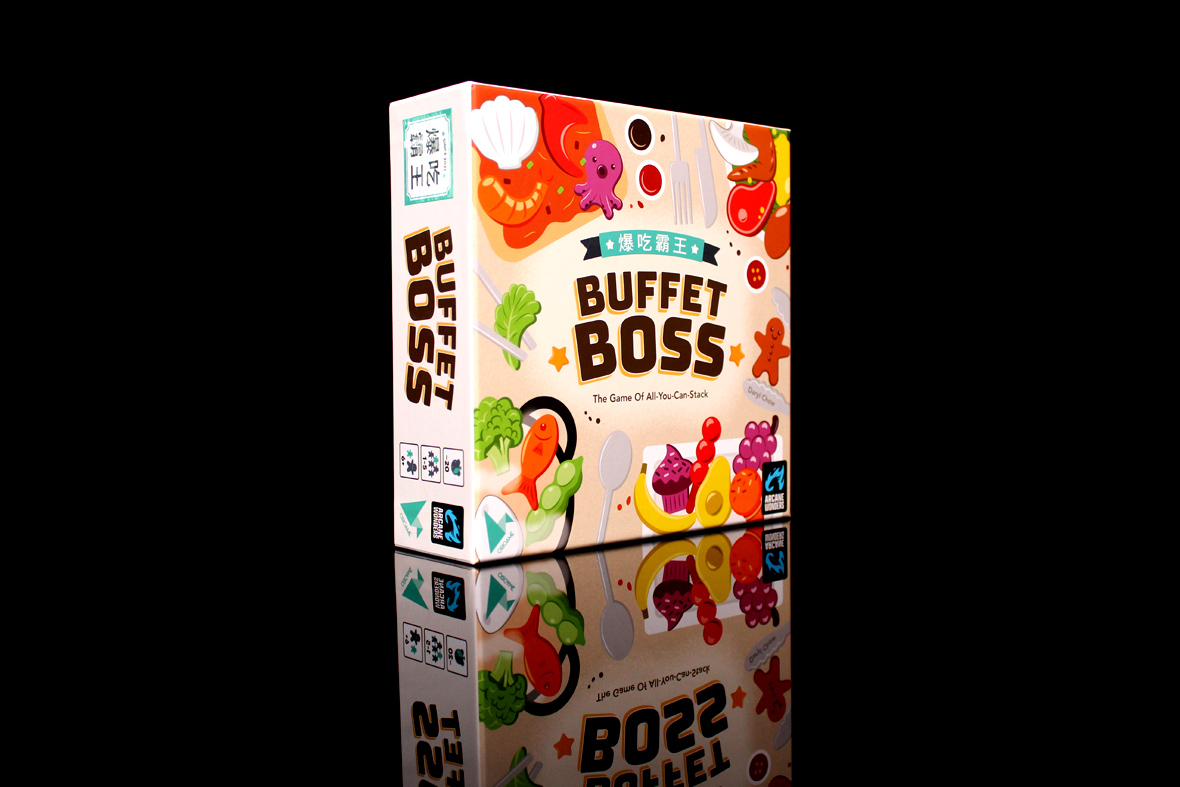
Base price: $30.
1 – 5 players.
Play time: 15 – 25 minutes.
BGG Link
Buy on Amazon (via What’s Eric Playing?)
Logged plays: 2
Full disclosure: A review copy of Buffet Boss was provided by Arcane Wonders.
I actually made some headway on a few things that I had been trying to do this weekend, but for the most part it was just fixing my sleep schedule, unfortunately. Been a little out of sorts with all that lately, but progress is on the horizon! I’m exhausted currently and will likely actually go to sleep at a reasonable hour this time. As opposed to the, you know, 6AM previous. Part of it was actually an all-you-can-eat buffet experience last night, so maybe that’s a good lead in to this game? Was it inspired? Who knows. But let’s talk about Buffet Boss, new from Origame and Arcane Wonders!
In Buffet Boss, you know that the truest demonstration of food prowess isn’t just how much you can eat, but how much food you can stack on your plate. Maybe everyone knows this; I’m not always up on the hippest stuff. It’s part of being off social media. Thankfully, you’re here to spread the word and prove your worth. It’s actually pretty nice of you to do that, but you have to win the buffet challenge, first, after all. So draft your cards, stack your food on your wobbly plate, and see how it all works out! Can you make it to the top?
Contents
Setup
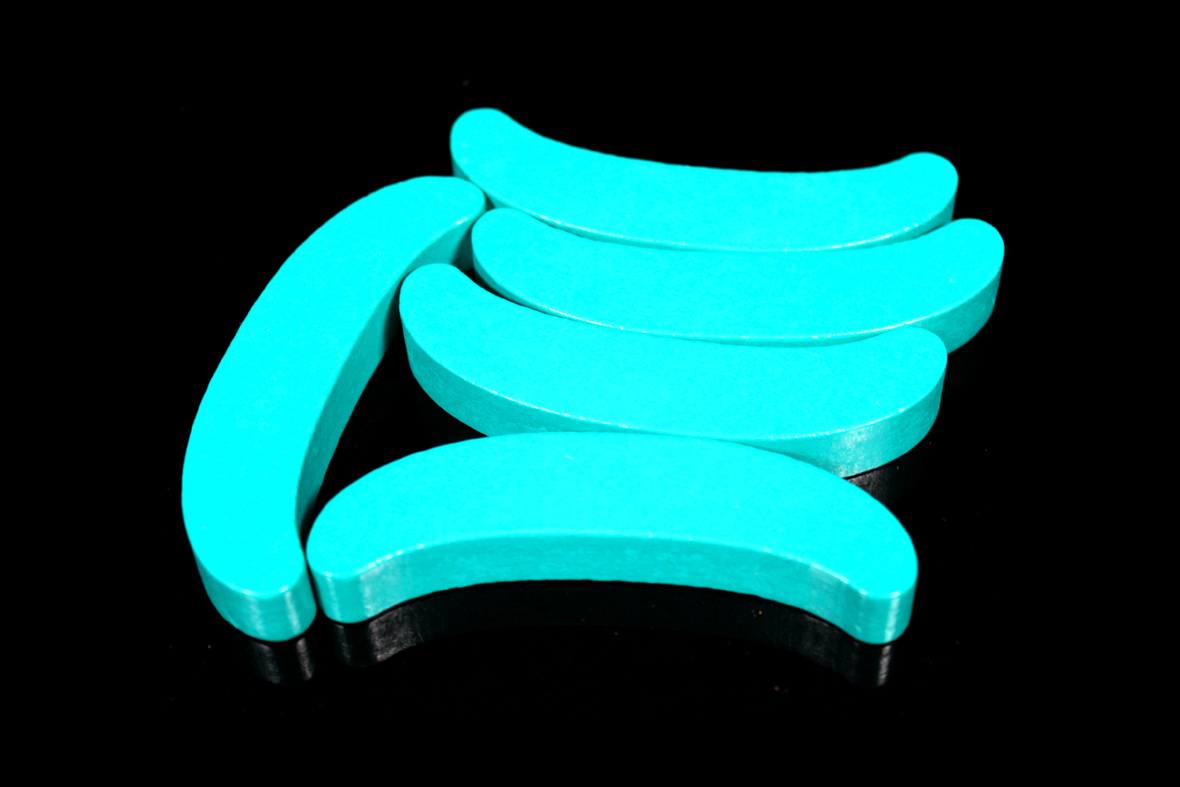
Depends on your mode, but largely the same no matter what you’re doing. Give each player a plate:
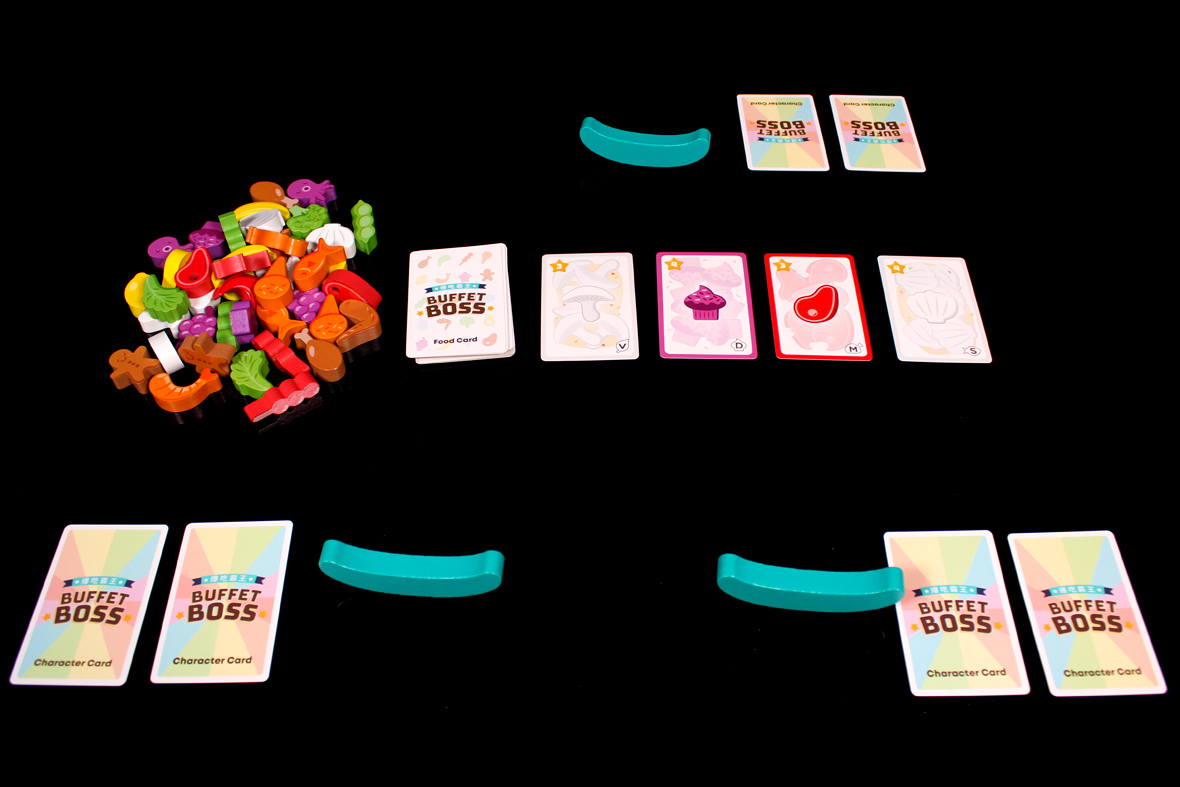
Shuffle up the food cards and remove some based on your player count, as well:

If you’re playing Dinner Buffet (the more complicated mode), each player gets two Character Cards, also:

Set the Food Tokens aside for now:

You should be all ready to start! Deal number of players + 1 cards into the center.
Gameplay

The core of the game is essentially the same across the three modes. One is a simpler mode to get you accustomed to the game, one is the full game experience, and one is a solo / cooperative game mode. Your goal is the same: become the best buffet boss possible by stacking all the food you can see!

To start a round, you’ll reveal one more card than the number of players in the center. Then, the first player goes. They choose a card and keep it, taking the corresponding food item and stacking it on their plate. Normal stacking rules apply, but you also have to place it one-handed. Younger players or players who need an accommodation of sorts can use two; we’re not monsters. No perpendicular stuff or touching the table; you wouldn’t want your food touching the table when you eat.

If you knock a Food Token off, the three-second rule applies! You have three seconds to place it back on your plate following normal rules, most food hygiene science be damned. If you knock multiple pieces off, you get to choose one. Place the others in the Waste Bin. Now, if you methodically knock one piece off at a time, and continue to knock one piece off when you replace the previous piece, you’ve found a loophole that will just get you disinvited from subsequent games. Then, your turn ends.
When there are only two cards left, the final player for that round can choose one or both to place on their plate. If they only pick one, the other one is discarded and either way a new round starts with the player to the left of the previous Start Player becomes the new Start Player.

Continue playing until you’ve played five rounds. Once you have, it’s time to total up your scores! You only get to keep Food Cards if there’s a matching Food Token on your plate (if you have two or more of the same Food Card, you have to have the same number of matching Food Tokens). If you don’t (because some Food Tokens ended up in the Waste Bin), set those cards aside and they won’t score. The player with the tallest stack also gets a bonus 5 points. Finally, if you’re playing with the Dinner Buffet rules, reveal your Character Cards and choose one to score. The player with the most points wins!
Player Count Differences

So this one’s really interesting; usually with more player counts in a drafting game it’s a bit of a mixed bag. You get to see more options because more cards are being passed around, but the hands get progressively worse and worse until you have the worst of all possible worlds with your final hand. That’s nasty, but that’s also how it be sometimes. Here, that’s still an issue, but going last is kind of interesting because you can take both of the final two cards, if you want to risk it. That insulates you from just getting fed worthless cards when you’re last to go, because two 2s still make a 4, if you can risk the stack. That’s a really neat way to make going last in a draft kind of exciting and interesting while still accommodating higher player counts. You kind of get the best of both worlds with more players, as a result; going first means you have a wealth of options, and going last still means that you can risk it for bigger windfalls, points-wise. It makes for a much more high-player-count-friendly game than I expected, and that’s some smart design. I still like it with fewer players, but I like how much I like Buffet Boss with more.
Strategy

- The cards have point values for a reason. The higher-value cards tend to be trickier. Not impossible, but there’s definitely an egg and it’s definitely extremely egg-shaped. That roundness can really mess you up depending on how you place things.
- You can use the tilt of the plates to your favor. Sometimes it can act as a functional counter-balanace to the weight of your plate and how things are shaking out? Sometimes it can be helpful, I suppose, but sometimes the plate can rock back and forth, which is definitely not what you want.
- Be careful! Losing a ton of food can lose you the game pretty quickly. If things dump off your plate en masse, you’re pretty much toast. So try to be precise and careful when you’re placing things, lest you clown yourself clean out of the game.
- Almost all of these pieces are round; be careful. They’re tricky on purpose, but you can get a lot of mileage out of some of the pointier ones hooking on or over or into each other. Use weights to balance things out, but keep in mind you can only use one hand!
- You can try to hate draft, here, but I’m not really sure what you’re getting out of it. Rather than taking something you don’t want because someone else does, it seems like it much more clearly benefits. you to take something you want because you want it. It’s more of a thing in other games; hate drafting, I mean.
- You should try to favor both of your Characters where you can, so you can decide later which one’s getting more points for you. Sometimes you get two characters who both benefit from Meat, for instance, so you can place in that overlap and see which one helps you more by the end of the game. Sometimes you get completely diametrically-opposed Characters with opposing goals. In the latter case, I tend to pick the card with the highest points potential, but that’s sometimes easier said than done.
- I find in stacking games, it helps to take a deep breath in before placing. It reduces how much my hands shake; I use the same trick for photography. I think it’s a thing? If it’s psychosomatic, it still counts!
Pros, Mehs, and Cons

Pros
- The art style is a lot of fun! It’s whimsical, which I think you kind of need when you’re making a game about stacking up food. It would be kind of weird if it were super serious and detailed? Plus, when you’ve got wooden food pieces, I think you have to go a bit less detailed so that you don’t lose some verisimilitude between the art and the pieces.
- Love a good stacking game. It’s just a great dexterity game style. It’s relatively approachable and you know what you need to do and when you’ve succeeded or failed; it’s generally pretty straightforward.
- I like that it’s individual rather than a shared play space; it lets you feel like you have more control over what’s happening. With a shared play space, if one player goofs it then it can tilt the balance towards whichever player(s) can clean up in the aftermath. A personal play space is more of your own problem and responsibility. You don’t get the benefit of someone else occasionally messing up to your benefit, but you have complete control over how you play.
- I really like how they’ve modified the drafting rules to make going last still pretty interesting. Doubling up is an extremely risky move, and you get a bunch of points for it. That’s a great trade-off, provided it goes your way, but getting too greedy in Buffet Boss will absolutely mess you up. I think that’s excellent.
- The tension between which Character Card you favor is sometimes really interesting and sometimes not, but I appreciate that it sometimes is. Sometimes you’re working with multiple Character Cards that have some synergy. When that happens, you have the ability to choose which one you’re going to ultimately score with and advance your strategy accordingly. If you don’t have a synergy between them, it’s just a little less interesting. You can still pick one and play towards it, but you have to likely make your choice earlier.
- A nice compact box, and I appreciate that the whole box gets used! Leave nothing out, I suppose. The box lid is your Waste Bin, and the box bottom is a ruler to measure the height of your plate stack. I like it when the whole box gets used; it feels … efficient? Effective? Something like that.
Mehs
- The wibbly-wobbly nature of the plates can make the entire game a bit unstable if you’re not on the most stable tables. Don’t bump the table during the game or everyone will regret it. Granted, if that happens, just … let players fix it up. We live in a society.
- I do wish the type distinction between the cards was a bit clearer. It’s a tiny letter, which is, again, fine, but not my favorite.
Cons
- It’s not really possible to recover from a mid- to late-game big spill unless your opponents do the same. I think in the grand scheme of things it’s probably fine? The game moves pretty quickly. It’s just a little frustrating when you’ve relegated yourself to the realm of “maybe someone else will lose even worse than I am”. I suppose the catch-up mechanic is playing perfectly and letting your opponents make their own mistakes, at a certain point.
Overall: 8.25 / 10
Look, if you’ve been reading the site for a while, you might know that when I see a game with Daryl Chow as a designer or codesigner, I get excited to see how it plays. Buffet Boss is great! It’s an inspired little title that’s essentially a step up in complexity from Animal Upon Animal that adds some more standard board-gaming fare to the classic game. And it works! So here we’ve swapped the classic die for more of a drafting situation, where you get to actually choose cards and what you want to place on the stack. It’s also personal, rather than a shared stacking space, and I love that. Where things get interesting is when you add in the Character Cards. Now, rather than just dealing with stacks and what’s available and easy to pile on, you need to factor in what’s good for one or both of your characters. It makes for a really interesting tension! Plus there’s fun shapes and different categories of cards and three distinct gameplay modes. Distinct might be stretching it a bit, but it’s still three modes and they’re different enough. I think it’s a hoot, though; Buffet Boss is wobbly and silly and engaging, with great art and a cute aesthetic to match. I do wish that it were a bit easier to recover from a spill of major proportions, but I suppose the counterpoint to that is that if you play more carefully it’s much easier to avoid that kind of risk? That’s just life in the city, I suppose. But Buffet Boss has been sticking in my mind all day, not just because I was writing this but also because I think I just inherently gel with Daryl Chow’s design ethos. I keep getting called back to his designs and I keep enjoying them. If you’re looking for another great stacking game, you’re excited about an increase in complexity over a classic game, or you’re just a hardcore foodie, Buffet Boss is a great time.
If you enjoyed this review and would like to support What’s Eric Playing? in the future, please check out my Patreon. Thanks for reading!
Discover more from What's Eric Playing?
Subscribe to get the latest posts sent to your email.