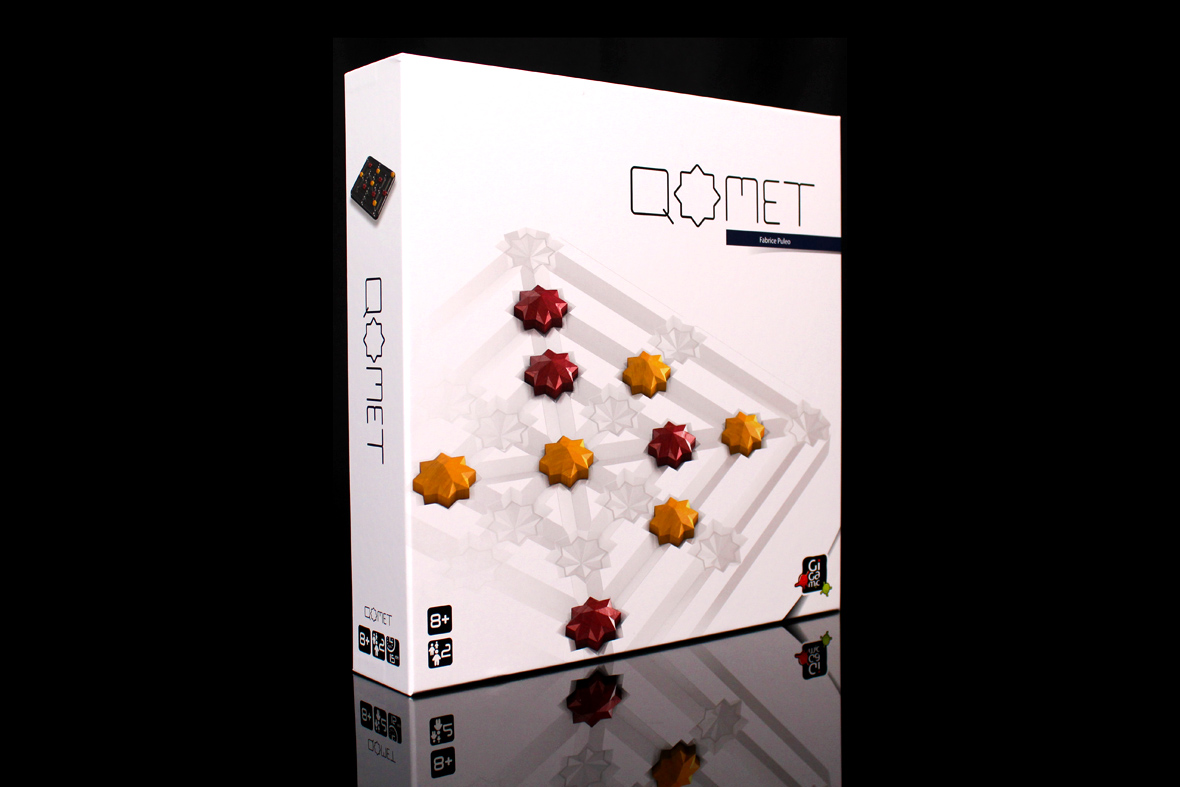
Base price: $40.
2 players.
Play time: ~15 minutes.
BGG Link
Buy on Amazon (via What’s Eric Playing?)
Logged plays: 4
Full disclosure: A review copy of Qomet was provided by Hachette Boardgames / Gigamic.
Look, sometimes you’re up until 6AM because your sleep schedule has gone to absolute pot. When that happens, it’s sort of a “might as well write because you’re not tired” sort of situation; we’re working out the details. Thankfully, there are always more games in the review queue, so we’re onto the next thing. A box of games arrived from Hachette, actually, and in there was a two-player abstract, Qomet! It was easy to get played, so we’re here with another review. Let’s check it out!
In Qomet, your goal is simple: squares. A square of stars that can light up the dark night sky! It’s certainly easier said than done, though, as your opponent wants the same thing and there are only so many spaces that are available. As you fight for location, you can push stars and place stars to form your perfect four-sided constellation. The Gigamic abstracts are beautiful and surprisingly weighty, and this is no exception. Will you be able to create your constellation in time? Or will you just end up star-crossed?
Contents
Setup
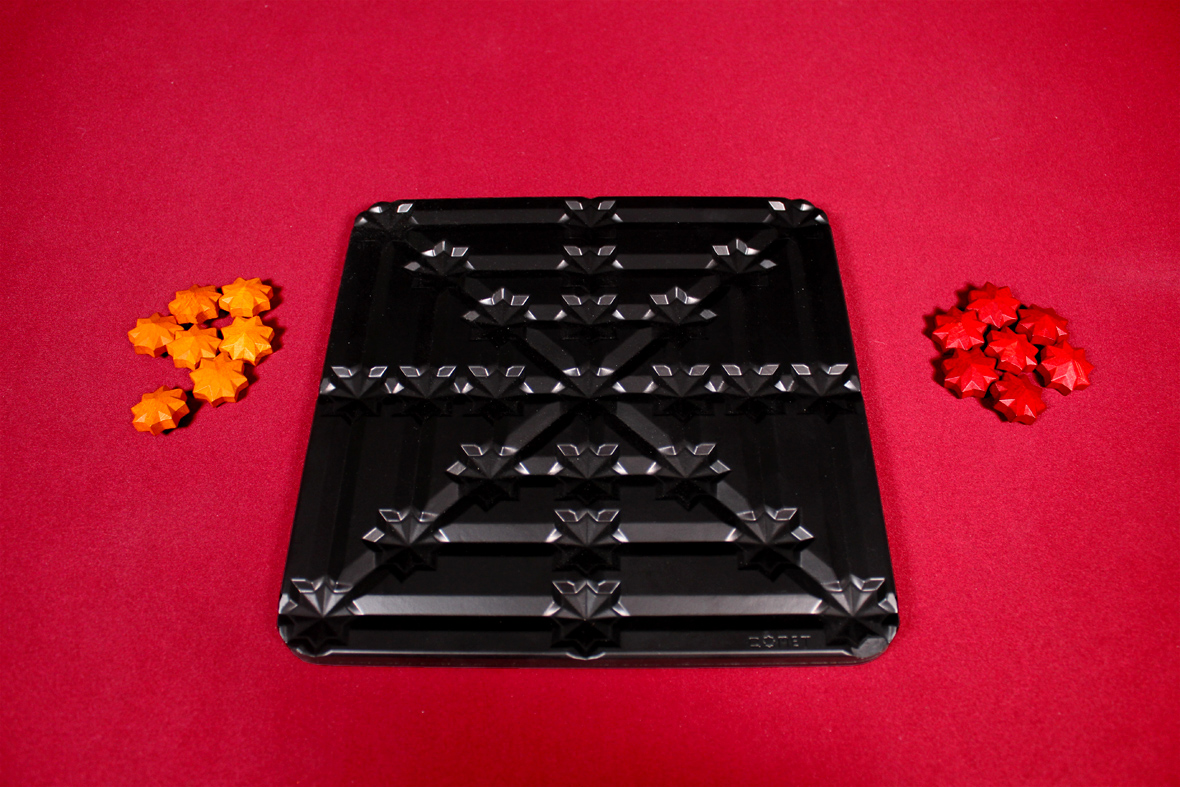
It’s pretty great how many of the Gigamic abstracts don’t require much setup. Set out the board:

Give each player the seven stars in one of the two colors:

And that’s pretty much it! You’re ready to go.
Gameplay

A good abstract excels when it’s easy to explain the core of it. This one’s easy! Your goal is a square. Each turn, you take a step towards that!
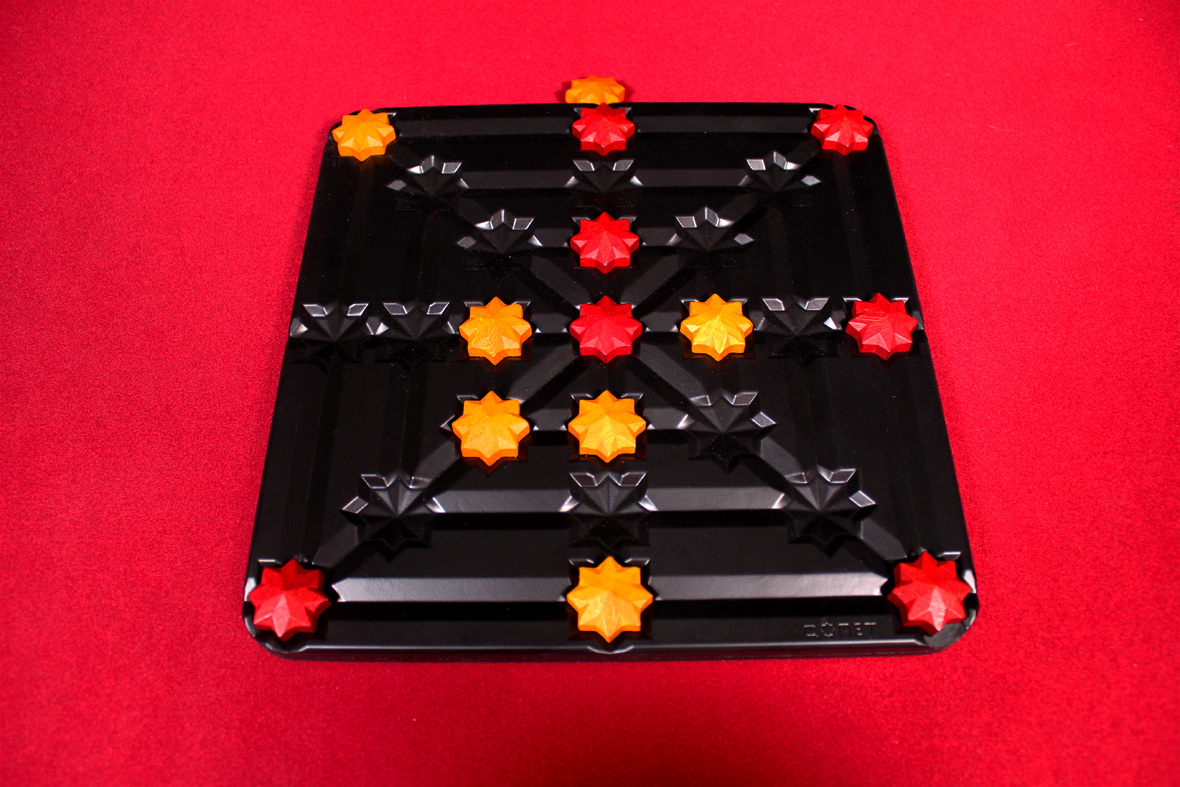
You can, on your turn, either place a star of your color or move one of your existing stars. When you place a star, it goes into any empty available spot.
Moving a star is a little more complicated. When you move a star, you move it into any space connected by a straight line. If there’s already a star there, you move it in the same direction unless it’s blocked by another star. You can’t push more than one star at a time, after all. You can, however, push an existing star off the board, in which case it returns to its player.

The game ends when any player gets a perfect square of four star tokens. As soon as they do, they win! That’s pretty much it.
Player Count Differences
None! This is just a two-player game.
Strategy

- You can get boxed in very quickly if you’re not careful. I guess pun intended, but the game can shift pretty quickly if you’re only paying attention to one tier of squares. Keep an eye on spaces that are the corner spot for more than one square; your opponent may try to move up or down a level of scope to confuse or distract you. And it can work!
- It’s not a bad idea to keep one star in reserve so you can place it quickly. Placing a star is a usually effective way to block an opponent. Keep in mind that it doesn’t always work, unfortunately, as your opponent might be able to push a star into a square and push your recently-placed star out.
- Stay flexible! You don’t want to get completely blocked either. Try not to get locked in or anything like that. It’s not too challenging to lock down an opponent’s piece or two, but the same can happen to you. You can also inadvertently block yourself, which isn’t necessarily advisable.
- I do try to push the other player’s stars off the board when I can. They can only place one per turn, so I figure even if they can place in any spot, it’s better that than have their stars limiting my movement so I can’t shift things around.
- If you try to look a few moves ahead, you might be able to head off disaster. I think that’s generally critical for any abstract strategy game. You should be trying to predict your opponent’s moves, since they have the same available actions as you.
- Your opponent can’t immediately undo your last move, so keep that in mind when you’re planning strategy. That will let you sometimes essentially block your opponent from a few directions if you move between two of their pieces. They can’t move either of those pieces since your new piece is blocking them, and they can’t push your piece backwards since you just moved it forwards and that’s against the rules.
- Doubling up (either with your pieces or your opponent’s) can be a great and effective way to further block them. You can’t push a piece into an already-occupied spot, and that’s a major cornerstone of the strategy. Using your pieces as an effective barrier only works if you have multiple stars in a row. Otherwise, they can just push your recently-placed piece out of the way.
Pros, Mehs, and Cons

Pros
- Boy howdy, they make that board thick. I mean, the Gigamic abstracts never mess around, but I do love how weighty the boards are. It makes the game feel significant and weighty and fancy. It’s one of my favorite things about the whole line.
- Love the simplicity of the setup. It does make the abstracts feel ancient in their own way, and that’s pretty cool. With this one, there’s only 15 pieces total (if you count the board as a piece), so it seems like the kind of thing an archaeologist would find in an attic.
- It’s kind of interesting that the whole thing is making squares. I just haven’t seen anything like it before. It’s nifty. Feels almost like a Tsuro variant.
- It’s a simple game at its core, which is nice, but the strategy is nasty. I definitely thought the game was going to be much easier than it ended up being during my first play, which was very satisfying. There’s a switch that flicks in your first game where you suddenly lock in on how weird this game is and then you immediately want to play two more. It’s a hoot.
- Quick play is pretty good as well! The game moves fast and there aren’t a ton of actions, so the turns can go a bit.
- I do love the common graphic design across all of the games. The games look super good and collected on a shelf; it’s nice.
Mehs
- The board is kind of low-contrast, aesthetically; I think it’s meant to give a spacey vibe but it makes the divots and contours a bit more difficult to read. It’s just a very deep black with no additional lines or markings on the board; it would have been nice to have some way to light them up. I know they’re not going to go with a, say, Galaxy Mode that shines and such, but it would be nice to have something.
Cons
- I do wish the stars were easier to slide in a cool way. They stick in their spaces, which is smart, but that means that you can’t necessarily unlock them and slide them without unnotching them a little bit from the base. It’s not a hard notch but it would be cool if they slid more fluidly.
Overall: 7.75 / 10
Qomet may be hard to spell consistently, but it’s not hard to play, and I think that shows both its strengths and the strengths of Gigamic’s abstract line. They’re all just kinda … neat? I don’t love Quoridor, but you know, there’s always one. While the pieces don’t particularly wow me, I do like the game’s schtick, but honestly, the squares thing is super weird. I kind of love that? It’s just such a strange way to set a goal for an abstract game. I assume it’s not that weird compared to the sheer volume of abstract games out there, but, look, I only get about a thousand plays in a year; there’s always going to be something I haven’t seen. But that’s kind of what makes it fun! The Gigamic abstracts are always a little odd or quirky as abstracts go, but I love the consistency in construction and style across the entire line, even when the game isn’t inherently my favorite. Here, though, that’s no worry. I had a lot of fun playing Qomet, even in some solo, two-handed games. It’s surprisingly difficult to outplay yourself in an abstract strategy game, but it’s worth it to try! Qomet is a great game for thinking spatially, handling back-and-forth challenges from your opponent, and trying to plan a few moves ahead. If you’re good at all that and you enjoy it, you’re going to have a blast with Qomet! If you aren’t good at those things, well, Qomet is a great game to skill up on them. Either way, I’ve really had a good time with it!
If you enjoyed this review and would like to support What’s Eric Playing? in the future, please check out my Patreon. Thanks for reading!
Discover more from What's Eric Playing?
Subscribe to get the latest posts sent to your email.