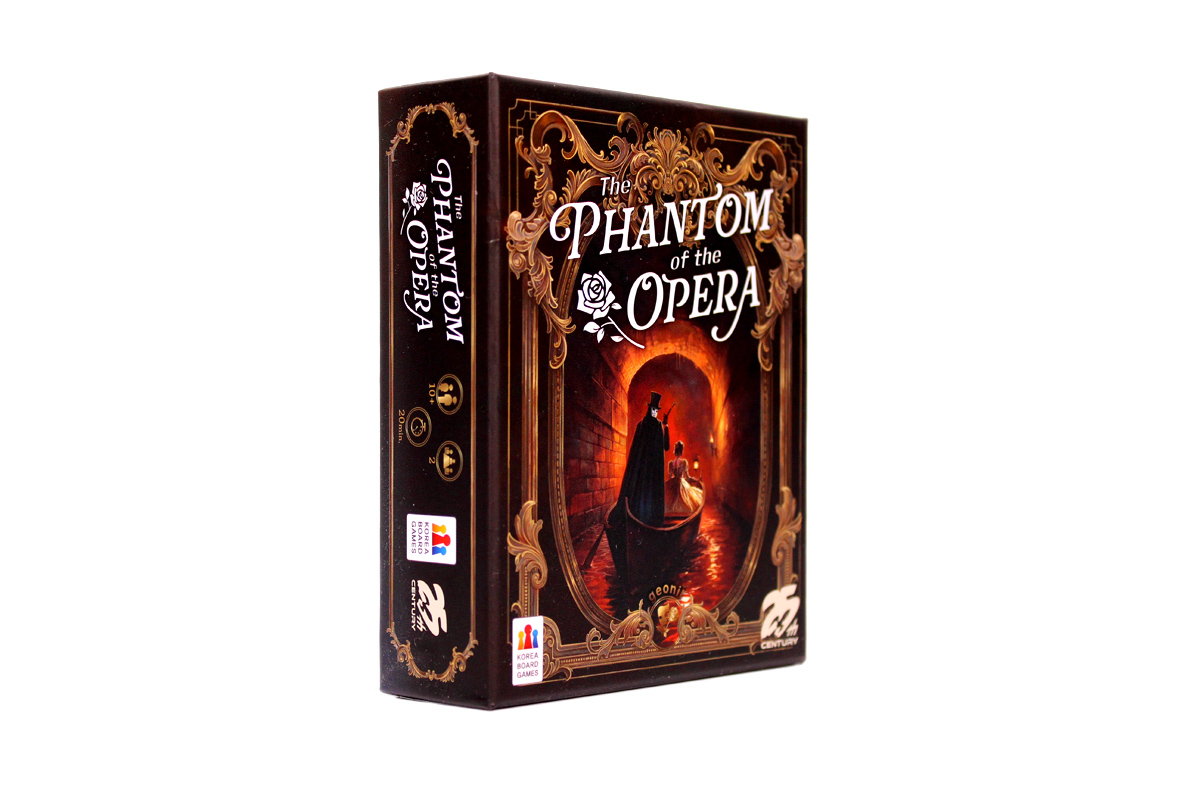
Base price: $15.
2 players.
Play time: ~15 minutes.
BGG Link
Buy on Amazon (via What’s Eric Playing?)
Logged plays: 2
Full disclosure: A review copy of The Phantom of the Opera was provided by 25th Century Games.
I’ve been jazzed about this game since I saw it at Gen Con, but that’s mostly because I have an intense love / hate relationship with Andrew Lloyd Webber’s classic The Phantom of the Opera. I feel nothing about the Gaston Leroux book. That itself could cover probably several pages of just me ranting about how bad / great the movie is or the strange plot choices or the absolutely insane sequel that got made. Love a video essay. But The Phantom of the Opera itself is the deeply timeless tale of an incel who makes that everyone’s problem, and what could be more relevant today than that? Let’s see how the game plays.
In The Phantom of the Opera, players take on the role of the masked villain and his captured victim, Christine. The Phantom needs her to complete his music and she, well, she saw the life-size rendition he made of her in that wedding dress that’s perfectly her measurements and some deeply Uncanny Valley nastiness and she’s decided she’s not into that. See, he thinks it’s because he’s scarred or something; it’s actually just that he’s super creepy and definitely murdered at least one person (two, if you’re counting Piangi in the musical, who did nothing wrong). These two goals are naturally at odds, so, trick-taking ensues. Will you be able to keep Christine trapped with your perfect melody? Or will you escape to the deeply-okay Raoul, trying not to read into the heterofatalist implications?
Contents
Setup
This one’s pretty quick. Shuffle the cards, deal each player ten:

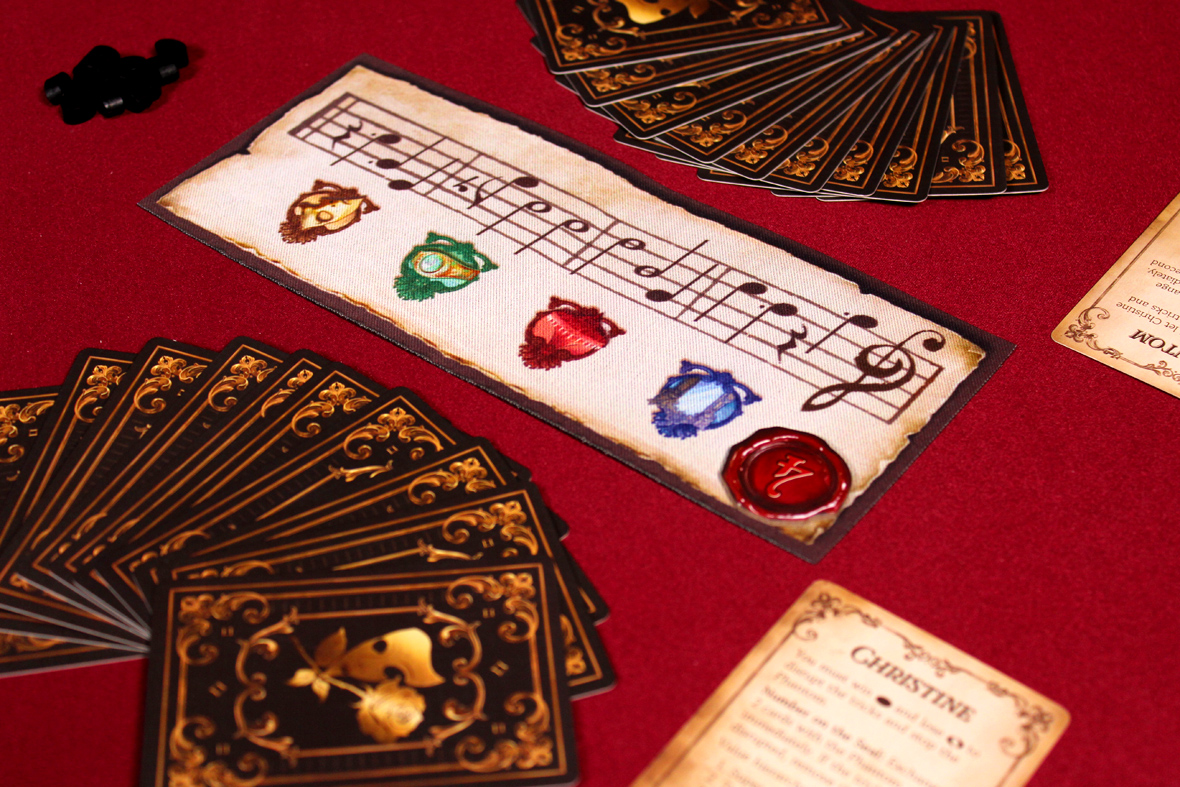
One player is the Phantom and one will be Christine. Each player gets a player reference card, and you place one of the double-sided music sheets (and the tokens) facing the Phantom:

Set the seals aside for now:

You’re ready to start!
Gameplay

While The Phantom seeks to complete his masterpiece, Christine wants to disrupt it! Do so by winning and losing tricks as the music demands!
To start a round, each player chooses a card to swap with their opponent. From those two cards, the first player to go chooses one to be the Seal Number for the round! More on that later. The Phantom starts the first round.
Then, the game follows standard trick-taking fare, with a few twists. One player leads, and the other responds! You must follow the start player’s suit if you can, otherwise you can play whatever you want. Highest card of the led suit wins! Trump suit (masks) beats any card of the non-trump suit, but there’s also a super trump! Depending on where you are in the melody, a different suit becomes the super trump suit.
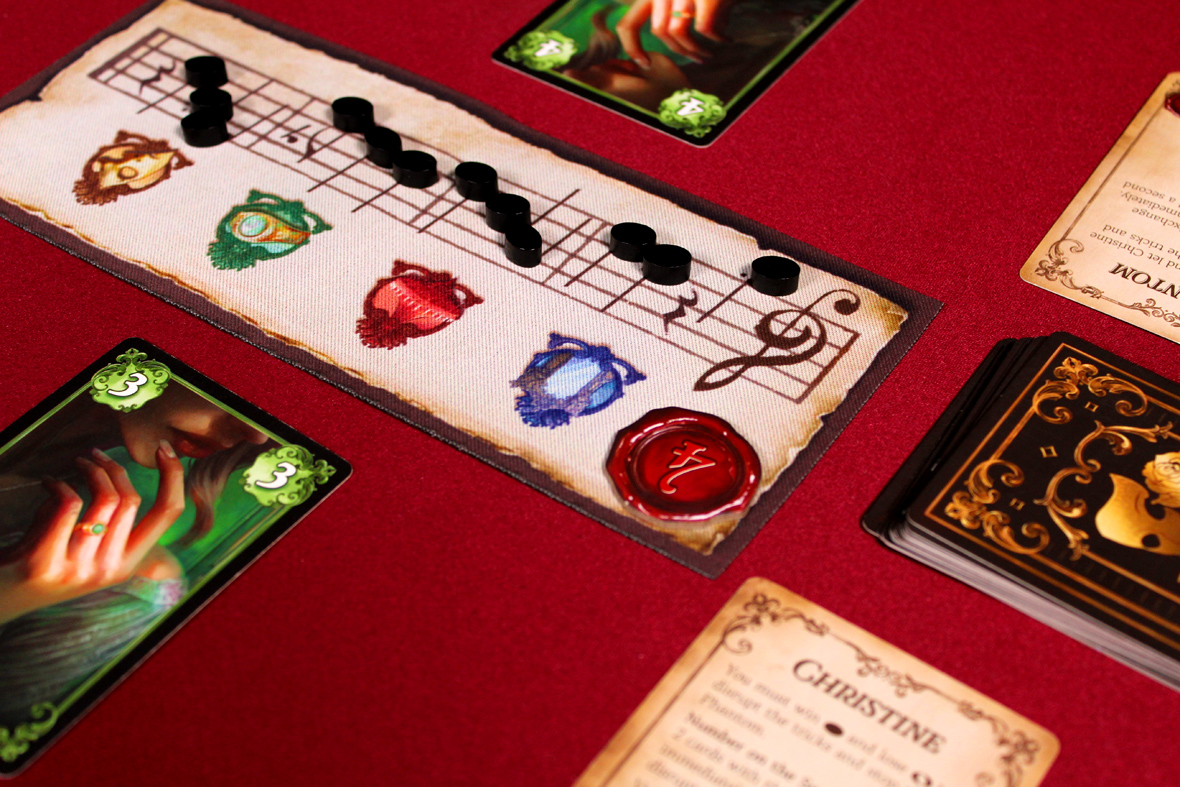
The tricky part is how the melody advances. That all depends on the Phantom! When a black note is next in the score, the Phantom must win the trick to advance! When a white note is next, the Phantom must lose the trick to advance. To block him, Christine needs to win or lose, respectively. Simple as that!

When a trick is played containing the Seal Number for that round, you must immediately swap two cards with your opponent. That trick becomes important, though! If the Phantom would advance the trick, he instead advances twice. If Christine would block the Phantom, she instead removes the last music note placed. Play until you run out of cards, and that’s the end of Round 1!
To start the next round, reshuffle the cards, deal out ten, and swap one with your opponent! Choose a new seal number and play the second round. If the Phantom completes his melody, he wins! If he doesn’t by the end of Round 2, Christine wins!
Player Count Differences
Just two-player games this week!
Strategy

- Be super careful with what trick is coming up next! If you misread it or misplay, you might end up stuck beholden to a Phantom that keeps winning tricks or you keep winning and helping them advance. That’s a lot easier to do as Christine since you failing in your goal lets the Phantom move ahead. As the Phantom, if you get stuck on a trick type, you’re stuck for a while. It only changes when you advance.
- The cards you swap with your opponent matter as well. They can be high-value if you want to lose tricks or low-value if you want to win them. Also keep an eye out for giving away your last cards of a suit so you can throw off if needed.
- Choosing the seal number so that it matches more of the cards you have in your hand can let you control these double-or-nothing rounds. That way your opponent can’t play a 4 and surprise you or something. You really don’t want to lose those.
- Keep an eye on the super trump suit. You may or may not want a lot of those, but each suit will become super trump at some point. Maybe giving some of those away early is the move, so your opponent gets stuck with extremely high-value cards? Depends on the board.
- If you’re not confident you can succeed at the double-or-nothing tricks as the Phantom, play them early. Christine can’t remove your music note tokens if there are none of them on the board.
- Playing a seal number right before the trick type changes can potentially confuse your opponent. They might pass you the wrong type of cards for their plan if you can catch them on their back foot. Worth a shot, anyways.
Pros, Mehs, and Cons
Pros
- The art is phenomenal. It’s moody, contemplative, and really speaks to the narrative in ways that I didn’t expect, which is cool! I think it really sets the tone for the entire game and I love how it turned out. I wish there was more, frankly; I’d love if the BIJOU / Morwen Cloastre team illustrated the whole book.
- Very portable. I love these small two-player trick-taking games! They have such a tiny footprint and you can take them basically anywhere. I’d leave the music notes in the box if you’re playing this while traveling, though.
- I haven’t played a Phantom of the Opera trick-taking game! I know it’s themed after the book, not the musical, as I said, but I think my mom would have loved it; she was a mega-Phan. Do they call them Phans? If they don’t, they should.
- The rhythm of the game is super interesting and tricky. Both players want to win black-note tricks and lose white-note tricks, so their goals are easy to remember but hard to guarantee. It’s very adversarial.
- Getting to choose which tricks are essentially double-or-nothing is also very cool. It’s hard, don’t get me wrong, but it’s very cool.
- I like that there are four options for music sheets. You can mix up the potential melodies the Phantom wants to complete. Adds some variety, which is always nice.
- Actually not a bad way to learn trick-taking. Since it’s just two players and you don’t have a lot of extra trick-taking affects (beyond a trump / super trump), it’s pretty easy to pick up, which is nice. Trick-taking is such a hard genre to learn normally.
Mehs
- The cards are a genuinely strange texture. They’re almost too thick? It means that players’ nails can scratch at the edges and I’m already seeing a little wear, which is a bummer.
- Try to remember that the music note doesn’t advance if Christine is successful. This threw us off in our first game and affected how we planned the cards we wanted in our hand, which wasn’t ideal.
Cons
- Oh, right, I hate the music note tokens. They’re extremely tiny and the sheet music doesn’t always lay flat, so they’re just a very fidgety part of the game. I keep worrying one is going to fall onto my floor and once it does, it’s gone forever. I wish the tokens had just been full notes rather than just the little oval part. I’m not a music major; I don’t know what they’re called.
Overall: 7.75 / 10
These little two-player trick-taking games are always a bit tricky and heady, and The Phantom of the Opera is certainly no exception. I do like it quite a bit, though, and I think that comes down to the theme being fun and the art being excellent. It has the whole neo-Gothic vibe coming through on all the cards; the only thing that would make it better on that front is if the cards were unique within a suit, but that’s expensive and I’m just being greedy. I was originally going to say that this likely suits advanced players more than novices, but I taught my friend trick-taking as a concept tonight and she handily beat me at this so I’m not sure I can still claim that. Maybe I’m just bad at it. Phantom does have a rhythm to it, though, and that comes with a warning: if you suddenly miss a trick that you were supposed to win or lose and you have your hand set up a certain way, you might find yourself unable to regain that rhythm to your advantage. That can sometimes cost you the game. The game isn’t a ton beyond what it presents itself to be, and that’s fine; I think a lot of these little trick-taking games are great to have in your repertoire if you’re a fan of the genre and then you can just mix them around. It’s part of what places like New Mill capitalize on, I think. Phantom of the Opera fans will probably love this just because you get to play as The Phantom and Christine, though I imagine a more “move around and do crimes” board game would capture their interest even more. If you must have anything Phantom-branded, you enjoy quick two-player trick-taking games, or you want a punchy card game without a ton of overhead, I’d recommend The Phantom of the Opera! It’s nifty.
If you enjoyed this review and would like to support What’s Eric Playing? in the future, please check out my Patreon. Thanks for reading!
Discover more from What's Eric Playing?
Subscribe to get the latest posts sent to your email.