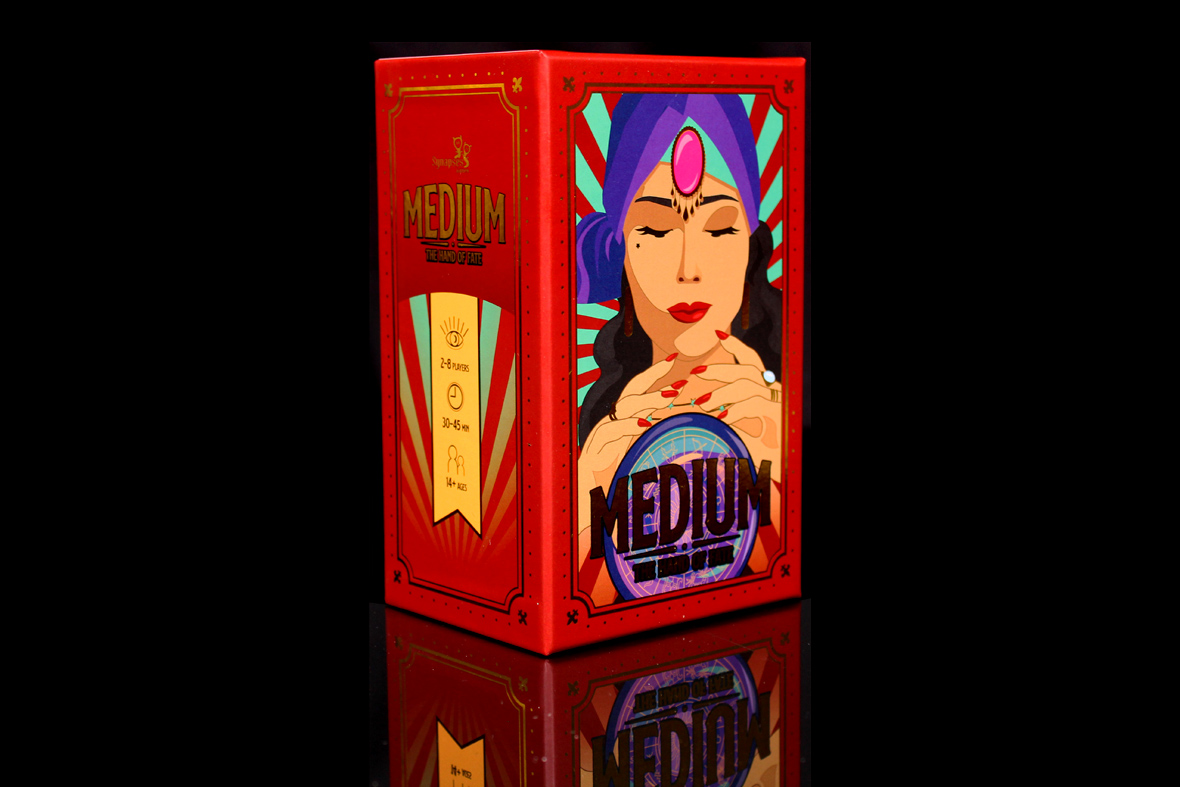
Base price: $20.
2 – 8 players.
Play time: 30 – 45 minutes.
BGG Link
Buy on Amazon (via What’s Eric Playing?)
Logged plays: 2
Full disclosure: A review copy of Medium: The Hand of Fate was provided by Luma Imports / Synapses Games.
I’m trying a relatively new thing (well, more of an old thing) where I try writing a review for a game that’s coming out in two months so that it’s available for me as a fun surprise some time down the road when I’m stressed out or traveling or seeing My Chemical Romance or at a family wedding. I’m not home a lot this fall, so having some buffer would actually be pretty nice? We will see. This next review is a game I’m pretty excited about, though: Medium: The Hand of Fate! It’s a sequel to the original Medium. Let’s dive in!
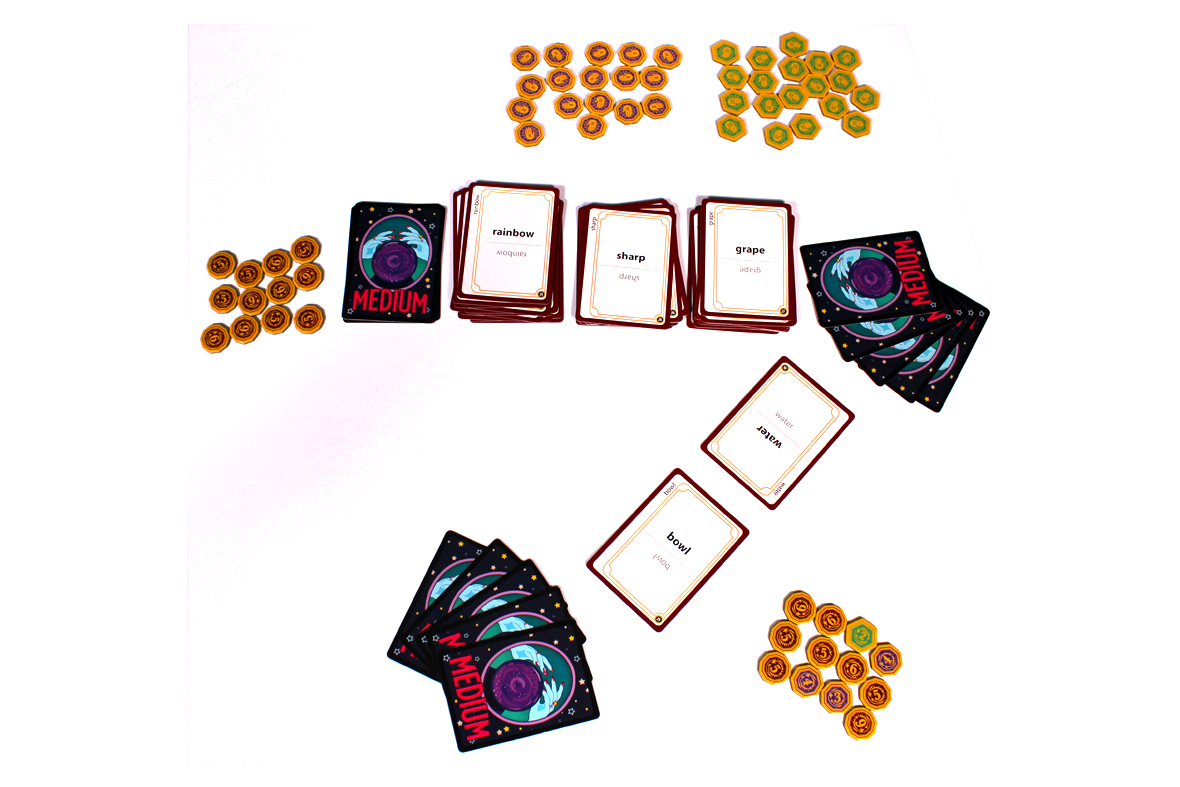
In Medium: The Hand of Fate, you’re back with your supernatural ability to know exactly what people are thinking! Mostly. To better aid your psychic connection, you’re breaking out even more crystal balls than usual. The other psychics can use them this time, mostly to make fun of you by predicting whether or not you’ll fail before you even start. Plus, Madame Fortuna is back to menace pairs of psychics who can’t compete against her all-knowing gaze. As in the original game, each player plays with the player to their left and their right. The left player gives the right player a card with a single word on it, and then vice-versa. From those two cards, you have three attempts to guess the same word (usually the word in between the two cards). If you fail, the two words you guessed are your new pair of words. Can you use the power of your mind to make a connection?


Contents
What’s New?

New words, of course, if you’ve played Medium before. 14 new sets, to be precise, and everything can be combined with the original Medium (and the expansion, Second Sight). The new ESP (Extra Special Power) cards are interesting, as well. One lets you ban a word, and that means that for the current connection, the pair of psychics cannot guess the word you’ve banned. The other lets you and the partner of your choice make an attempt to guess the same word after another pair has failed their third attempt. Rude, but funny.
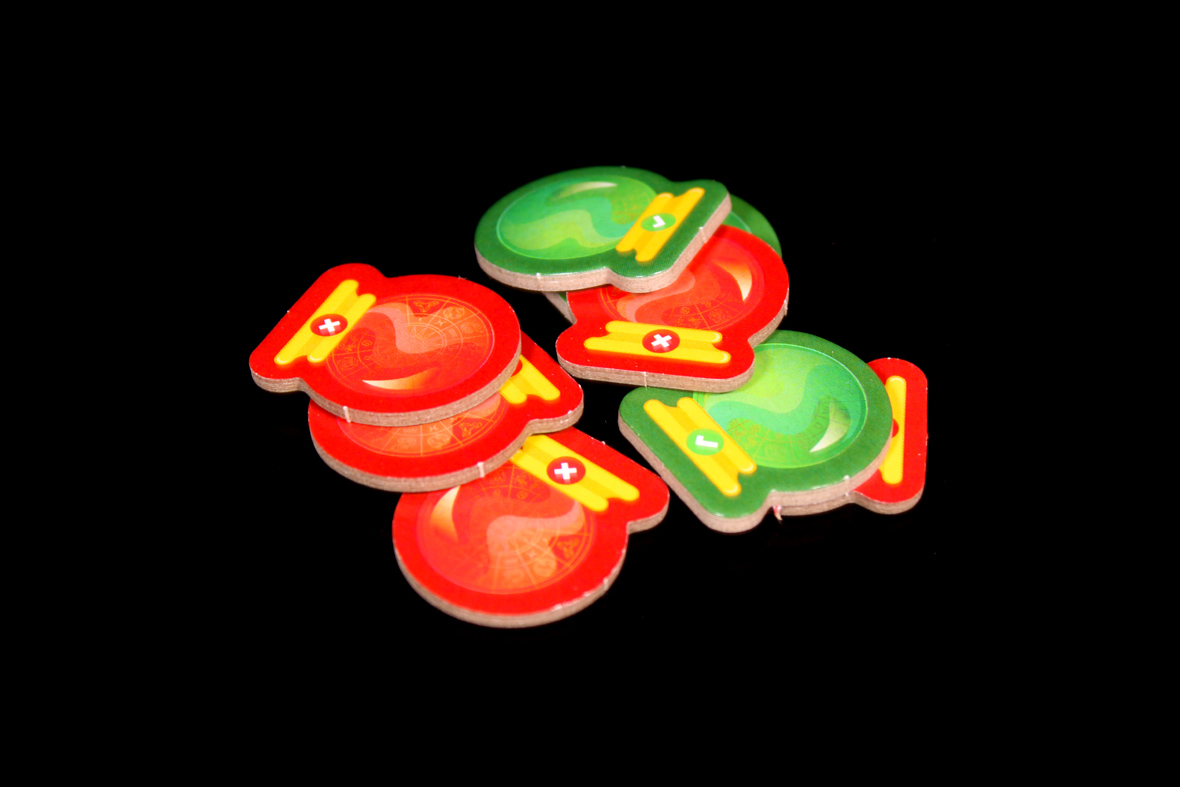

The major addition is the Hand of Fate set of crystal balls and tokens. The crystal balls are given to each psychic at the start of the game, and once a pair has given each other a card, each other psychic uses their crystal ball to guess whether or not the pair will be successful on their first attempt. If your prediction is correct, you get a bonus Hand of Fate point that is applied to both of your pairs’ scores at the end of the game.
Player Count Differences

I’d say pretty specifically and completely none, since every game is played exclusively with the players to your left and right. You have basically no ability to influence people across from you, save for your ESP Cards, and even then you run the risk at higher player counts of players just piling on to whoever is doing the best. The major player count difference is that the two-player game is surprisingly fun and genuinely simple. It plays the same, but every time you mess up on your first attempt you set aside a First Attempt score token, and that total score when the game ends determines if you won or lost. We lost, but not for a lack of trying! I actually like the two-player game far more than I expected, and I’d definitely play that again. One of the few times a variant didn’t feel like an afterthought, even though there’s no major change to gameplay. No real player count preference otherwise.
Strategy

- For the love of God, go high-level. Even the game specifically says to avoid saying “MERLIN” when you could say “WIZARD” or something like that. If you delve into specifics, you’re giving yourself too many options in a game that’s basically all about too many options.
- When you play the second card, have a word in mind. It helps if you play the card motivated by an idea rather than just a “I’ll figure it out later”.
- You don’t always have to do the middle word, but it usually helps to. Sometimes you get things like “LIVE” and “LAUGH” and the same word is probably best “LOVE”, not whatever is between live and laugh. It’s pretty rare but it’s got a non-zero chance of happening. Just watch out for those; don’t build your entire strategy off of those.
- Try to avoid specifics unless there’s a really obvious answer. Sometimes there’s a very specific answer. PARIS and METAL? Eiffel Tower. Things like that.
- Remember: what seems obvious to you is definitely not always obvious to anyone else. They’ve actually done studies on this. It’s called The Curse of Knowledge. Everyone is coming from a different perspective on this one, so this is also another good reason to try and avoid pop culture answers. You can’t fully know what someone else knows!
- It’s actually ok to throw a match opportunity to try and set yourself up for a better word. It’s similar to the S*ORE (or similar) problem in Wordle: it could be SHORE, SCORE, SNORE, SPORE, STORE, SMORE, SWORE; things like that. It’s better to guess a word like CHANT to knock out C, H, N, and T as potential options than it is to guess every possible word. You’re not going to win off of CHANT but you’ll improve your odds. If you think the Medium word has too many options, you can say a word to try and recalibrate for the next round. It’s not that big of a point differential.
- If you’re going to ban a word, wait for it to be a pair of words that has an EXTREMELY OBVIOUS ANSWER. You need something that is so knock-out obvious that I honestly can’t even think of it offhand. Maybe something like HERCULES and DAD? That seems pretty strictly ZEUS, so that would be a good one to block, I think.
Pros, Mehs, and Cons

Pros
- Yeah, I just really like Medium. It’s what I call the “car games” of board gaming, which are the games you grew up playing in some form or another but with fleshed out rules and productions so you end up with something really nice. Even if you didn’t grow up playing this specifically, it feels familiar so it’s easy to just get locked in on. The scoring and subsequent guess rules are nice also.
- This is definitely a “more is more” game. The more sets you have, the more you can mix together and the more weird words and opportunities for strange missed connections are going to emerge. I love that for you and for us.
- The two-player mode is actually really good? I’m very skeptical of two-player variants as someone who plays a lot of two-player games, these days, and I think it actually delivers pretty nicely on preserving the experience without compromising what makes it fun. It can be impossible if you and your partner are on different wavelengths entirely, but, you know, that’s a player issue rather than a game issue.
- The Prediction Tokens are great for keeping players engaged between turns. I really like letting players bet on pairings and whether or not they’ll succeed. There’s a tendency to zone out when it’s not your turn because you don’t have much to do (especially when you’re not playing with ESP cards).
- I can teach people the basic premise of the game in 20 or 30 seconds. They even have a great example you can refer to on the back of the box. It rules; perfect for a party game.
- Even the missed matches are sometimes pretty funny. The game is not easy! But watching two people go for it and whiff it can be pretty entertaining.
Mehs
- I’d love if everything fit into one box, especially since the boxes have such weird shapes already. It’s not ideal, since it makes them hard to store (and I’m pretty sure I lost my copy of the original Medium, sadly). But having a box that could fit the whole set would also give an opportunity to have a more standard-sized box, which I would appreciate.
- Similarly, thicker dividers would be nice. Just to have a way to break the dividers apart more easily when you’re putting sets back. The card dividers are okay, but they’re not my favorite.
Cons
- Not sure why the rules want you to hide your prediction. Make it public! Tell your opponents you have no faith in their success! It’s ruder that way.
- I’d still love to see opportunities to address the things I didn’t love about the initial game. Something like a catch-up mechanism or a way to do a quick practice round with the group would be great! Not sure how to get there, but oh well.
Overall: 8.5 / 10
Overall, I really like the Medium series, and The Hand of Fate is another excellent entry! Major points in its favor for its approachability and for using the Prediction Tokens to keep players engaged even when it’s not their turn, beyond them just guessing what the word might be under their breath. That’s what I usually do, at least. The ESP Cards are a nice little addition, but not as compelling as some of the other options I’ve seen in other Medium variants. Blocking another team is funny but not necessarily the most strategically interesting play, for instance. That said, this is just as good of an entry point into the Medium series as any other title, I think, so you’d be hard-pressed to get me to pick between the sets to make a specific recommendation. I just like the whole series a lot! I love a word game and a bit of competition, and I’m literally never competing with anyone, really; I’m just doing the best I can with my partners and seeing where things end up. It feels less stressful than more directly-competitive word games, as a result, even though trying to look at someone and guess what they’re thinking is almost always a mess. Easy to pick up, though, and that makes for a great party game, so I’m excited to play it again in the future. If you’re a word game fan, party game fan, or just a burgeoning psychic, you’ll probably enjoy Medium: The Hands of Fate as much as I have!
If you enjoyed this review and would like to support What’s Eric Playing? in the future, please check out my Patreon. Thanks for reading!
Discover more from What's Eric Playing?
Subscribe to get the latest posts sent to your email.