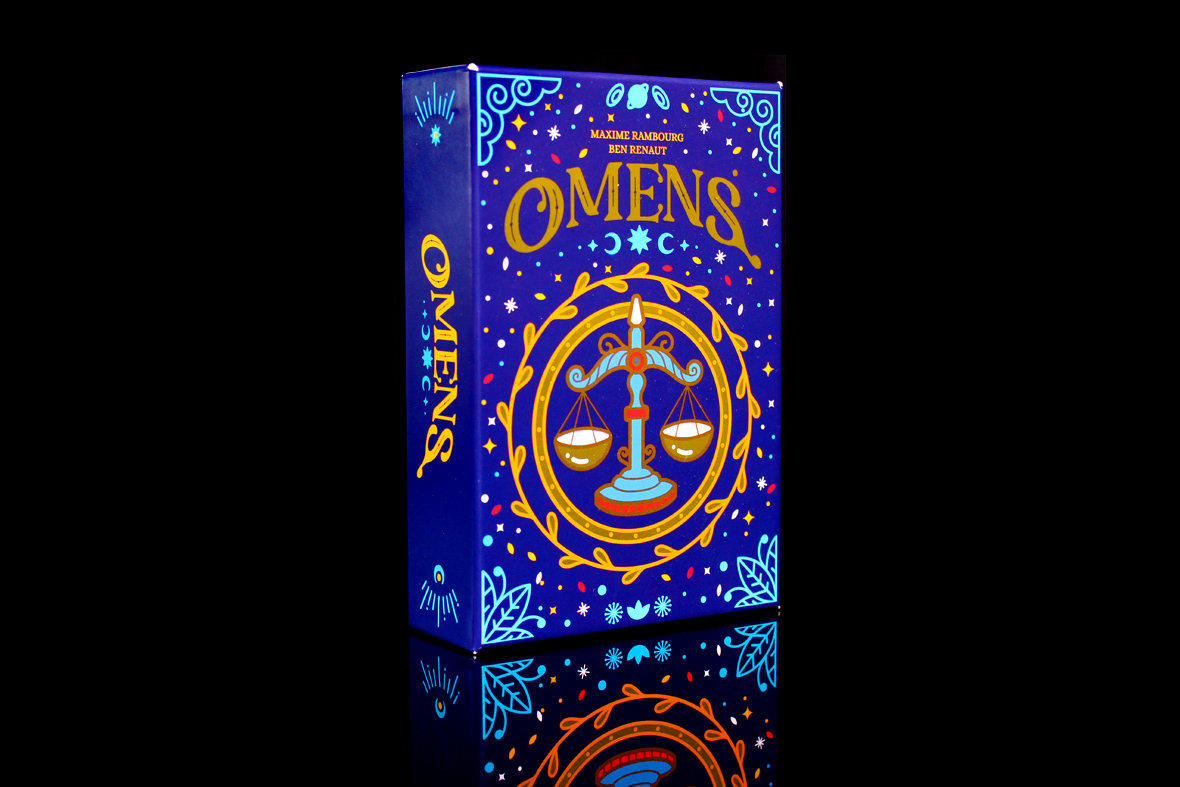
Base price: $20.
4 – 6 players.
Play time: 20 – 30 minutes.
BGG Link
Logged plays: 3
Full disclosure: A review copy of Omens was provided by Hachette Boardgames / Spiral Éditions.
Wow, this week’s reviews were easy to write. Maybe that’s a spoiler. I wish I timed myself more when I wrote reviews, just to get a sense of what scores tend to take me the longest to write. I’m nearly positive that it’s games in the 4 – 6 / 10 range. If you really dislike a game, it’s usually not difficult to explain why. The challenge there is writing it in a way that preserves the analysis and doesn’t come off as excessive or petty. Nobody needs another angry guy on the internet yelling about games. If you love a game, it’s pretty clear from the get-go. If a game was slightly less than okay, sometimes it’s hard to say anything. You’re just bored. You have to force the ideas out and the entire exercise feels terrible. Maybe this has made you more curious? Who knows. Let’s see where Omens ends up!
In Omens. your group has uncovered a mysterious box of cards with a secret: when played in certain ways and in certain orders, some cards will disappear until the next time you play the game. Is this magic? Is it fortune-telling? Is it something sinister? Probably not the last thing unless you’re about to get Jumanji’d. But there’s still an opportunity to turn this into a great game. So split into teams, grab some cards, and figure out how to go out first! Can you turn the omens to your advantage?
Contents
Setup
This is an interesting one, as it’s a 4- to 6-player team game. First thing’s to divide players into teams. You have your cards:

They’re just really nice to look at, so let’s do that again:
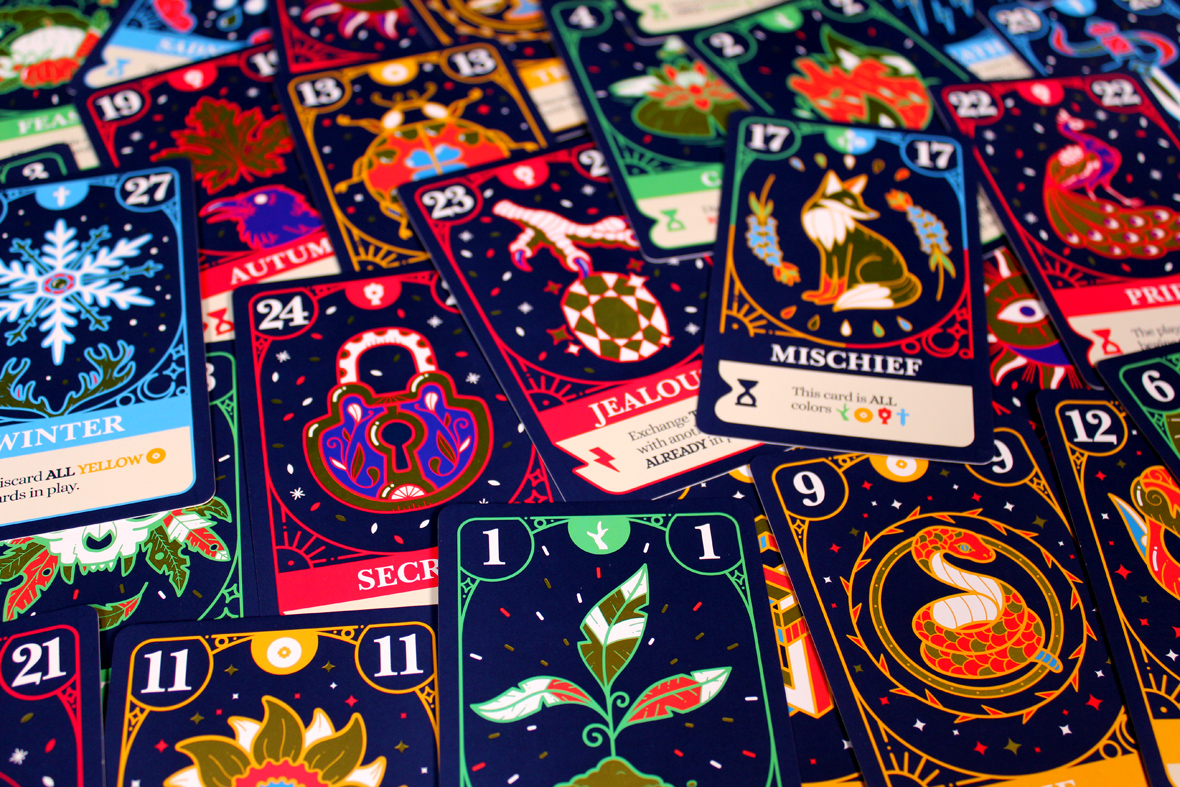
Several of the cards are blue cards called “The Absolute”. Shuffle those six cards and deal them out. If you have fewer than six players, return the remaining ones to the box for the rest of the game. For four / five players, the highest and lowest The Absolute card holders form a team, and the other players form a team. For six players, 30 / 35 are a team, 31 / 34 are a team, and 32 / 33 are a team. Give the teams Player Aid cards (turned to the yellow, not gold side) to indicate that:

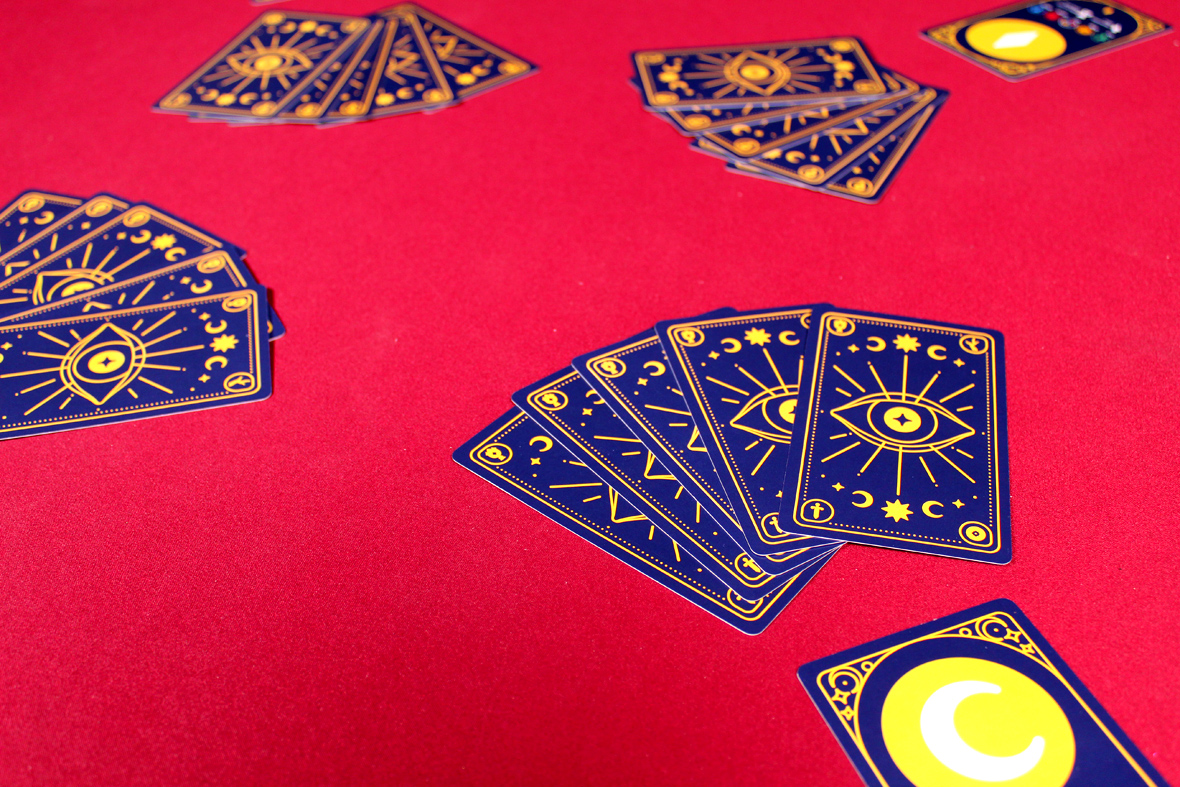
Then shuffle and deal out the remaining cards. At four players, each player gets four extra cards (for five total). At five, the two-player team gets four extra cards and the three-player team gets three extra cards. At six, all players get three extra cards. You’re ready to start!
Gameplay

I’m aware this is a shedding game, but it plays similarly enough to a trick-taking game that I think it will appeal to players who have a similar enthusiasm for that. With that said, let’s dive right in.
The core of the game is get rid of your cards. If any player has one card left in hand at the end of a turn, their team wins the round. If multiple players do, the player with the highest card left wins the round for their team. First team to win two rounds wins the game.
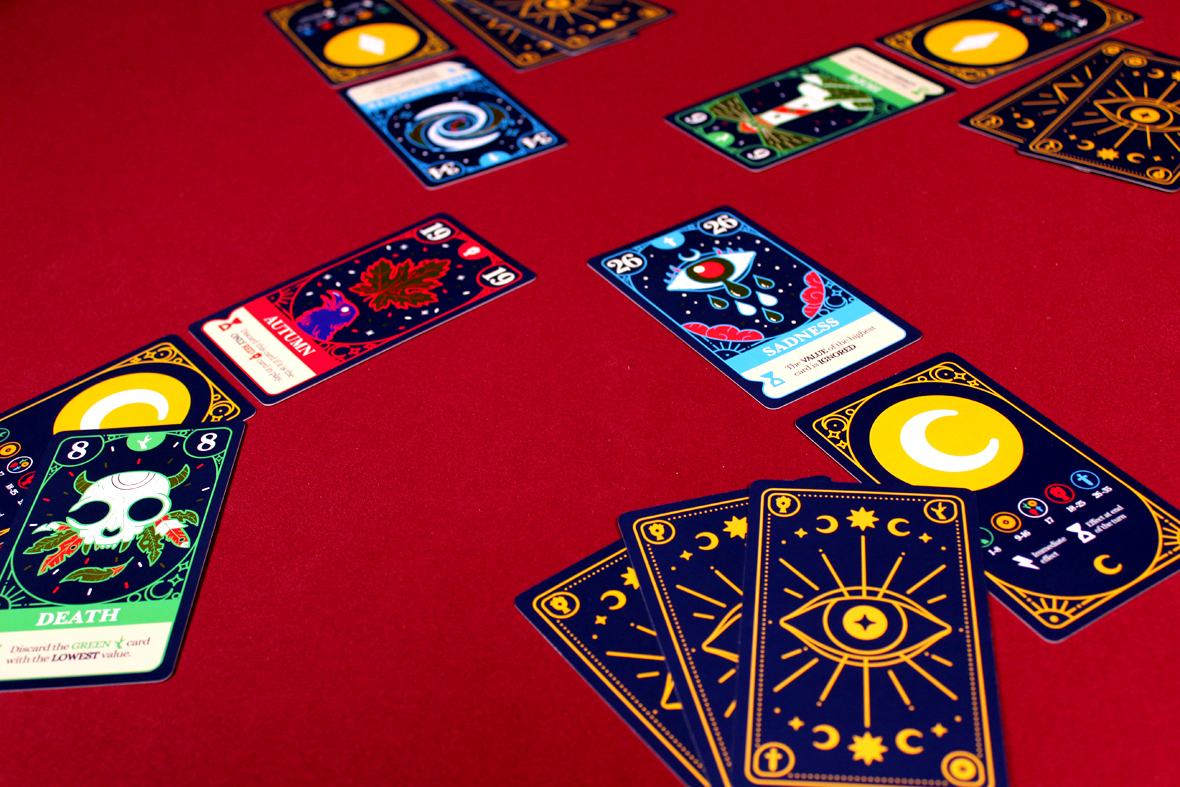
In the first round of the game, the player with the highest The Absolute card leads off. On your turn, just play a card from your hand. Some have instant resolution effects and others resolve at the end of the trick. If there’s a lightning bolt, resolve that effect instantly. Then, it’s the next player’s turn and so on. Once everyone’s played a card, that’s the end of the trick. Resolve all end-of-trick effects and then generally, the highest card played wins. If you win the trick, discard your card out of play. All other non-discarded cards get returned to their player’s hand. The player who won the trick starts the next one.

Play continues until a player is down to one card. As I said earlier, their team wins a point! Flip that team’s team markers to the gold side to indicate that. Then, shuffle up all cards (including the remaining cards and the players’ assigned The Absolute cards) and deal each player the same number of cards you did in Setup. The player who won the round for their team starts the next one.
Play until any team wins two points!
Player Count Differences
The major difference between player counts comes down to team dynamics. The smaller team at five players has to get rid of more cards, for instance, whereas with six players it’s essentially a free-for-all between the three teams. This means your strategy needs to be careful and precise if you want to just help your teammate(s). One thing worth noting is that with five players, you should shuffle some seating around if all three players on the same team are sitting next to each other; if they can play one-after-the-other, it can be a little annoying. Otherwise, the game plays pretty similarly with a variety of player counts; your goal is to either support your teammate and block the plans of your opponents or accept your teammate’s support while still thwarting your opponents. It’s tricky, but fun! I’ve enjoyed most player counts, though I lean towards four or six for balance’s sake.
Strategy

- This is a team game; play accordingly. While that doesn’t mean you should always support your teammate(s) blindly, it does mean that sometimes the goal of the round is not going to be you in particular winning. Your teammate(s) might just have better cards for going out and you might have better support cards. As long as one of you goes out, you both get the point.
- The Absolute is pretty interesting; don’t waste it. You don’t really want to trade with an opponent unless you have a genuinely terrible card that you’ll have trouble getting rid of. They will give you their worst card. You can save The Absolute for later if you want and pass a card that’s easy to discard to your teammate if they’re close to going out, for instance.
- Playing first is a very different animal than playing last. If you play first in a trick, you set the tone. Things like “Discard the highest Green card” will pressure opponents to all play green. If your teammate has the highest Green card (check the Player Aid), then that’s pretty good! Playing last, on the other hand, means you can respond to every card that’s already been played. Have a higher card? You can play it for an easy win, usually. There are certain cards that also benefit from being played first or being played last, so think about how the round will go as a result of what you’re playing.
- Thwart your opponents’ plans. If they played a card that discards the highest card of a color, play your highest card of that color. If they played The Absolute, play a card that ignores the highest-value card or lets the lowest-value card win. There are plenty of options, but you need to be responsive to them.
- Keep an eye on what your teammates are playing, even if they don’t win. If you can’t win a trick, it’s an opportunity to communicate to your teammates what cards are in your hand. You can use that information to decide how to get those cards out of their hands in the future.
- Also don’t dunk on your teammates? If they’re already winning, do something else. You don’t need to steal the win away from someone on your team. That’s bad strategy and it’s rude.
- Remember that The Absolutes get shuffled into the deck in subsequent rounds. You might end up with none, or many! They’re high-value cards, though, so use them wisely.
Pros, Mehs, and Cons

Pros
- Look, I love a game that puts consideration into its art. This game is gorgeous. The gold effect makes each card interesting and dynamic to look at, and I love the color work.
- Tarot-vibes are also right up my alley. There’s a reason I love The Light in the Mist and The Shipwreck Arcana so much. Well, several reasons, but I really like what they do with Tarot and fortune-telling vibes. Omens fits right in there, though likely a bit more with Shipwreck since it has its own entire set rather than using the common Major Arcana like Light in the Mist does.
- I do think this is a nice gateway for trick-taking games. You don’t have as much of the inherent complexity of trick-taking with following suit or betting on how many tricks you’ll win or shooting the moon or whatever particularly intense trick-taking feature you like. This blurs the line between trick-taking and shedding, I suppose, since you’re just working your hand down. You could use this to gauge how much players like those features. If they’re into it, you can scale towards more trick-taking, ladder-climbing, or shedding games. So many good choices in each category.
- This is everything I love about trick-taking but with some extra intrigue. I really like how there are so many cards that synergize with each other or play off of each other. I never feel like I have a particularly bad hand; I just need to figure out how to make the cards that I have good. There’s so much flexibility in Omens between tactics and strategy that I’m just fully locked in whenever I play.
- The team play is really interesting! You can play off of each others’ cards in a really good way. For instance, I can play a high Green that discards the lowest Green card, and my partner, seeing that, can play a low Green that discards the highest Green card. Even if we don’t win the trick, we still both discard our cards and that’s a viable strategy. There’s a lot of opportunities for dynamic partnership, and figuring out how to get information to your partner based on what you have and what you play is really interesting. I usually worry about a player’s first time in a team game, but once you understand enough of the cards you can usually pick it up on your own.
- Plays pretty quickly. First to two wins is a great pace for a two- or three-team game; you can get engaged and still have a good time, and if people want to play again you can just shuffle the teams around without it being an Entire Thing.
- Pretty portable, too. I’d call this a small-box game. You can take it with you pretty easily.
Mehs
- You will have to remind players to use the Player Aid card. I think players are just conditioned to ignore them from other games, but here they actually matter quite a bit? They tell you the range of all the card colors, so you know what to expect from cards that affect the highest or lowest card of that color. A lot of questions players ask during the game are answered by the Player Aid card. Is that annoying? Yes. Do I love my friends despite that? Also yes.
- I always have trouble finding players for 4+ player games. I think it’s one of those things where if you have enough people for a higher-player-count game the situation usually doesn’t lend itself to a game night; people want to watch movies or play Jackbox or something. As a result, I find these games hard to get to the table and that can be a point of frustration.
Cons
- There’s a lot of reading and a lot to remember, which may be a turnoff for some players. Each card has unique effects, which I love, but that forces a lot of cognitive load onto new players. There’s an opportunity for frustration when a player is surprised by a card with an effect they weren’t aware of or didn’t expect, but nobody wants you to read every card to them at the start of the game. I’d say you can mitigate this a bit by taking a quick pulse check at the start of the game to see how much players want the cards explained to them. This usually mitigates it somewhat, but keep an eye on player sentiment if you want to prevent this being too much of an issue.
- In a five-player game, seating can matter a bit. When I last played at five, we had the three-team all one right after the other, and then the two-team. It wasn’t ideal, as the three-team could (and did) essentially combo off of each other for an uninterrupted streak. Did it help that the two-team had been drinking? No, but, neither did this. I’d just recommend avoiding that specific seating arrangement for optimal play.
Overall: 9.25 / 10
Omens is one of my favorite games I’ve played in 2026. It’s almost annoying to type that because now every game I play for the rest of the year, especially card games, I’m going to be comparing back to how Omens made me feel as a player. I was completely engaged while I was playing, just thinking about my cards, how to help my team, and how to block my opponents. It’s an interesting game that challenged me on strategy and tactics. You cannot win just by yourself; you have to rely on your team to set up combinations and synergies and strategies that let you all work together. Unfortunately, that is entirely emergent; you can’t communicate and you have to figure it out on the fly. This means that even if you’re not winning that trick, the card you play is important. It’s a signal; it’s information. That ends up making Omens feel, at times, almost like a deduction game? You’re keeping track of cards to inform what you play and when to set yourself up for success, and that makes the parts of my brain that enjoy deduction games light up as well. What you end up with is a card game that impossibly toes the line between being light enough to play with just about anyone and complex enough to be interesting. Didn’t know they knew how to do that. Sure, the initial complexity of learning all the cards can be a lot and team play can always lead to some problematic dynamics, but I think Omens brings enough to the table to more than make up for those flaws. I’m going to play Omens again. Just a matter of time. I’d definitely recommend you play it as well!
Looking for more great games to take on the go? Check out my Small Box and Wallet Games Hub for more recommendations!
If you enjoyed this review and would like to support What’s Eric Playing? in the future, please check out my Patreon. Thanks for reading!
Discover more from What's Eric Playing?
Subscribe to get the latest posts sent to your email.