
Base price: $12.
1 player.
Play time: ~30 minutes.
BGG Link
Logged plays: 3
Full disclosure: A review copy of Count of the Nine Estates was provided by Button Shy.
I slept for twelve hours today, which is pretty solidly my ideal Sunday. However, this put me wildly behind schedule for writing, since … well, while I’m sleeping, I’m not writing. Nothing to be done. There’s a game I’d very much like to review, but I think I need a few more plays to fully get the contours of the game and talk about it. More on that later. Unfortunately, that’s all I played before today, so I had to hustle a bit and here we are. Old reliable Button Shy and a nifty abstract from our friends at Bitewing. Let’s dive right in and check them out!
In Count of the Nine Estates, you’re the titular count (though neither a vampire nor obsessed with numbers, sadly) and you want to build up the Nine Estates to consolidate your power and authority. Unfortunately, you’re also pretty broke. Like, your estates don’t produce a ton of resources. If you’re going to make it, you’re going to have to also make some tough decisions. But you love tough decisions, don’t you? That’s why you play games or why you became a noble. So get in there and build your fledgling empire. Will you have what it takes to get the crown’s attention? Or will you end up laboring away in a quiet exile?
Contents
Setup
Setup here is pretty straightforward. Shuffle up the Estates and reveal them. As you do, make a top row of “Nobility”, then a middle row of “Clergy”, and a bottom row of “Peasant” Estates.

Prepare the Structure deck by making sure all the cards are square-corners side up. Then, shuffle the Structures, rotating some of the cards around so that you’re mixing up the cards more. That’ll make a deck, which should be placed horizontally next to the Estates. Once you’ve done that, choose which side of the cards you want to be up.
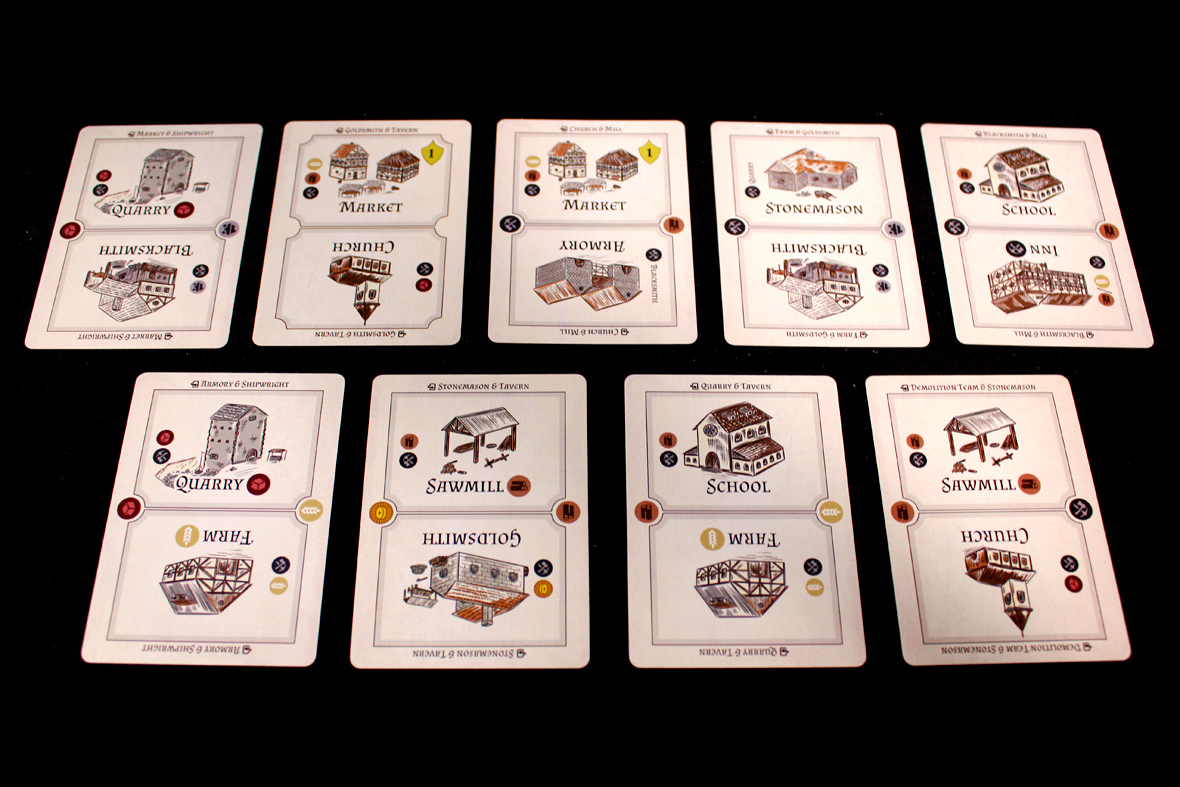
Slide the top card of the deck to the right, and find something to keep score with. You should be ready to start!

Gameplay

This one’s tricky! Over two Eras, your goal is to build up Structures and Estates to score points. But be careful! Some decisions may make it difficult to progress forward, and once an era ends, your Structures need to be built up anew.
Each Era is composed of multiple rounds. On a given turn, you’ll look at the Estates in front of you and the Structures on top of the deck, next to the deck, and in the discard pile next to the center card. Those three Structure Cards are the Active Cards for this turn.
You can do nothing, which flips the center card and places it in the discard pile. The rulebook doesn’t specify a flip direction, but be consistent. To build a Structure or Estate, you must spend resources. These can either be on the Active Cards or on the built Structures and Estates in your play area. If you spend resources on Active Cards, you’ll tap them by turning them horizontally (if they’re in the discard pile) or flip and discard them if they’re the center card or the top card of the deck (in that order). You can spend resources on a card you’re trying to build. If you spend resources on a Structure or an Estate Card, tap those as well. When you build a card, place it in a Build Area in your play area. I recommend making a column per round you’ve played, so you can keep track of the number of rounds in your Era.
Once you run out of cards in the deck, the round is over! Discard the center card (flipping it over, as usual) and then flip the deck. You may then choose one bonus for the next round:
- Shuffle the deck.
- Rotate the deck 180 degrees.
- You may choose one card next round to rotate 180 degrees.
They all have their merits. You may end an Era whenever you’d like! When you do, you score:
- 1 point per Structure.
- 1 point per duplicate Structure.
- X points on shields on Estates built this era (use the pictured value).
- X points on shields on Structures (again, pictured value).
- -2 points per round played in this Era.

After scoring, you reset! All Structures are returned square-corner side up to the deck and shuffled again, and you can choose which side is going to be up. Play another era, scoring the same way as you did previously when the Era ends, and then see how you did!
- 26+: The King is overthrown!
- 22 – 25: The King is worried.
- 18 – 21: The King is impressed.
- 14 – 17: The King is unmoved.
- 0 – 13: The King is displeased.
Player Count Differences
This is always a nice section to write when it’s a purely solo or two-player game. Nothing to report, here, as a result.
Strategy

- I think it generally helps if you have an extra Work Crew you can pull from. You need one to build literally every Structure and every Estate, so if you’re just pulling random resources each turn you’re pretty much screwed. A few Structures can give you a Work Crew once per round, and sometimes it’s worth having that just to bridge the gap of a bad draw, especially since the rounded-corner side of the cards can be so unforgiving.
- Take a look at the Estates and devise a plan. You need to know exactly which Structures you need to build which Estates so that you can get them locked down in advance. You also need to know which Estates you’re aiming for since they’re mutually exclusive within a row and a column (taking one discards the others in its row and column).
- What bonus do you want when a round ends? I frequently find myself taking the “rotate one card”, but if you have certain deck configurations you may want to shuffle or rotate the whole thing. Keep an eye on your cards as you move through a round so that you know what to pick at the end!
- Don’t waste bonus resources! You should be using your Structures every round since they automatically refresh; anything else is just wasteful. Your Estates, well, you really only get to use them once per Era, so you shouldn’t waste them, but don’t just use them to use them either.
- Gold, as a wild resource, isn’t too bad to have. Like the Work Crew, you can use it to fill the gap of a bad draw.
- Certain Structures are going to be pretty critical. I think this is where I wish they had more of a player aid, so I knew which Structures and Estates required which Structures in order to build and could plan accordingly. As it stands, I know the Quarry and School and Blacksmith are all pretty important as dependencies for other cards, but the Market can matter a lot depending on your game as well!
- Watch out for playing too many rounds! The more rounds you play the more of a score penalty you take, so be mindful of that. You really don’t want to start getting into Round 5 or Round 6; even if you do, I mean, what cards will you have left?
Pros, Mehs, and Cons

Pros
- Pretty intricate for such a tiny game. There’s tough choices here! What to build, when to build it, and how to prioritize and plan a path through construction with such limited resources are all challenging things to reckon with. I ended up playing another time for my review so I could just wrap my head around all of it again.
- Very portable, which is always nice. The Button Shy advantage, though I hear they’re moving to boxes since it makes the games, you know, 1000% easier to sell in stores. It’s a polarizing decision, but ultimately, if they’ve done the market research and that’s what they need to do, I’d rather them be in a spot to keep making these cool little games.
- The art style’s whole minimalist vibe is very nice. It gives an old scroll or a like, surveyor’s drawing or something, which I find very peaceful.
- If you’re looking for more challenge from Button Shy games, this one’s pretty tricky! I think it’s nice that there’s a range of difficulty from Button Shy as a solo game publisher. This is definitely on the higher end, but there are still some games that I’ve tried playing from Button Shy that I’m just generally not good enough to play effectively. So I suppose this is easier than that, but not much!
Mehs
- The narrative of the game isn’t particularly clear. Why is the best tier overthrowing the King? If we’re the Count of Nine Estates, why can we only build three of them? These things have been bothering me for my last few plays.
Cons
- The rulebook here is pretty rough, and needs a few gameplay examples. I was so confused my first game. I think something like the direction a card should be flipped is important and it’s completely out of the rulebook, for instance. More critically, since the rulebook’s font is already small, anything that’s super critical should be explicit and bolded, otherwise players are likely to miss important details. Being able to play a resource that’s on the card you want to build? It’s implied, but you can do that. Make that explicit. Needing to follow the Peasant -> Clergy -> Nobility order for building Estates? It’s explicit, but make that bold. It’s a critical rule. Make it clearly stated that Structures are returned to the deck between Eras. Things like that.
Overall: 6.5 / 10

Overall, I liked Count of the Nine Estates! It’s tough, but that’s half the fun, I think. Plus, every time you have a bad outcome, you really can just play again and do better! I’m not totally sure how to do better, but I still wrote the entire Strategy section of this review, so I enjoy some authority. The rulebook, though: it’s not it. There are a handful of places where examples would make my initial few plays much less complicated, and, critically, explicitly mentioning that you can spend the resource on the card you want to build to help build it is a very important detail that’s just left as implied. These little things snowball a bit to make the game harder than I think it needs to be, but once you get the game rolling, it rolls at a pretty smooth and pleasant pace. I think Count of the Nine Estates is more complicated than, say, the Simply Solo titles from Button Shy, but I do like how it’s got some pseudo-deckbuilding energy to it. It’s not a deckbuilder, but being able to affect the order of the cards is an interesting strategic option. The really challenging aspect of the game is figuring out whether or not you want to pass on a card so that you still have access to the card and what’s on the back of it. It’s tricky! A player aid would help a lot, but, it’s Button Shy, so you get the 18 you get (though they could have printed it on the back of the rulebook). If you’re interested in one of Button Shy’s trickier offerings, you like a solo game with some depth, or you just want to be a fancy count, Count of the Nine Estates might be right up your alley! It’s certainly an interesting one.
If you enjoyed this review and would like to support What’s Eric Playing? in the future, please check out my Patreon. Thanks for reading!
Discover more from What's Eric Playing?
Subscribe to get the latest posts sent to your email.