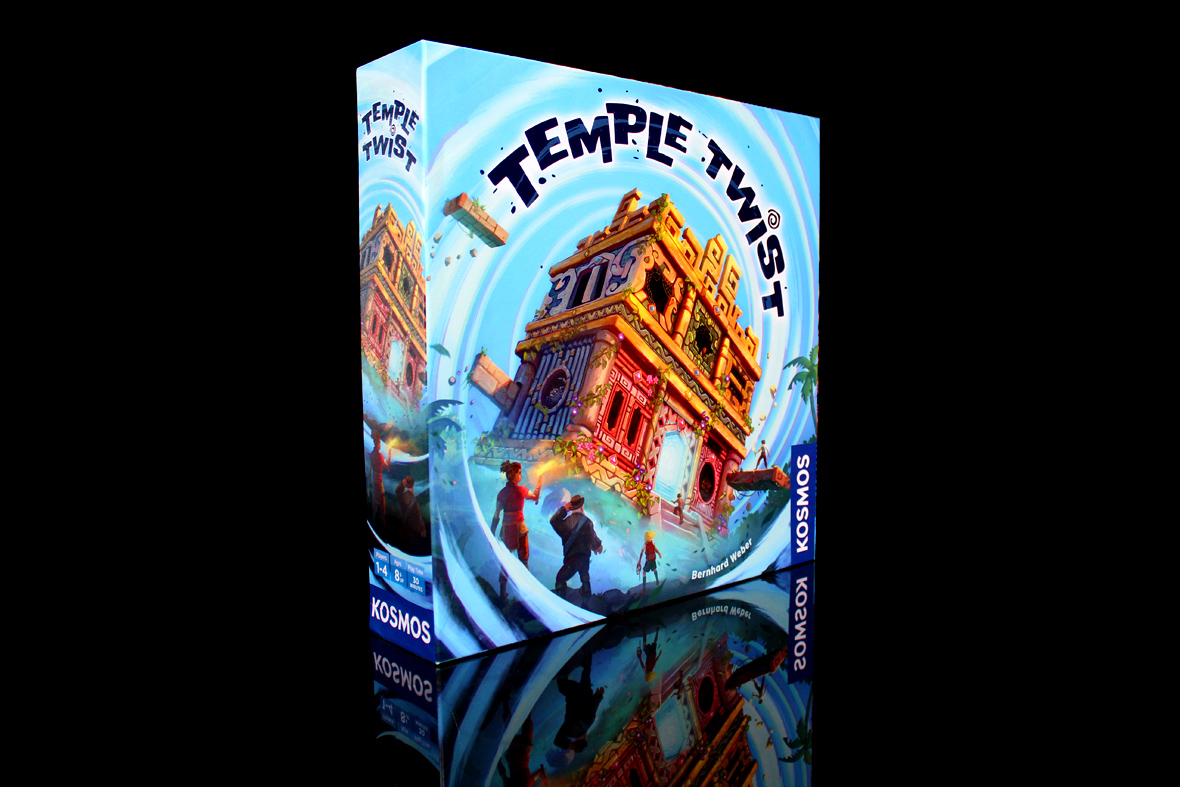
Base price: $30.
1 – 4 players.
Play time: ~30 minutes.
BGG Link
Buy on Amazon (via What’s Eric Playing?)
Logged plays: 6
Full disclosure: A review copy of Temple Twist was provided by KOSMOS.
I can’t believe I’m finished writing my second review for the week and it’s only Tuesday. I look in the mirror and don’t recognize myself anymore. Maybe I’ll write another two! I think part of it is that it’s been a good week for games; I haven’t played a lot, but the ones I’ve played have been really compelling, like the recent Temple Twist from KOSMOS. They’ve been on kind of a streak for me since I liked Oh My Word so much, so let’s see how this one holds up!
In Temple Twist, you’ve been led to a mysterious temple in the middle of the jungle looking for artifacts. Why? Well, hopefully you’re part of the local culture and you’re looking for them so that you can bring them to local museums to highlight the rich diversity of your nation and people. That’s what I’m hoping you’re doing, and nothing in the game suggests that you’re not doing exactly that. So it’s probably fine. Much to your surprise, though, this temple is weird and keeps spinning like that one hallway in Inception! What was up is down, what’s down is now left, and what’s right is actually wrong. That last one feels more personal and less directional, but you call it like you see it. So get in, explore, find artifacts, and get out. Will you be able to survive the twists of this ancient temple?
Contents
Setup
First, you have to build the actual temple. The rulebook will help, but here’s what it looks like when you’re done:

You’ll place it so that any of the three doors are oriented normally (flat-side down), and then add the Explorer Cube inside of that door:

Set the immovable walls aside for now. Add five of the movable walls anywhere at random inside of the temple

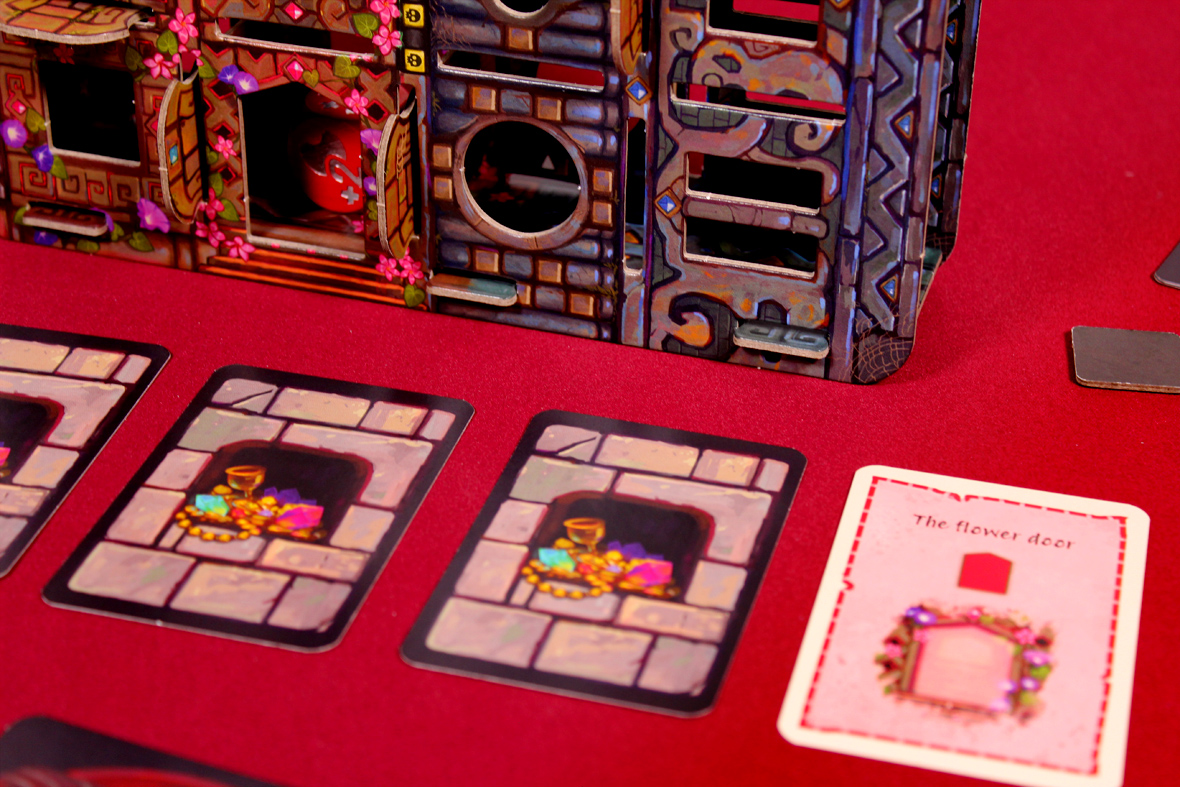
The rest get placed nearby for the game itself. Shuffle the Room Cards and the Door Cards:

Set aside the Additional Action Cards (red backpack). Then, shuffle the 12 Starting Action Cards (blue backpacks) and distribute them out as evenly as you can to all players.

Set the Communicate and Swap Tokens on the table, and give the Torch to the starting player. The Activate Die token can be set aside:

The Challenge Cards can be shuffled as well, but set aside for now.

Similarly, set aside the Expedition Cards:

Finally, set aside the Snack Tokens:
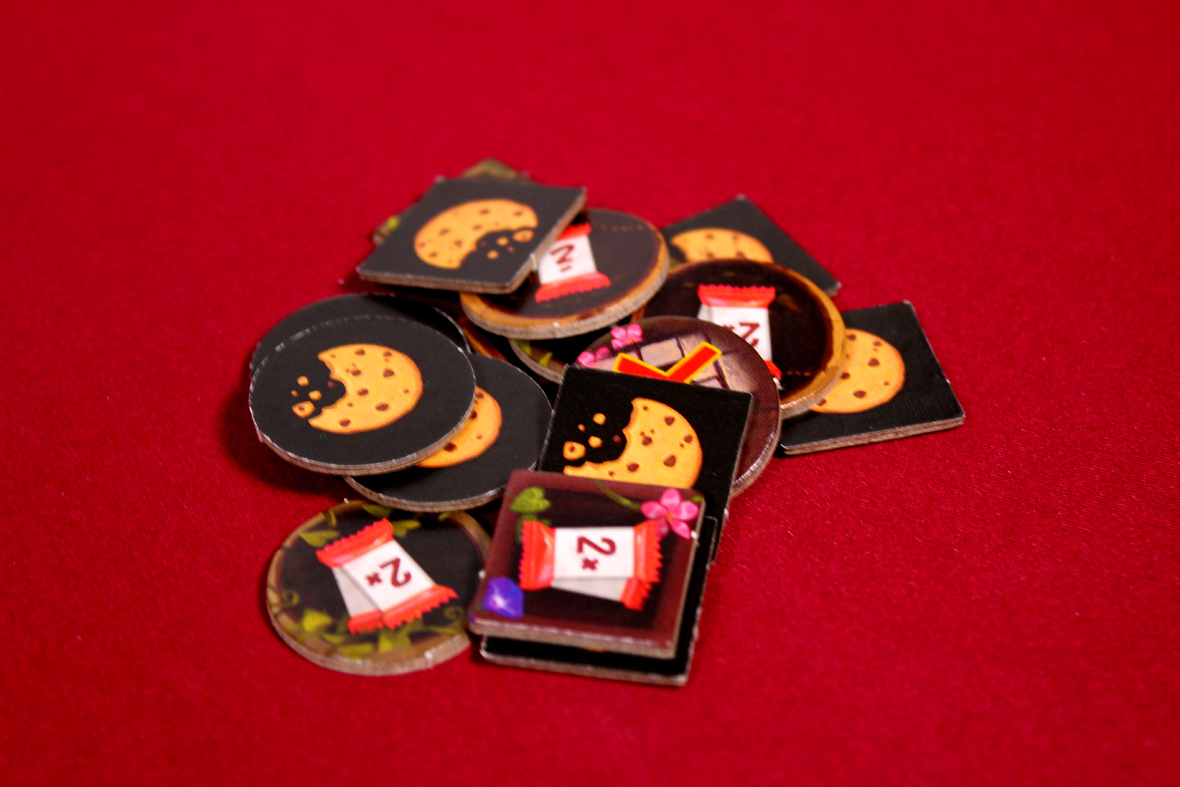
You’ll also set aside the other challenge tokens and Slimy; you’ll use those later.
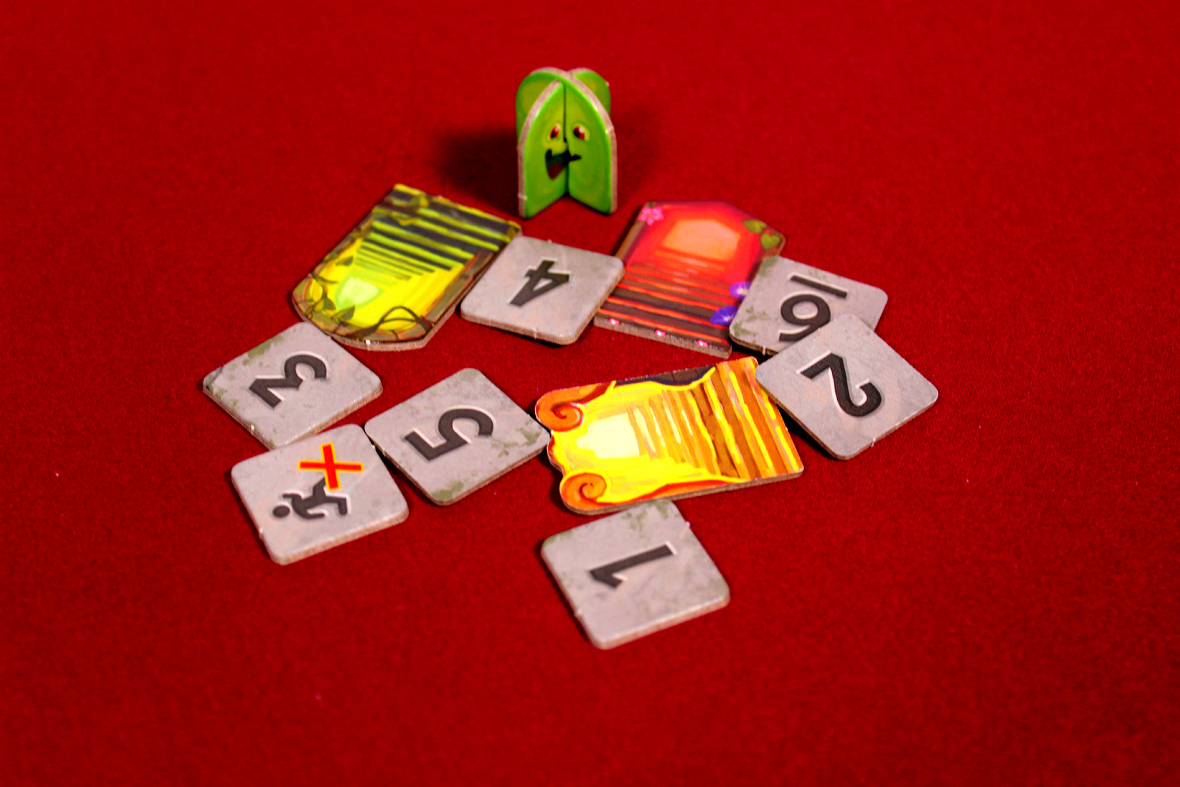
You’re ready to start! I’ll explain the different modes in Gameplay.
Gameplay

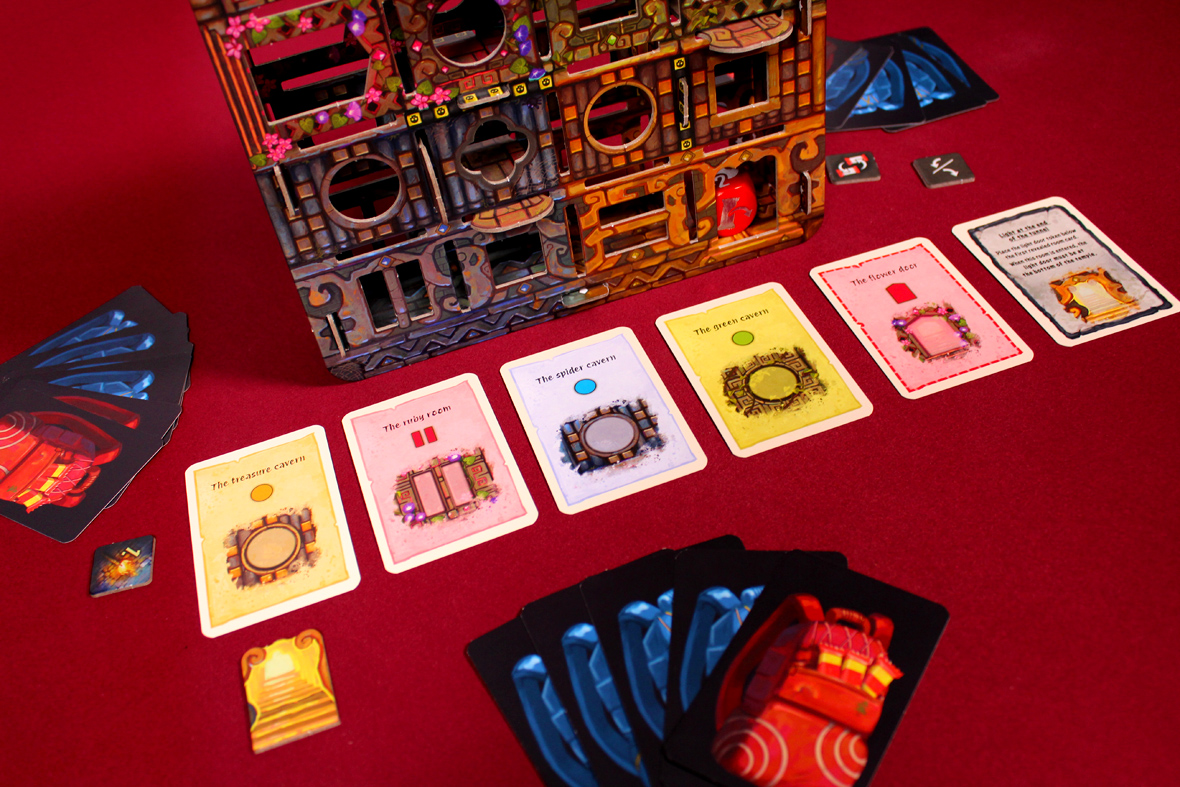
In Temple Twist, your goal is to explore and then escape! Each game, you’ll have Room Cards that you need to make your way to, and then a Door Card that indicates which Door you need to exit from. How you handle that depends on your game mode!
Standard Game
For a standard game, you’ll draw and reveal two Room Cards and one Door Card. That’s your goal!
Each turn, you’ll play an Action Card from your hand. Each Action Card lets you do one of the following things:
- Add / Remove a Wall: You can slide one of the movable walls into or out of the temple. There’s also an x2 version of this card, but you have to add two walls or remove two walls; you can’t add one and remove one.
- Move a Wall: Remove any movable wall and replace it somewhere else.
- Rotate 90 degrees: Rotate the temple 90 degrees in the direction of your choice. There’s an x2 version of this card as well, though you can do different directions for this one if you’d like. You can turn the temple at any speed, but you should turn it corner over corner.
- INFINITE ROTATIONS: That’s what we call this card, at least. Turn the temple 90 degrees in one direction of your choice as many times as you want. Unlike the x2 version, you cannot change directions.
Be careful when you’re rotating! If you goof the temple such that the Explorer Die is flung out of the temple, you lose immediately. Don’t do that.
If your turn ends and the Explorer Cube is completely in a room pictured on a Room Card, flip it over! You’ve explored it! Then, it’s the next player’s turn.
To win, you must explore all the rooms on your Room Cards and then finish your turn in the correct door (the one pictured on the Door card) with the door right-side up. If you’ve done that, you win! If you run out of cards before then, you lose. Do not despair, though! If you’ve lost, you can reset the game and draw two action cards from the Additional Action Cards pile to help you in your next game! Distribute those with the others.
Either way, for your next game, leave the Die and walls where they are! You’ll start with the temple in that configuration.

Challenge Mode
To make the game more difficult, you can start by adding more Room Cards when you play. For each one you add, give the team two additional Action Cards (total) in the initial distribution.
For a more intense challenge, try the Challenge Cards! For each one of those you draw, some weird effect happens (and you get another two additional Action Cards). Each player can only have a maximum of six Action Cards in their hands, so if they would have more, leave them in a draw deck for players to use at the end of their turn. They can draw back up to six.
Challenge Cards have a variety of interesting effects, from banning exploring certain rooms to limiting which walls you can place to forcing you to deal with other hazards, like Slimy. How many can you handle?
Expedition Mode
In Expedition Mode, you’ll instead use the Expedition Cards to determine the game’s setup each time you play. This will let you play a campaign mode! To help you, you’ll get a bonus: if you enter the Chamber of Destiny and explore it, you can spend the Activate Cube token to gain the bonus pictured on one of the visible sides of the Explorer Cube! This can get you Action Cards or Snack Tokens, which will help a lot!
You start with the First Expedition Card, and if you win, you bring any Additional Action Cards and unused Snack Tokens with you to the next game! If you lose, try again and get two additional Action Cards as well.
Player Count Differences

Not too many, since you’re playing cooperatively and interacting with the temple only on your turn. The main differences here are that with fewer players, as you gain additional Action Cards, they’ll have to be set aside into a deck and you may have odd sets of cards available to you at any given time. If you play with Challenges that are player-specific, that might introduce some variability, but that’s, again, going to be the most significant difference you might see. I played this a lot with four players and had a pretty great time, so it scales up nicely with player count. I’d play with four again! There are some limits on communication, but the game (in the early stages) isn’t so complicated that that matters, and by the time you get to the truly challenging levels, your group has largely learned a communication style that works for them or they’ve gotten a ton of Action Cards from failing. Both work.
Strategy

- It actually does help if you assign names to the weird moves you’re going to start making. It’s fun and useful. Sometimes you need to do a turn that jumps the Explorer Cube across a gap or you need to do a sliding rotation or something. Come up with a name for that technique so you can reference it later! It improves your immersion and it’s fundamentally silly, both of which will also boost your enjoyment of the game.
- You can get just about anywhere with infinite rotations and a bit of planning. There’s probably a mathematical property to it, but I’m not installing a LaTeX plugin to find out and nobody wants to see mathematical notation in a board game review. But if you keep rotating the temple in one direction, you can usually get just about anywhere with a sufficient number of walls, depending on how much you juice the rotations.
- Watch out for game-to-game issues. You don’t want to wall off a critical room you’ll need to get to later or build a critical pathway through a room the game marks as Do Not Enter, for instance. Those essentially cause you to fail the game before you even start!
- For Expedition Mode, it makes sense to prioritize long-term changes that make accessing the Chamber of Destiny easier. We, at one point, had to add an immovable wall permanently and chose to add it to the Chamber of Destiny to make it easier to land there and spend the Activate Cube token to get more cards.
- In general, things that let you gain more Action Cards are good. I’d prioritize them over things that give you Snack Tokens (single-use) or let you exit out of any door, unless you’ve created a Situation with the walls. I say this because Action Cards in Expedition Mode persist from game to game, so you’re essentially boosting your team’s ability to survive and eventually explore and escape. Everything else helps in a pinch, but those add explicit longevity.
- Watch out for rogue bounces. If you pull a wall out from under the Explorer Cube, for instance, it might bounce in a way you’re not predicting (the die they’re using is wooden, for one, and it also has some weird edges and corners). That doesn’t always lead to an easily-expected bounce.
- Swapping cards is a great way to preserve “higher-power” abilities. For instance, if you need to make a single rotation, don’t waste an unlimited rotation card; swap it with a player who has a single rotation card and let them use the unlimited rotation later where it’ll have more utility.
Pros, Mehs, and Cons

Pros
- Love a tactile game experience. This has a lot of what I liked about Shaky Manor but it’s got more verticality to it instead of just shuffling things around on a flat surface. That said, this is also more strategic and Shaky Manor is a 4AM convention game. Both are great, and they feel like they’re part of the same family.
- The game’s just fun. It’s hard to explain it in any other way. The core interaction loop is super engaging, the challenges are approachable in theory and entertainingly difficult in practice, and the cooperative elements left our group laughing and complaining in equal measure. Whatever the design and development that went into this game was shooting for, they landed it. The game is just, at its truest core, a lot of fun.
- I like how modular everything is. You’re getting a lot of variability and that matters. Different rooms and different orderings require different paths and different plans, especially as you pull out and push in various walls.
- I also like the pseudo-legacy / campaign elements. I think it’s neat that you leave the temple as-is from game to game. It makes me as a player want to immediately pick the game back up and try again, especially since it’s already set up and ready to go. This would make a wild legacy game with unlockable components and permanent temple changes, for real.
- There’s a smart amount of structure in each of the game’s modes, as well. You can go from a low-complexity and low-structure mode (Basic Mode, just draw room cards and go) to a high-structure and high-complexity mode (Expedition Mode, play it like a campaign) or use the Challenge Cards as a happy medium. I think the game trusts the players to determine the way they’d like to play the game and then it accommodates that desire, which is some pretty smart design.
- Oh, the art is nice too. Very temple-y; it kind of gives Legends of the Hidden Temple in a way that makes me nostalgic.
Mehs
- It would have been fun to have more of a story for Expedition Mode. Just a slightly missed opportunity to align it with some of the other more narrative-driven campaign games coming out of KOSMOS, I think. There’s some text on the Expedition Cards, but I’d love some sort of actual story.
Cons
- I do wish the movable walls were a bit more steady as you’re rotating. I don’t think I’m too rough with the temple, but I’ve launched at least two movable walls out during play, and when you’re in the Rotate Zone, you really don’t necessarily remember the state of the board before you started spinning it. Makes it hard to recover the old version of the temple. Granted, that’s not going to ruin my enjoyment of the game, but it is routinely annoying.
Overall: 8.75 / 10
I’m really impressed with Temple Twist! It’s not that I expected it to be bad, by any stretch of the imagination; it’s just that it’s impeccably designed and fits in well with KOSMOS’s catalogue. The publisher has been really coming back to the Campaign Games well over and over lately, from The Crew (there are four The Crew games!) to My City to all those sorts of things, and this is another winner for them, through and through. It’s got a ton of things that you could want in a game without an overinflated complexity or too much fiddliness. There’s still some, since, well, it’s a bunch of cardboard assembled into a 3D shape that you’re constantly physically manipulating, but that’s (literally) table stakes, to some degree. You’re not going to be able to get away from that, especially at this price point. Now, you’re not getting three games in one (despite the three different modes), and it’s worth noting that. Instead, you’re getting increasingly-well-scoped modes that put you, the players, on a certain pathway through engaging with the game’s various elements. If you want to do your own thing, the Challenge Cards let you randomize (or choose) your difficulty; if you want the game to lead you down a pre-planned ramping difficulty path, Expedition Mode is right there. The actual game itself does not change, nor does your interaction with it, and Expedition Mode uses the same challenges as the Challenge Cards, just in a predetermined gradual difficulty increase. That’s an interesting design style, I think, and the game’s stronger for encouraging and allowing players to engage with it in multiple ways. I don’t think I’ve thought this much about design in a hot minute while writing reviews, but the design here is just good. It makes me want to dig in more and think about how you could expand or change it. Would I love a sturdier temple? Yes. Maybe one day. But in the meantime, if you love a dexterity challenge, you’re looking for a great cooperative game, or you just want to shake a cardboard box and see what happens, I’d strongly recommend Temple Twist! It’s been a joy to play.
Want to play more off-the-wall dexterity games, or looking for your next teamwork challenge? Check out my Dexterity Games Hub and Cooperative Games Hub for more great recommendations!
If you enjoyed this review and would like to support What’s Eric Playing? in the future, please check out my Patreon. Thanks for reading!
Discover more from What's Eric Playing?
Subscribe to get the latest posts sent to your email.