
Base price: $60.
1 – 5 players.
Play time: ~30 minutes.
BGG Link
Buy via Allplay!
Logged plays: 2
Full disclosure: A review copy of Overparked was provided by Origame.
Sometimes it’s the dream to write at 2:30AM and today I’m living that dream. I’m not entirely pressed, since I don’t actually need to be writing right now; it’s just going to free me up a bit more so that I can dive in and explore new games at Gen Con proper, which I’m very excited about. The games I play this week (last week, since you’re reading this in the future) are going to be the next batch of reviews to come down the pipeline, along with some Kickstarter previews that are dropping this month (and there are many of those). To that end, let’s get started right away with Overparked! Overparked is another game by Daryl Chow, who I think is one of the best game designers currently active. Just a genius. So let’s see how it plays!
In Overparked, the show’s about to start! Are you going to see it? No. You’re the valet parking guy. That’s not your job. Instead, your goal is to fit as many cars as humanly possible into a space and just kind of see what happens. The more the merrier, so you and your coworkers decide to make a game of it! There are objectives and challenges and who even knows what cars you’re going to get in at any time. Will you be able to turn a mess into order, or will this rush of traffic be too much for you?
Contents
Setup
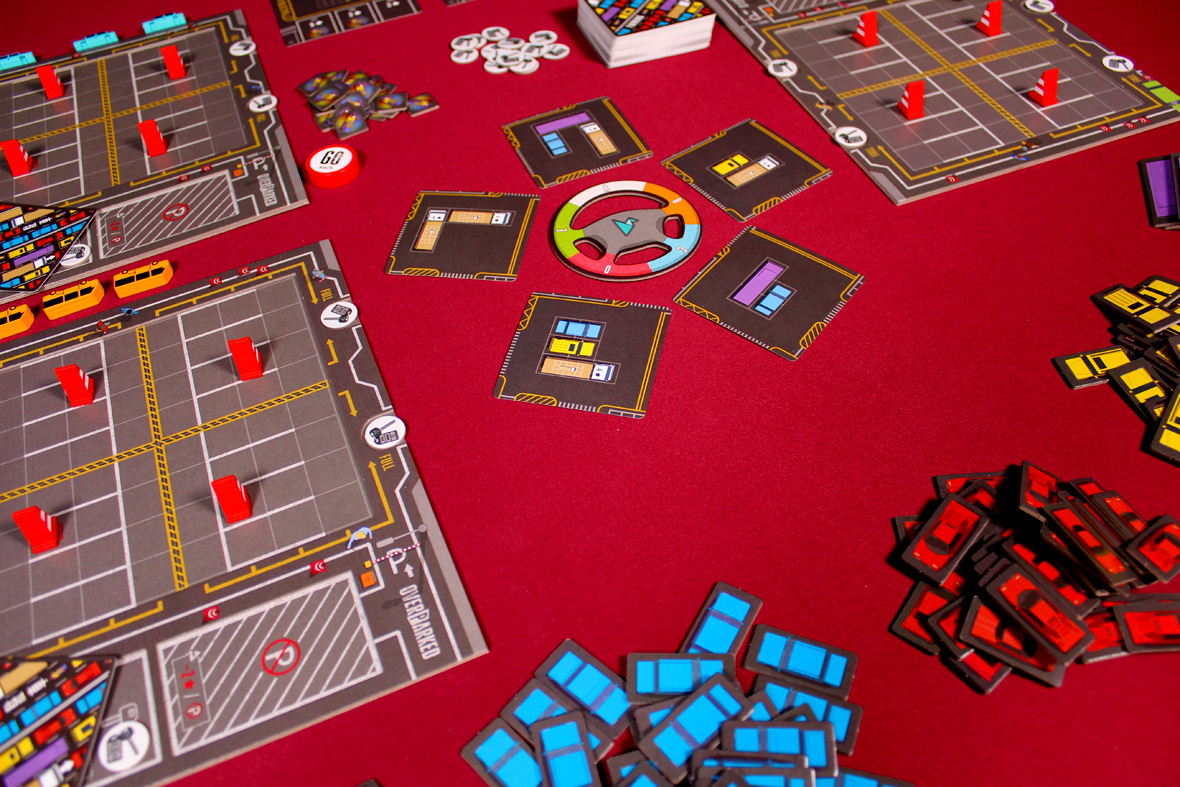
Set the Steering Wheel in the center of the playing area:

Shuffle up the Parking Cards, next, and give each player two. Then, deal five out: one to each of the five sections of the Steering Wheel. Players can look at the two in their hands, discard one, both, or neither, and draw back up to two.

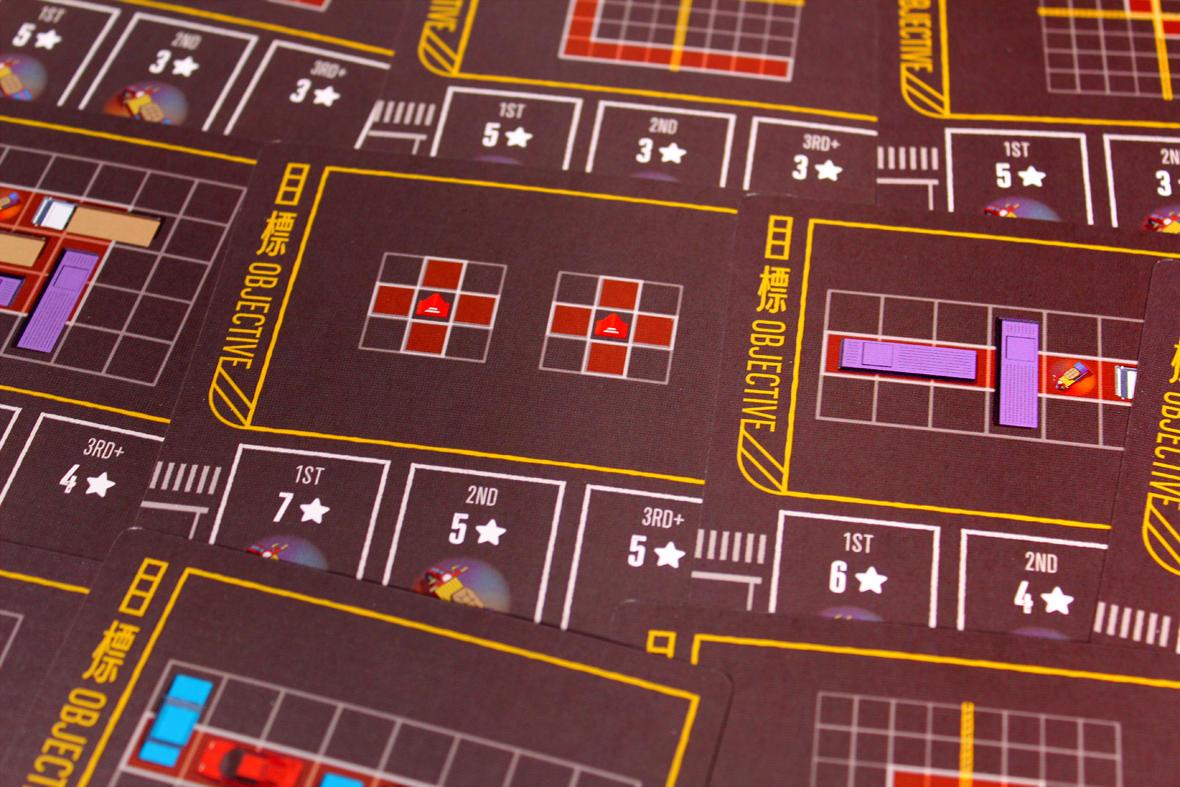
Next, shuffle up the Objective Cards; reveal three.
Give each player a Parking Lot Board as well.

Then, give them four Traffic Cones each, and choose one player to be the start player and give them the Start Player Token.

The Traffic Cones get placed on the red squares on the Parking Lot Boards. Give each player five Key Tokens and set the Motorbikes aside. Each player places four of their Keys in each slot on their player board, and one Key in the Key spot.

Each player gets three Objective Cars in the same color as their player board:

Set the other Vehicles nearby.

If you’re playing the standard game, use the standard Trucks; for the Advanced game, give each player a set of trucks in their color.

You should be ready to start!
Gameplay

Overparked! Your job is parking cars and taking names, and you’re all out of names. Thankfully, you have plenty of cars. So park ’em!
The game progresses until one player can’t fit any more cars. The start player turns the steering wheel until their color / letter is aligned with the Parking Card they want to take! Fortunately or unfortunately, all the other players get the Parking Cards aligned with their color / letter as well! Once you’ve taken a card, choose one of the three cards in your hand to play! Players can do this simultaneously. The important thing is that you must place all of the cars on the card; you can rotate them but not mirror them or anything like that

While playing, you can spend a key to move one of the cars on the card any number of spaces forwards or backwards, even off the board! If you do that, you don’t have to place it. There just has to be an unblocked way for that car to get off the board. To earn keys, you can either completely fill out a quadrant (cones count) or you can earn them from some Parking Cards.
As you play, you might play over traffic cones or be unable to place one or more of the vehicles on the card. When that happens, the traffic cone or the unplayable vehicles get placed in the No Parking Zone! They’ll be worth negative points later. You might also complete Objectives! When you do, place one of your Objective Cars on the rightmost open space on the Objective Card. If multiple players complete the same Objective in the same round, they both place on the same space; otherwise, only one car can be on an Objective Card space (save for the last space).

Beyond that, the game continues until one player doesn’t have an open 2×1 space to place a card, and then the game ends! You score points for the following:
- The largest contiguous group of vehicles of each color scores 1 point per space. Note that Motorcycles are every color, so you can continue multiple groups through them.
- Trucks score based on the standard game (completely surrounded for 4 points) or the advanced game (truck-specific objectives).
- -2 points for each item in your No Parking Zone.
- -1 point for each empty 1×1 space on your board.
You can use any remaining keys to cancel out penalties! Otherwise, that’s the game; the player with the most points wins!
Player Count Differences

What I think I like most about Overparked is not just that player count changes the game significantly but that player color choice matters a great deal, also. As you saw, the steering wheel has five color sections on it that do not change throughout the game. A is always as far from C as B is from E. This means that your relationship with other players during the draft phase is going to change as players pick different colors. Looking to saddle someone with a bad card? Well, it depends a lot on what player color they picked. You also get fewer explicit choices yourself as the player count increases, so the cards you get might feel more based on your luck (or the whims of your opponents) with more people. That’s a very different feeling at two players than five players. Also, while there’s always a race for Objectives, at two players no matter who completes it, you’re both getting motorcycles. At three+, that’s not necessarily true. You have to hustle to get in there before someone else does and takes what you have assumed is yours. It makes for a very dynamic, engaging game as you switch between player counts, so I don’t have a strong preference. Five is a lot for this game, but it still works; you’ll just need to keep playing after you run out of cards in the deck.
There’s also a solo mode! If you’re into that.
Strategy

- Use Motorbikes as junctions between colors; you can get a ton of points that way. They count as every color, not just a wild color, so if you have multiple zones of the same color connected by Motorbikes, you can use them towards your largest zone of one color.
- Don’t hoard keys; they’re worth the same to avoid a penalty as they are to get rid of one at the end of the game, but in the former case you might be able to place something else. They’re roughly equivalent (between moving a car away or cancelling a penalty), but using keys to move cars around so that you can more quickly fill up your board is a good idea, since then you also cancel out the 1×1 empty space penalty. The game is an optimization puzzle, after all.
- Objectives are super-high priority at higher player counts. At lower player counts, you’re almost certainly going to be able to get a few Motorbikes, whereas with more players, if you’re not careful, you might miss out on the early Objective Card spaces and get stuck with fewer points and no Motorbikes, which is the saddest outcome.
- There are a lot of different levers you can try to optimize for, so not everything is going to work out. In fact, trying to get everything to work out might end up making your life harder. This may mean that you miss some Objectives or some truck scoring requirements or you put some stuff in the No Parking Zone; that’s all fine. Don’t get locked into the idea that everything needs to happen all the time forever; you will inevitably have to prioritize.
- Filling out Quadrants should be a priority, since it lets you earn keys for free. Keys are pretty useful, after all, but there are also occasionally Objectives for that. I’d rank Objectives slightly higher than Quadrant completion, but hey, if you don’t have anything else to do, fill out those Quadrants!
- Watch out for leftover empty spaces! They’re worth -1 point for every empty space, so, you know, don’t just use keys to dump cars out of play or consistently take Parking Cards that don’t force you to place vehicles. They’re good in theory (and sometimes in practice), but you don’t want to keep playing them exclusively.
- If you’re playing the Advanced Mode, you’re likely not going to score all of your trucks. Acceptable losses are okay. You just have to prioritize what you can, as I mentioned elsewhere. Here, though, the trucks are pretty complicated to score completely while you’re worrying about big color groupings, Objectives, and general placement challenges, so sometimes it’s just a matter of getting a few high-value trucks and using the others to fill out spots.
Pros, Mehs, and Cons

Pros
- I really like the steering wheel draft method. It makes the draft pretty interesting since there’s weird relationships between who gets what cards, as opposed to a more standard draft. Means that you can get pretty different gameplay just by changing player colors!
- It’s nice that even taking penalties isn’t particularly bad in the short or long term. You can largely undo them before the end of the game if you collect enough keys or take certain Parking Cards. It lets you optimize a bit without worrying about taking a ton of penalties or anything.
- I also more generally like that the spatial puzzle isn’t too complex. Sure, there are cones in your way, sometimes, but it’s not like you can’t move them or just go around them in a fairly useful fashion.
- There’s just a lot to do for an otherwise simple game. Yes, you just play cards to get tiles to place on a grid, but I do think the drafting method, the Objectives, and the penalty management elevate the tile-laying to a more interesting point than I first expected.
- Giving players three cards in hand after the draft is great; it lets you store good / situational cards for later and lets you feel like you have choices even when you’re dealt a card. I actually think this is a place where Daryl Chow excels, personally; across all of his designs that I’ve played, there have been a number of spots where it’s clear that he knows how to make the player feel smart and empowered, which is a difficult needle to thread. Even here, when I get dealt an essentially random-or-worse card, I have other options from previous turns that I’ve been saving for a rainy day or a better board, so I can almost always do something useful. That’s a good experience for me, the player, and it speaks to the quality of the design.
Mehs
- There are a lot of pieces. It’s fine! I think I just haven’t played a lot of tile-laying games recently so I just got a little surprised.
- Okay, I was thrown off initially by the ludonarrative inconsistency of this being very-explicitly parking-themed but you just place the tiles wherever. I thought you’d have to have room to bring the cars in a la the Rush Hour game or something. I think Overparked is certainly inspired by it, but you just place the tiles like a standard tile-laying game. What helped me is remembering that valet parking people are geniuses when it comes to car organization and optimization, but my first game I was still a bit confused.
Cons
- The Objective Cards aren’t particularly intuitive, so I’m glad they have explanations in the booklet. The “Specific Fill Objectives” show an image that vaguely makes sense to me but definitely requires the explanation. I think part of it is that Cars and Buses are different despite comprising the four major color options of the game (as opposed to Trucks), so a Bus might block certain objectives despite not being a Truck itself.
Overall: 8.25 / 10

Yeah! Overall, Overparked is a nice iteration on the standard tile-laying game, adding thematic elements and a nice level of complexity that doesn’t compromise its approachability. I stand by what I have been saying, which is how much I respect Daryl Chow as a designer, and I think a lot of his skillset comes through in Overparked, even if it’s not my all-time favorite of his designs. Things like the Motorbikes being able to connect multiple groups of different colors or the interesting drafting method? Classic Daryl Chow. I do find some aspects of the game less intuitive, but that’s mostly because I think buses fall in a weird space where they’re not cars, but they still have a color associated with them (unlike trucks), so I end up getting confused as to their status whenever I play. Beyond that, though, Overparked is a solid light strategy game that reminds me of that Rush Hour traffic jam game, but with more strategy than puzzle. If you’re looking for some light strategy, you love parking cars, or you want to see some interesting takes on drafting and tile placement, I’d recommend checking Overparked out! I’ve had a great time playing it.
If you enjoyed this review and would like to support What’s Eric Playing? in the future, please check out my Patreon. Thanks for reading!
Discover more from What's Eric Playing?
Subscribe to get the latest posts sent to your email.