
Base price: $27.
2 – 5 players.
Play time: ~25 minutes.
BGG Link
Buy directly!
Logged plays: 4
Pacts | Inkwell | Scream Park
Corvids | Playthings
Full disclosure: A review copy of Here Lies was provided by DVC Games.
For as long as there have been mysteries, there have been people excited to solve them. This is not a serious intro; could you imagine? But in all seriousness, we’ve been playing a lot of mystery and deduction games on the site lately; it’s one of the reasons I built up the Puzzle & Mystery Games Hub for y’all, to better organize the games that end up there. And here we are with another exciting mystery to solve. Will I like it enough that it’ll end up on the hub? Only one way to find out! Unless you were directed here from the hub page itself, in which case you likely already know.
In Here Lies, players are members of an elite detective society, come to discuss their cases and the highlights and lowlights therein. Sherlock Holmes is also there, but mostly to be a pretentious jerk so that nobody gets sued again. I think it’s hilarious that someone tried to make the legal argument that Holmes can’t respect women for a little bit until those stories enter public domain, but that’s neither here nor there. Put the greatest minds of the age together to resolve old mysteries, ask questions, and inevitably arrive at the conclusion. Can you unravel each detective’s most interesting mystery?
Contents
Setup
Setup is fairly case-dependent, so you’ll want to have whichever player will be the Lead Investigator consult the Case Booklet first. You can set the Body Diagram in the center while they’re doing that:

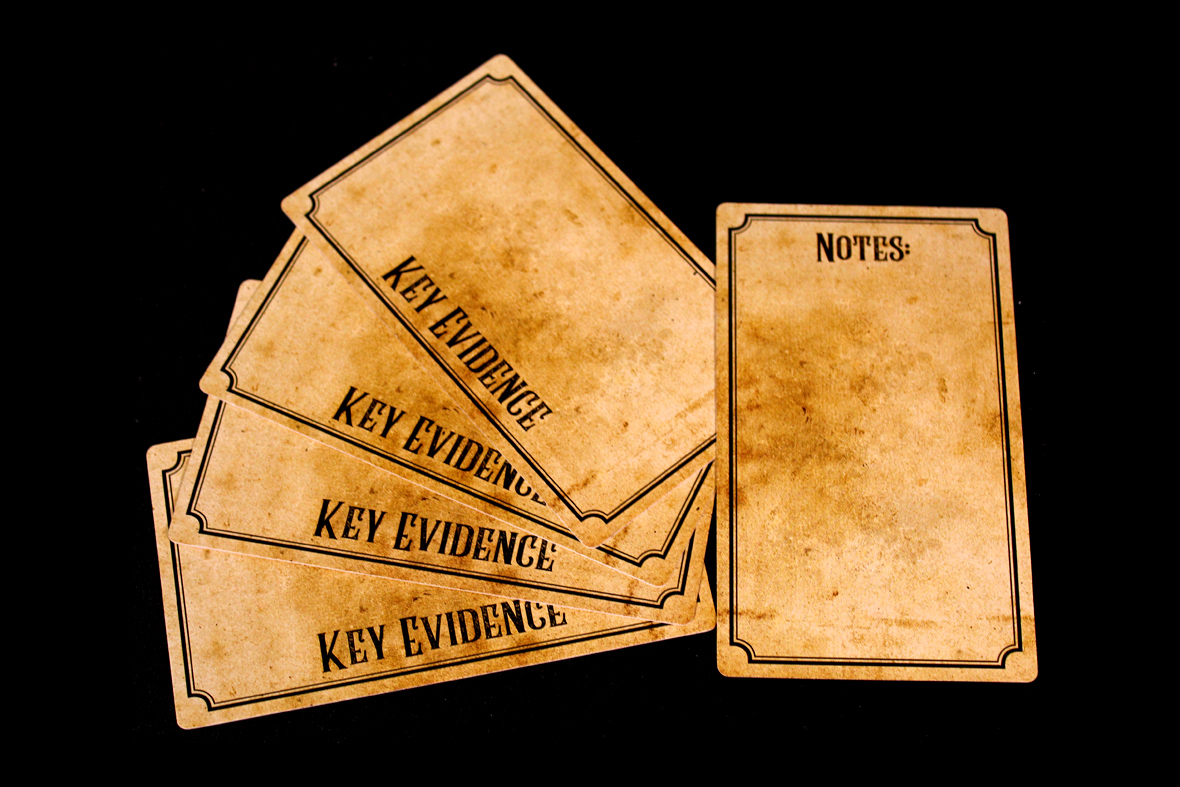
The Lead Investigator should get the Key Evidence Cards:
And once they’ve determined if they need to be a specific character, let the other players choose their characters as well:

The Lead Investigator uses the ability side, while the other Investigators do not. Each Investigator has their own set of Insight Cards, also; the Lead Investigator doesn’t need theirs.
Give the Lead Investigator the Confirmation Tokens:

Set the Time Tokens nearby:

And then set aside the smaller cards; some of them have the categories to be solved, some are Allies, and some are just blank.


The game will tell you which you need to care about, and you may have Allies coming over from previous games. Once that’s all set, you should be ready to start! Have the Lead Investigator read the lead-in for the case to the group and write their details on the Name and Year Card:

Get ready to solve a mystery!
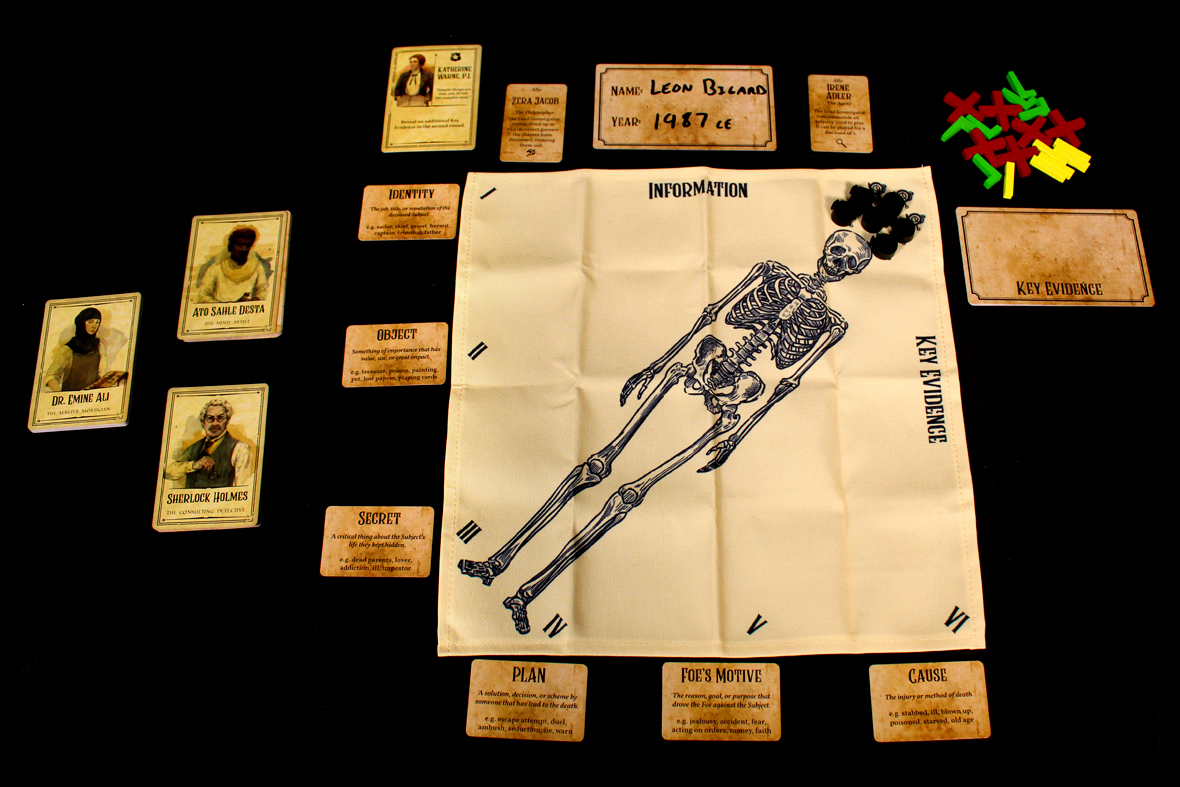
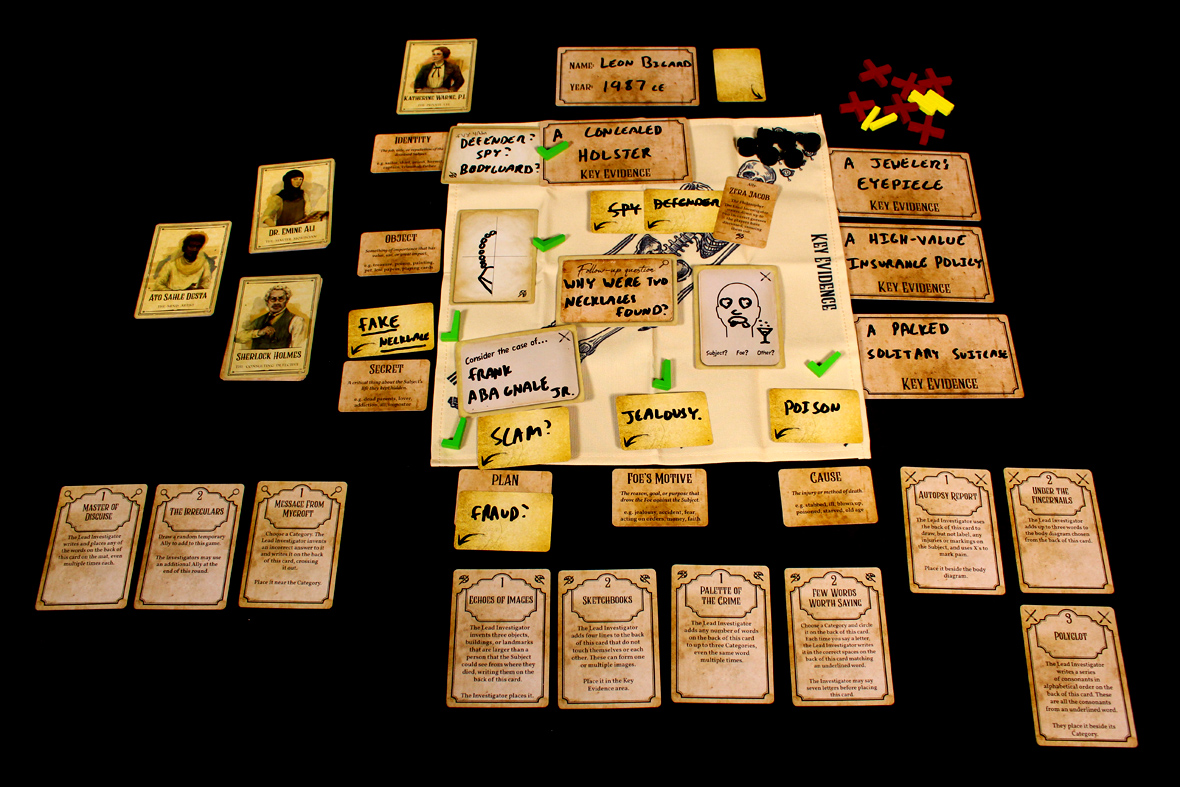
Editor’s Note: To avoid spoilers, the case used here is not a case that is in Here Lies, in case the year 1987 threw you off. This is a real (fake) case, though, and which case it is is revealed in Pros / Mehs / Cons. Thanks for reading!
Gameplay

Investigate! That’s the goal, anyways. The players are split between the Investigators and the Lead Investigator, and the Investigators want to solve the case! The Lead Investigator helps. Each player chooses one of the Investigators and then draws cards from their Insight Deck based on the player count:
- 2 players: Use two Investigators and Insight Decks, 6 cards each.
- 3 players: Draw four cards each.
- 4 players: Draw three cards each.
The Lead Investigator then provides a Key Evidence for the round.

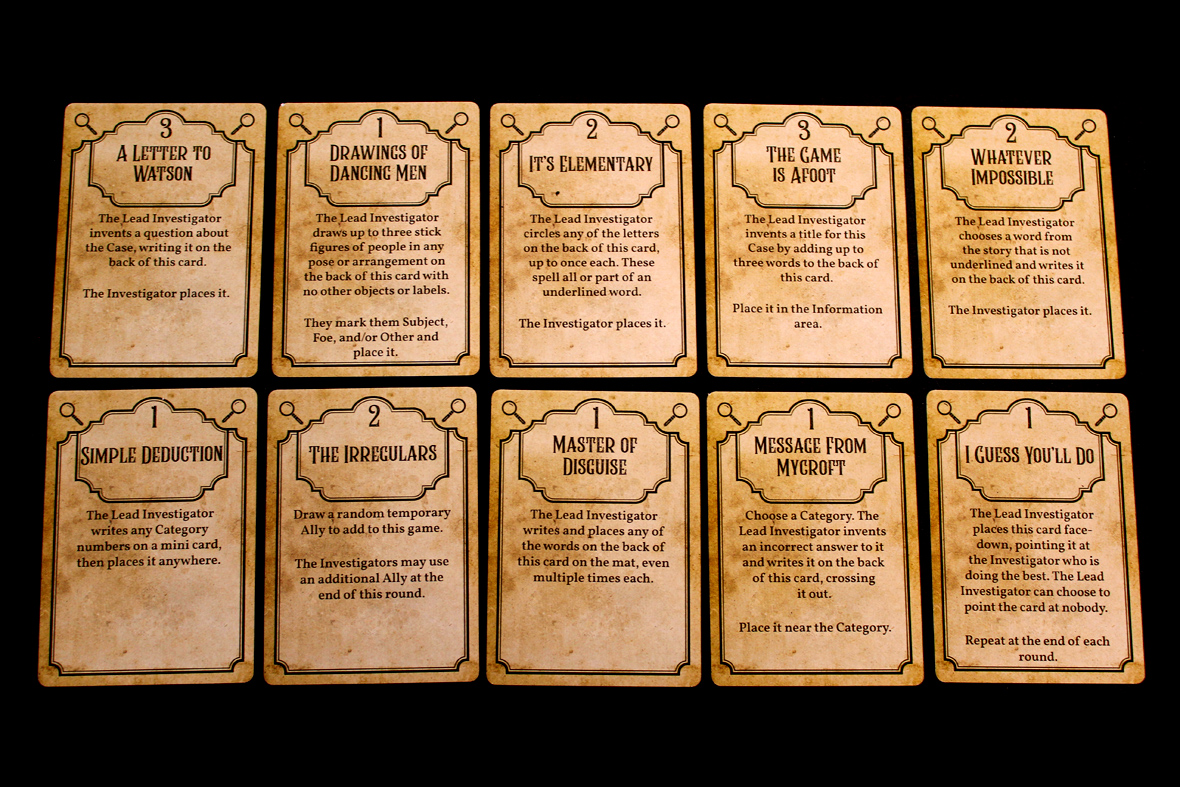
Each game takes place over a few rounds, dictated by the Case Book. There are no turns! All Investigators can act at any time, but their actions are limited by how much Time each round has. To spend Time, an Investigator can play one of their Insight Cards. These can be shown to other players or just played face-up so that everyone can decide what to do next. Insight Cards force the Lead Investigator to provide information, but usually in a weird way, like a drawing or a pose or just all the consonants from a word. Standard stuff. As you get clues, the Investigators (usually) will place them on the mat. Try to keep it organized! Note that the Lead Investigator can’t answer many questions, but they can clarify unclear parts about the game or ask to end discussion and play an Inquiry card. Generally, the Lead Investigator is the GM for the game, so if that’s you, just try to help make sure that the game is fun. This also means that the Lead Investigator is the final judge on what’s against the spirit of the game.

After all the Time Tokens have been spent, the Investigators can discuss the case a bit more and then move on to the Case Check Phase. This is where they can play an Ally (if they have any) and then get graded on their performance. Generally, for each category, the Lead Investigator will place one of the three tokens:
- Green Check: The correct answer has been said at any time, even once. Close enough also counts, to your judgment.
- Yellow Dash: The Investigators are headed in the right direction, but aren’t there yet. I also use this if they have veered away from the right answer and aren’t currently in the right part of town, even if they previously said the right answer.
- Red X: The players aren’t anywhere near the right answer, or they haven’t said anything for this category.
Once this happens, start a new round with new Key Evidence, and players can discard Insight Cards to the bottom of their deck and draw new ones to their hand limit.

Play continues until the end of the final round, in which a final pitch is made summarizing the case and providing one answer for each category. The Lead Investigator grades only that, giving 2 points for each Green Check, 1 point for each Yellow Dash, and 0 points for a Red X. A score of 10 is considered a win!
Note that if the players at any time say all six correct answers in order, the Investigators immediately win with a score of 12. So that’s pretty cool!
Player Count Differences

I think Here Lies gets easier as you add more players for one simple reason: not every Investigator is particularly suited to solving certain cases. With more players, you personally get to play fewer cards (on average), but you have access to more abilities, which can occasionally turn the tide of the case. The amount of time you get per round does not scale with player count, which is appropriate, since, well, you just have different cards to use, not more, per se. You do get a bit more coverage, as a result, but it can be a bummer if you don’t get to play your cards. Thankfully, you’re still there to talk the case and think through the deductions, so it’s still useful to have more people. I think Here Lies expands nicely, though I will say that two is extremely difficult, as you only have one Investigator playing two characters. With nobody to bounce ideas off of, you have to get lucky or be a deduction champion. Both are impressive, and I’d still recommend playing with two if you’re looking for a challenge. Otherwise, just play with more people; it’s fun no matter what.
Strategy

- The different Investigators have different strengths; lean into that. That may be relevant to the case, but also figuring out which Investigator you vibe with is going to help you figure out how to get the most out of the cards you’re being given.
- As Lead Investigator, your goal should be to determine what’s going to be the hardest to figure out and then help the Investigators get there. That may change round-to-round as well, but for instance, picking out a Key Evidence that’s related to a category they haven’t guessed yet is a helpful way to influence things. You’ll also want to think about how to answer questions in the best possible way to help them guess correctly.
- The game will explicitly tell you if you can provide underlined words as answers. It’s important to note that but also say that you shouldn’t try to tiptoe the line on that one. If the underlined word is CAR, you may decide to accept AUTOMOBILE or TRUCK as options, but you shouldn’t necessarily provide AUTOMOBILE as an answer if you’re told you can’t use underlined words. Make it fun for the Investigators.
- Certain cards are less helpful until you have more of the picture of what happened. An easy example is a card that lets the Lead Investigator move cards on the board around as they would like. That’s explicitly not helpful until there are at least, say, three cards on the mat. There are other examples, so try to determine what the best cards to start with are, as well.
- Before the next round starts, think about what cards you might want to discard; some are just not useful for particular cases. If a card seems like it won’t apply here, just dump it and get a new one; it’s not worth the headache.
- Think about the larger picture of the case; why might certain categories be present versus not? If you don’t see FOE’S MOTIVE, for instance, is it possible that there wasn’t a foe? How would that change how you approach the case?
- One thing you can do is vocalize theories; if you say all six of the correct category phrases in order, you instantly win. If you do that and don’t win, something must be wrong. Blah blah you could just say every possible phrase– that’s not even an interesting response to that. Of course I mean to use this sparingly and within reason so as to not annoy the Lead Investigator, but any response, even a “that’s not completely right” can be useful information. Just don’t try to game that system; it makes the game less fun if you play it like that.
Pros, Mehs, and Cons

Pros
- I’m fairly bored of Sherlock Holmes, conceptually, so I appreciate that there are a variety of other characters to choose from. He’s just been done to death, I think, and there are plenty of other characters around to solve crimes. I particularly like the diverse set of characters available, here.
- I appreciate that there’s a little bit of story that’s sometimes even relevant! I just like flavor text a lot; it’s a flaw of mine.
- The tutorial cases are a great way to get you started. It’s a great tutorial; truly. You start with fewer categories and shorter rounds so you can learn the flow of the game and how to solve cases before things get tricky.
- I really like that each character has their own way of solving the case, so you can approach things from many different angles. They have their own weaknesses, as well, which may make certain cases harder, but there are deduction, art, autopsy, and word-focused characters, among others, so you can really take on the character that appeals most to you.
- This is a pretty engaged deduction game! You’ll be doing a bunch of work no matter what role you take. The Lead Investigator does a lot more than other games I’ve seen, like Deception: Murder in Hong Kong or Mysterium. You’re essentially the only way that information gets given to the players, but you also have to color in a lot of the extra details that aren’t included in the story if they’re asked about!
- The campaign aspect of the game is interesting also. I like that you can get more allies and that the cases get harder, but I also just like the story and setting of essentially a book club for great mysteries. Seems fun to do.
- The instant-win aspect of the game is smart, but I also like how each round’s finale works. I like that players are forced to come up with a working theory, but if they’re already right, just let them win the game. No fuss or frills, just a “you’re correct; that’s the instant win condition”, and then you can play again.
- There’s a good amount of flexibility with what constitutes a valid answer, so you can cut your co-players some slack. The Lead Investigator decides what is right, so if you want to push your friends to make a distinction between ACCOMPLICE and FELLOW GANG MEMBER, you can. You also can attempt to make that distinction and then still give them full credit for doing their best. That’s half of the fun of this game.
- I really like how portable the various DVC Games are, as well. It’s such a fun little box size; perfect for a library.
- This seems like a really good format for just cooperative mysteries in general; I wonder if you could license it in a fun way? For instance, as I mention elsewhere, the photos in this review are specifically a case based on The Corpse Flew First Class, a fantastic episode of Murder, She Wrote. That way there are no spoilers. I’d play a Psych Here Lies or Murder, She Wrote Here Lies or Scooby Doo Here Lies. Feels like a gold mine, particularly that last one.
Mehs
- The original mat is frustrating, as it likely needs to be ironed or something to actually lie flat. Thankfully, in newer editions of the game they’re using a nicer upgraded mat, so, that’s more of a me problem than a y’all problem. Downgraded it to a Meh, as a result, since it won’t affect your game.
- I’m very bad at drawing and should be allowed to refuse drawing tasks sometimes. I’m just not good at it and it’s not helpful when I draw. Though I did have some success with actually looking at the image I wanted to draw while I was drawing it. I just wish there were alternate-but-still-helpful tasks for those of us who lack artistic anything.
Cons
- There’s at least one charades task that I will refuse if I’m ever the Lead Investigator again. I don’t like charades! I had a really bad experience a decade ago or something where I was trapped in a three-hour game of charades against my will. Turns out, as I think I mentioned elsewhere, they “don’t believe you can guess on the other team’s turn” and don’t like it when you exclusively guess “camel”. I digress, but, it’s not my favorite way to engage with a game.
- Having a ton of dry-erase cards comes with its own problems. One is obviously that erasing all the cards at the end of the game is a pain, yes, but the other is that if you fail to erase them well, they’ll stick together. This can make you worry you’ve lost cards and that you’ll have to make an excuse in your review for why you only have nine of the ten ally cards, only to find it at the last possible second. That happened to a friend of mine, probably.
Overall: 9.25 / 10
I was told when I was first getting into Here Lies that it shares some of Rosetta‘s DNA, and that’s very clear from the get-go. But I didn’t expect that it would take that initial shared DNA and run in a completely different (and genuinely fun) direction. Here Lies ends up sitting somewhere between several of my favorite deduction games, like Deception: Murder in Hong Kong and Mysterium, as one player with all the information desperately tries to pass that information along to other players, only to watch helplessly as they glean the wrong conclusions from it. The players, on the other hand, just have to try and figure out how “soot” is relevant to a hot air balloon or what any of that has to do with a letter from the Queen. It’s great. It’s inspired. It’s essentially improv. I think it’s incredible that the different detectives each have their own particular playstyle and that can sometimes be very good or extremely bad for the case you’re trying to solve. There’s just a lot to like, here. I was initially worried as the campaign runs out after 25 cases, but honestly, I think if you’re looking for some creative writing exercises, I wouldn’t be shocked if they either released a guide for writing. your own or had a competition for some new cases to create a player-submitted pack. Seems like a fun pursuit in time. Sometimes the game can be frustrating in humorous ways, as some of the interaction mechanisms are drawing-based or charades-based, and if your Lead Investigator doesn’t like that kind of thing or doesn’t do well with it, you’re going to have problems. Not all of the Inquiry Cards are that way, though. Here Lies has a ton of potential, and I think it’s a remarkably neat implementation of a mystery-solving game that has that deduction element, but forces you to get there in weird and quirky ways. Exactly what I’ve come to expect and love about DVC Games, and especially given how portable Here Lies is, it’s going to be a game that comes with me a lot of places. If you’re looking for the next neat mystery game, you want to dive into an exciting campaign, or you just want to draw the silliest death mask possible, Here Lies is a lot of fun and has a lot of heart, and I’d definitely recommend checking it out!
Looking for your next great mystery to solve? Check out my Puzzle and Mystery Games Hub for more great recommendations!
If you enjoyed this review and would like to support What’s Eric Playing? in the future, please check out my Patreon. Thanks for reading!
Discover more from What's Eric Playing?
Subscribe to get the latest posts sent to your email.