Base price: $15.
1 player.
Play time: ~15 minutes.
BGG Link
Check it out on Kickstarter!
Logged plays: 3
Full disclosure: A preview copy of The Cursed Cat was provided by Button Shy. Some art, gameplay, or other aspects of the game may change between this preview and the fulfillment of the Kickstarter, should it fund, as this is a preview of a currently unreleased game.
I truly thought I had written more of this before I started watching X-Men ’97 with a friend. She has never seen it before, so, you know, that’s important stuff. Then I looked at two empty reviews (and more to come since I’m out of town for Gen Con) and realized that I need to write as soon as possible. So here we are. Button Shy is back with four brand-new games for the summer! Very very exciting stuff, so, I’ll be digging into two of them over the next two weeks. First up is The Cursed Cat, the latest in the Simply Solo series! Let’s check it out.
In The Cursed Cat, well, you have a cat, and you love them, but they have maybe made your life a bit more difficult today. Specifically, it’s made a mess of your lab and summoned some nightmarish monsters to it, and you need to clean them out and get things sorted. If you can just get them all to the portal, you can probably cast them out with a spell and make it work. So gather your spellbook and make sure the cat doesn’t cause any more problems before you can clear out your working space. Can you get your lab cleaned up in time?
Contents
Setup
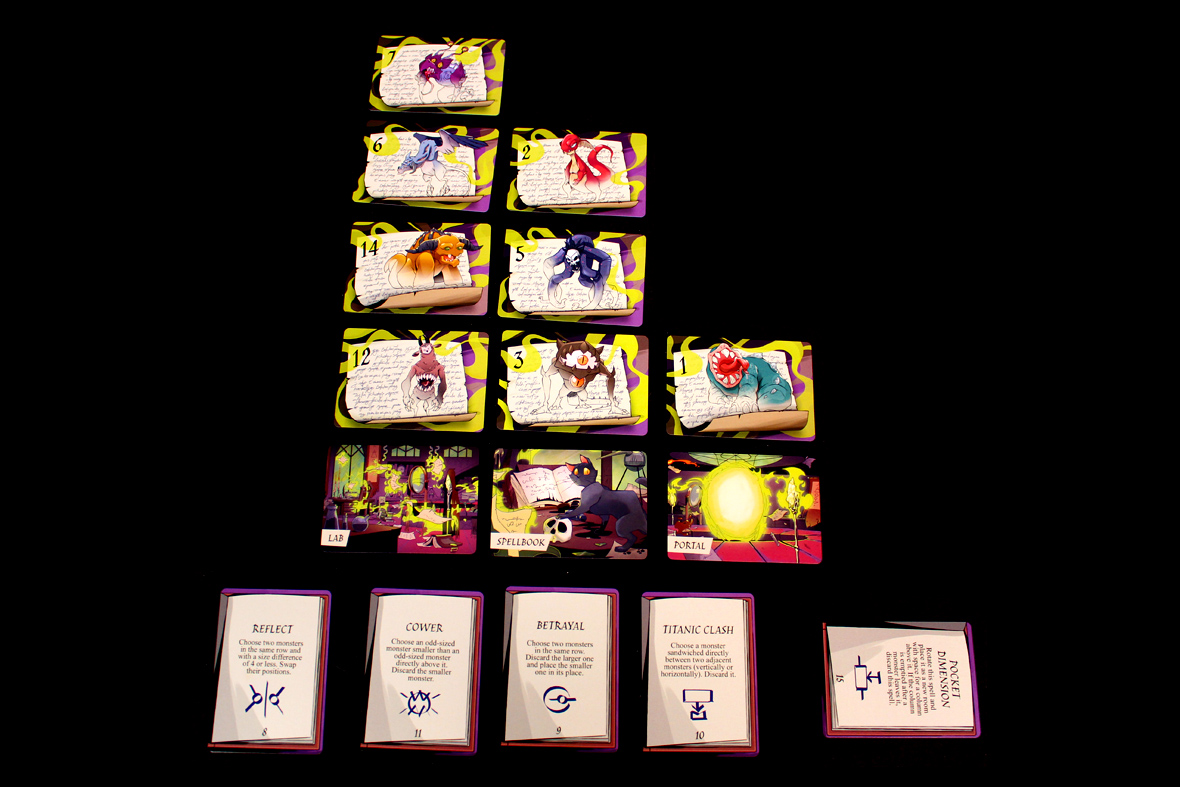
This one’s quick to set up, which is always good. Place your room cards in order, with Lab on the left and Portal on the right:

Shuffle up the Spell / Monster Cards, spell-side up:

Place three face-up to make a Spell Row, then deal out rows, left to right, of Monster Cards. Based on your difficulty, you’ll use different amounts of monsters in each location. Place each subsequent monster in a room above the previous one already placed there.

- Easy: 4 Monsters in the Lab, 2 in the Spellbook, 1 in the Portal.
- Medium: 4 Monsters in the Lab, 3 in the Spellbook, 1 in the Portal.
- Hard: 5 Monsters in the Lab, 3 in the Spellbook, 1 in the Portal.
Sort each row in descending order, so the lowest-value card is the rightmost one. Don’t mess with the columns. Finally, on Easy, discard two cards from the deck; on Medium, discard one card; and on Hard, don’t discard any. You’re ready to start!
Gameplay

Let’s get into it. Your goal is simple: get all the monsters either into the Portal or discarded from play before you run out of spells! You’re a mage; you’re not doing things with your hands. That’s a sucker’s game.
Each turn starts with relocation. As long as your spell in the previous turn didn’t fail, you can relocate up to two monsters. A monster can be relocated if it is the top monster of its column and you’re relocating it onto either an empty column or a monster with a higher number. That’s the Size Rule!
Once you’ve relocated (or not), you must cast a Spell. This can be one of the three cards in your Spell Row or the top card of the Spell Deck, but beware; cards in your Spell Row do not get refilled. Once they’re gone, they’re gone. If you can’t fully complete the effects of a Spell Card, it fails and you only get one relocation next turn. Alas. Either way, discard the used spell.

If you run out of spell cards and your turn ends, you lose! If you get all the Monsters in play (that aren’t discarded) onto the Portal, you banish them and win the game!
Player Count Differences

None! Solo game.
Strategy

- It’s not not Towers of Hanoi. I mean, it’s pretty explicitly Towers of Hanoi, but you want one big tower on the right. It’s interesting! Keep in mind that sometimes that means to move something from one column to another, you might have to work backwards. Or you normally would, but the spells are kind of designed to help you shortcut that.
- You have to attempt a spell every turn, and if one fails, you only get one relocation. This means that you may have to cast a spell when you don’t want to, and that might make you move backwards. Instead of getting to that point, think during your relocation step on how to move monsters and set the board up so that the spell helps you rather than hindering you.
- Casting from the Spell Deck is better long-term. If you cast from the Spell Row, you lose that option in the future and have fewer spells to choose from. That said, if you need that specific spell, cast it. Better to use it than lose it.
- The spells are going to force you to think in a different way. You may wonder why discarding a large number is a good idea; after all, you need large numbers to place monsters on. But instead of thinking about it as discarding a large number, think about it as removing a number that’s too high from play. It can’t go on anything, so it needs to go. You can figure out how to move your other numbers around later.
- The top card of a column is important. That’s the only monster you can move on a given turn, so try to make sure they are movable.
- Relocation shouldn’t just be moving monsters to the Portal. You might move monsters so that they’re in a more useful orientation for a particular Spell you’re thinking about casting. That’s worth prioritizing, for sure, since you have to cast a Spell every turn. Think ahead!
- A number of Spells target cards with other cards above or below them. Single-card columns aren’t necessarily going to be the most helpful, as a result. Like I said, try to set yourself up so that you can use a spell effectively. Just getting monsters to the Portal might not be enough.
Pros, Mehs, and Cons

Pros
- How has Scott Almes made eleven of these? Absolutely nuts, but I’m here for it. The other Simply Solos are in the big box below, but this guy has time to do this, the Tiny Epic games, and whatever else he’s working on? He’s gunning for Knizia.
- I like the Monsters! They’re weird little guys. Weird little guys are my favorite in games. They always have so much going on and they’re visually very great. Who did the art? Oh! The same Andrea Ivetic Vicai from A Nice Cuppa? Nice.
- The spatial puzzle of this is very satisfying. I don’t love games that are just iterations on nim, but an iteration on Towers of Hanoi is interesting and it really works well here! It’s tricky since you can’t place monsters on top of smaller ones and you have to try to use a spell, which may not do what you want!
- I also really like the spells? They take some getting used to but their utility is great once you figure out how to actually move monsters around.
- Very easy to pick up and play. I really like Almes’s Simply Solo games for that; they’re neat, intricate enough, and quick.
- It does seem like it would be fun to have alternate spell options that you could sub in or out to make your own custom spellbook. If the cards are numbered, the mind immediately wanders to that conclusion, I think? Or maybe I played too much Lost Legacy.
Mehs
- Is a Spellbook a room? That feels weird, but I’m not particularly burdened by it. Seems like not my horse, not my monkeys, et cetera.
Cons
- I understand it’s called The Cursed Cat, but the cat not featuring in gameplay at all feels like a misdirection. I just kind of assumed there was going to be more cat-related action. The expansion implies that might be the case, but, I feel taken for a ride as a noted cat fan. Let the cat do some crime!
Overall: 8.5 / 10
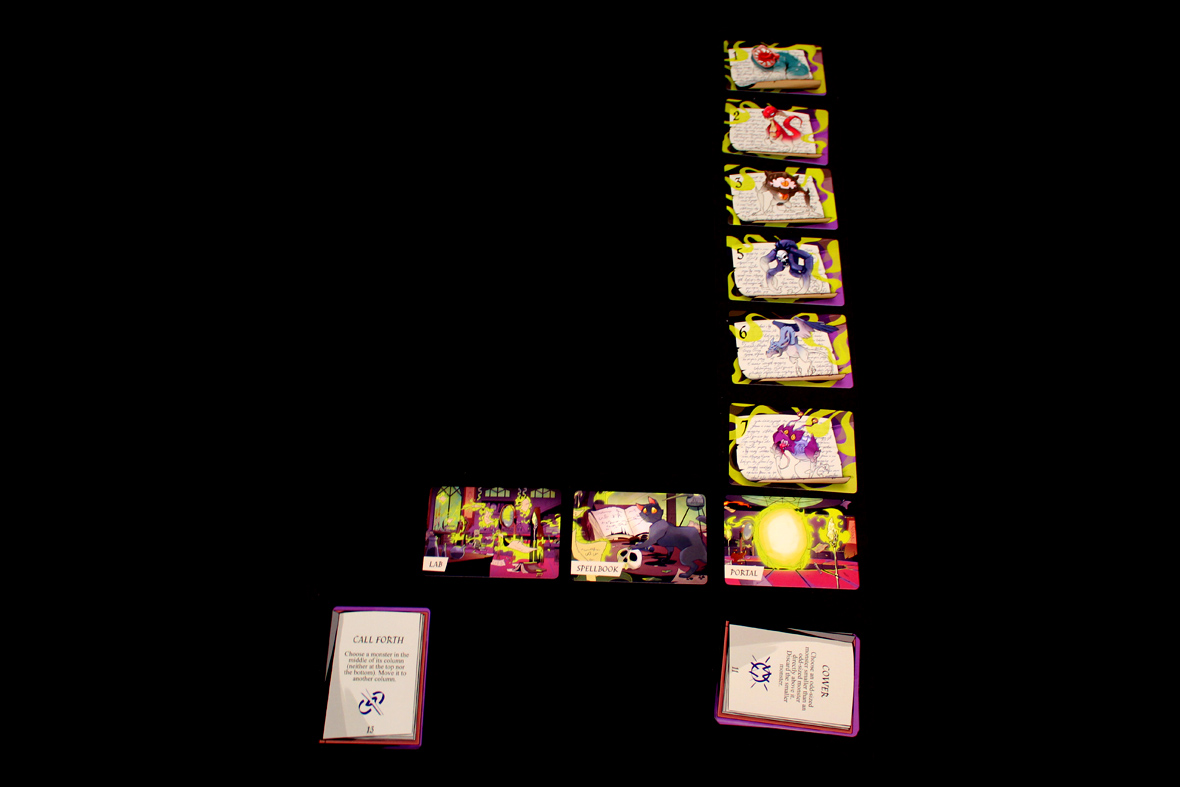
If a solo game makes me feel smart while I’m playing it, I’m probably going to like it. The Simply Solo line does that in spades, I’ve found, so I feel like that series is made just for me, and The Cursed Cat is no exception. My gripes with the name aside, The Cursed Cat is a nifty spin on the Towers of Hanoi that’s all about spatial reasoning and magical shortcuts to make one giant tower on the portal that you can kick out. That means that play is quick, punchy, and colorful. The spells are interesting, and having them on the back of the Monster Cards means that you get a pretty different experience each time you play. No point in becoming reliant on a specific spell; you can’t be sure if you’ll see it again in subsequent plays. The game takes a little bit of time to figure out, as a result, since you’re learning about movement rules and how spells can help or hinder, and that makes some of the spells feel unintuitive. What I really like about The Cursed Cat is that that’s the whole point. The spells should feel unintuitive because they’re supposed to get you to think about the game in a different way, and once you align how you think with what the game’s presenting, it’s a lot of fun. That change of perspective is a really interesting demand of the player, and The Cursed Cat makes it worth it. I think this is going to be a solo puzzler that I come back to a few times (especially while I’m in transit to Gen Con) and Button Shy continues to impress. If you’re morbidly curious about how one man can create eleven different 18-card solo games, you enjoy magical shenanigans, or you just like a spatial puzzle, The Cursed Cat is a great choice! I’m looking forward to my next play.
Looking for your next great wallet game? Find a good one on my Small Box and Wallet Games Hub!
If you enjoyed this review and would like to support What’s Eric Playing? in the future, please check out my Patreon. Thanks for reading!
Discover more from What's Eric Playing?
Subscribe to get the latest posts sent to your email.