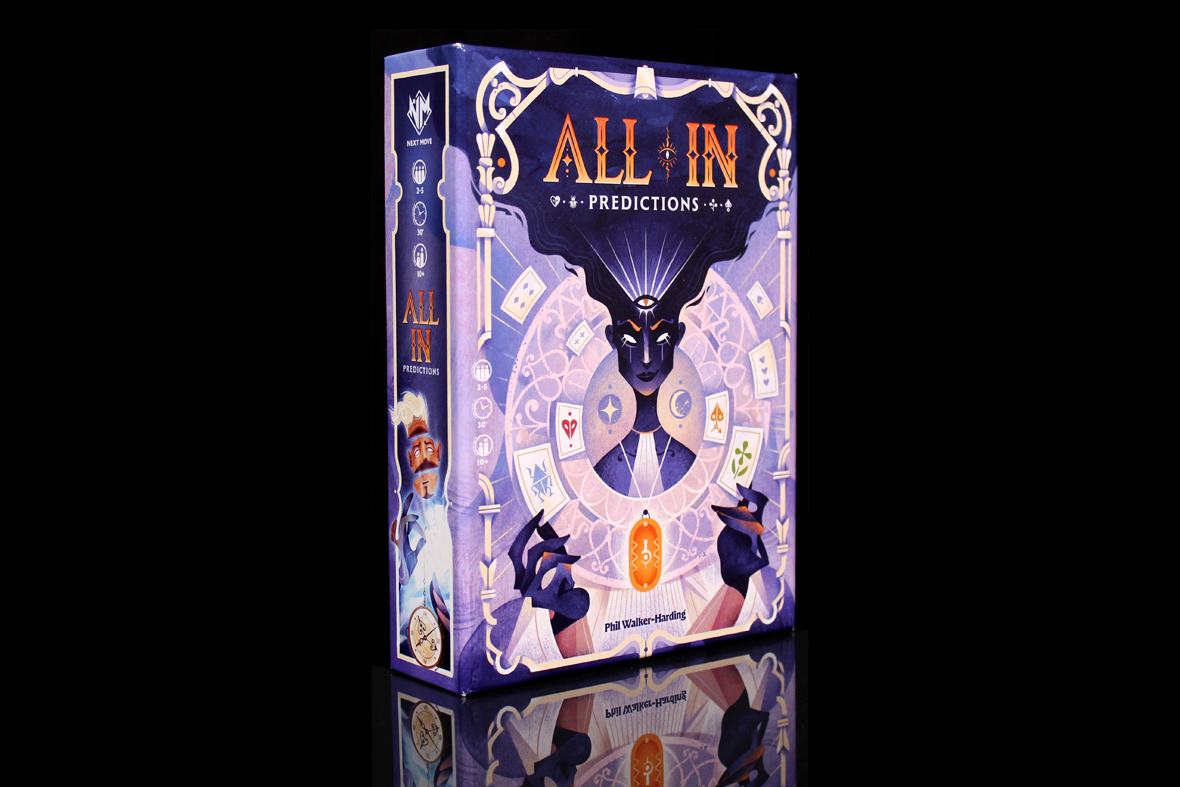
Base price: $22.
2 – 5 players.
Play time: ~25 minutes.
BGG Link
Buy on Amazon (via What’s Eric Playing?)
Logged plays: 5
Full disclosure: A review copy of All In: Predictions was provided by Asmodee.
I already complained about Daylight Savings Time in my other review for this week, so I don’t have much else to lead in on this time. I suppose there’s a new (old) Zelda coming out this week? So there’s that at least, but I have to be responsible and do all of my actual chores and tasks before then, including at least another full set of reviews. But that’s a lot of cart-before-the-horse since I haven’t even finished writing these yet. Let’s get to it with All In: Predictions!
In All In: Predictions, players use the powers of the Foretellers to just absolutely cheat at cards, which is probably what they had in mind when they granted you use of their abilities. Or maybe they gave you their abilities because they knew they were going to help you win card games with them? Very Yu-Gi-Oh of them, but I also imagine it’s a pain in the ass being able to see the future and see yourself doing something either very silly or very pointless. Very much a temporal inevitability at that point. But if everyone can see the future, do you already know who’s going to win?
Contents
Setup
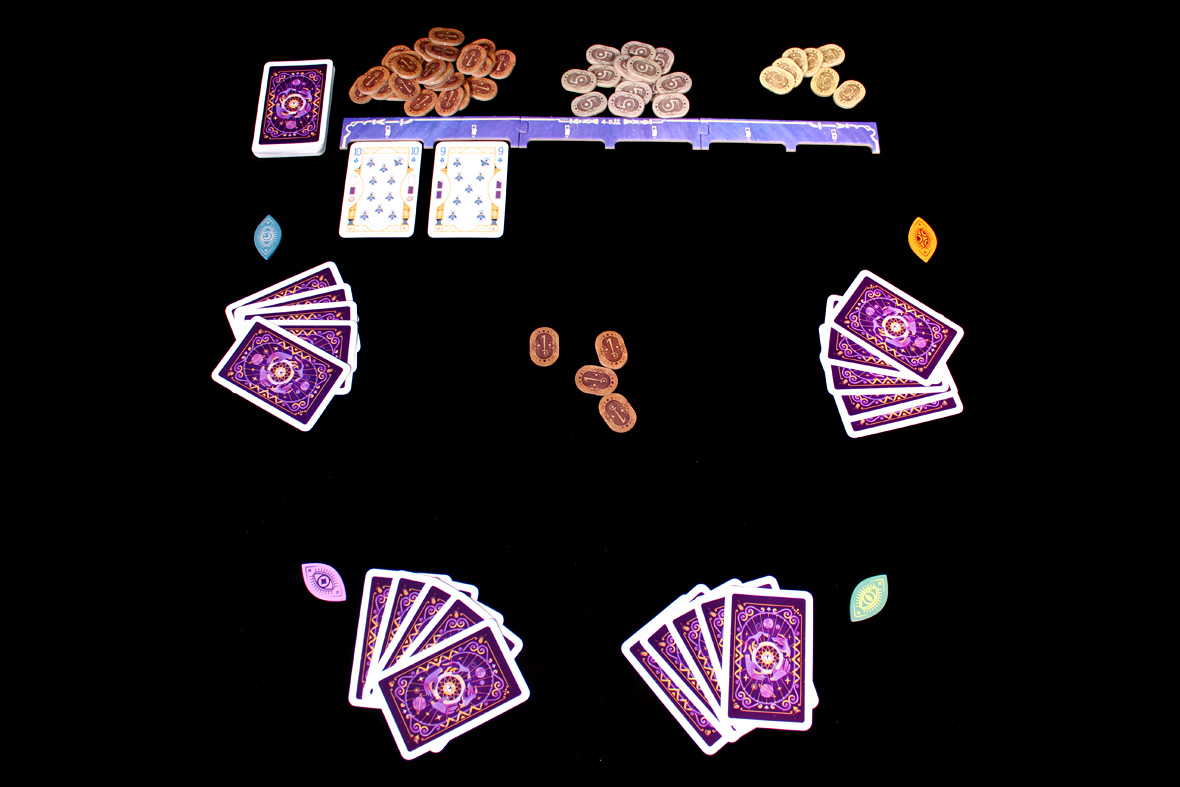
Not too tough. Shuffle the cards; each player gets five:

Each player gets a Prediction Token:
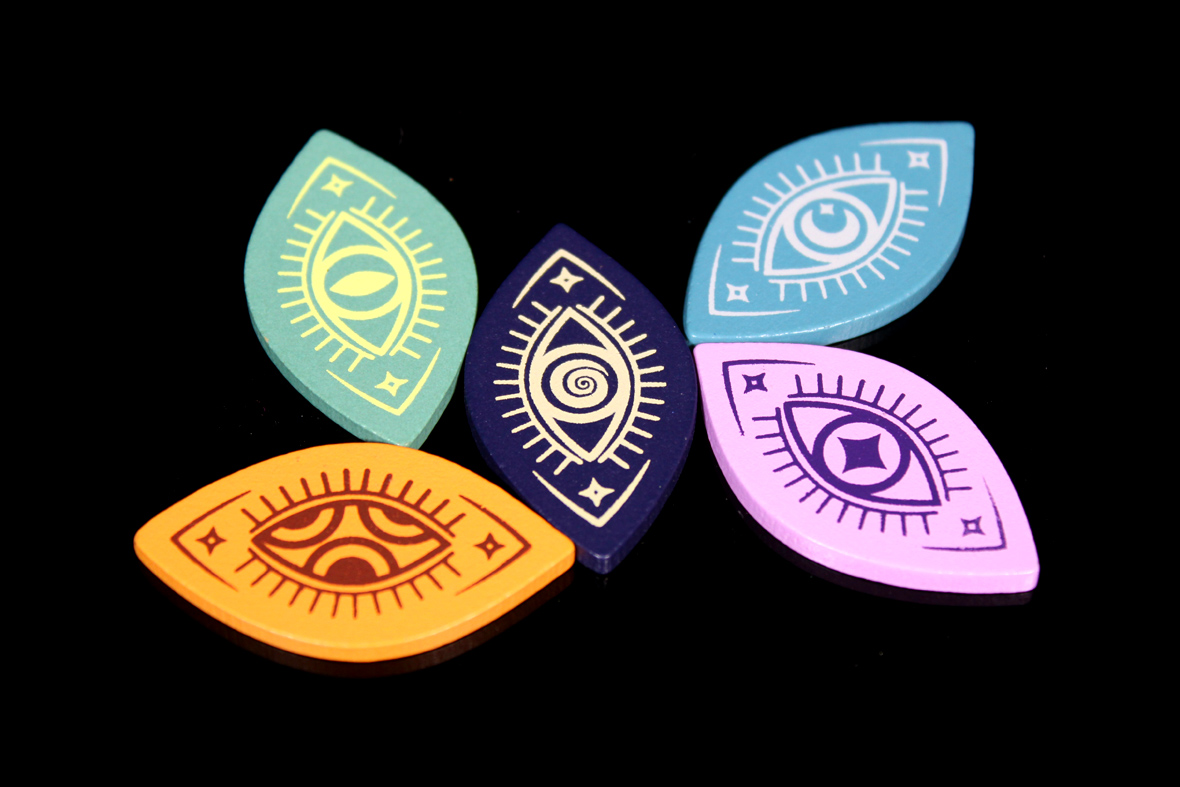
Assemble the Frame for your specific player count:

Place two cards face-up in the display on the leftmost side. Then, set four runes into the center to form the pot:

You’re all good to start!
Gameplay

All In: Predictions is played over three rounds, as players try to assemble the best hand of cards and predict the winner!
On your turn, you can play a card, pass, or go All In if you’re the first player to do so that round.
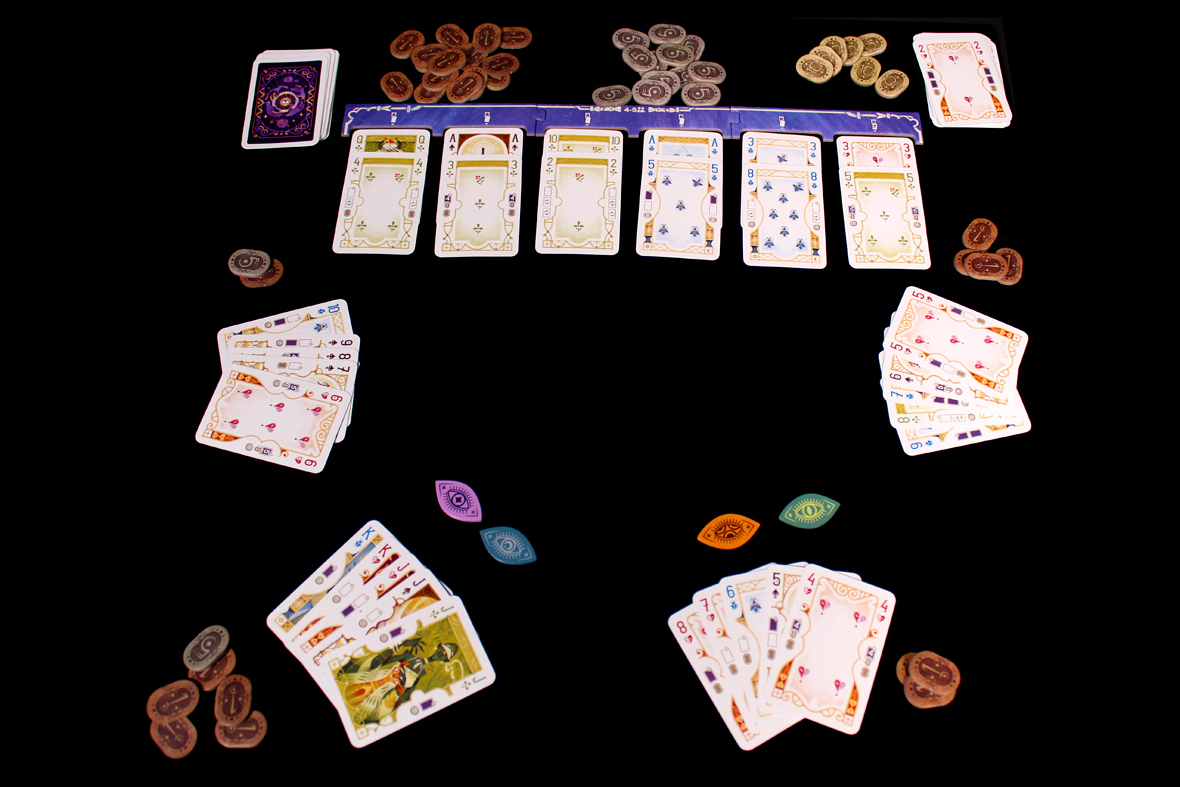
If you play a card, execute all the required abilities on the card and then add the card to the display. Place the card in the leftmost available empty spot. If they’re all full, then add to the second row, again, leftmost first. There won’t be a third row. Cards behind other cards are blocked! You can’t have them until you remove the frontmost card first.

If you pass, add the top card of the deck to the display; that’s it for your turn. You can take your next turn normally.
If you go All In, you’re done for the round. You add two cards to the display and on each subsequent turn you Pass. The nice thing about going All In is that only one player can do it each round and the player who went All In can’t be targeted by effects that force them to reveal cards from their hand or the strength of their hand.
Once the display is full, it’s time to move on to the Prediction Phase! In player order, each player places their prediction token in front of the player that they believe has the strongest hand. Then everyone reveals! The players who guessed correctly split the pot evenly. Players then also gain runes based on the strength of their hand, so that’s nice.

Set up for the next round by using two more runes for the pot than the previous one. The player who has the worst hand starts the next round. The player with the most runes at the end of three rounds wins!
Player Count Differences

More players introduces more risk! Mostly there are more players pulling from the same deck, so there’s more spread of cards that you might not have accounted for. There are also more players that might pass you in terms of having a better hand, so you’ll need to pay more attention to who’s taking what so you know what’s not going to be available for you. At two players, the game is interesting because you have to predict the best hand simultaneously. You put your token in your hand and you put both hands in front of you, then open simultaneously. Reveal your token to pick yourself and reveal the empty hand to pick your opponent. It’s interesting!
Strategy

- Don’t just go All In straight out the gate unless you’ve got a very good hand. You can always spend a few turns trying to make your hand better to get even more runes if you wait a bit, or another player might go All In and take some of the heat off of you. Ideally, you’d predict yourself correctly and alone so you maximize the number of runes you get.
- Having a backup option is good, but ideally you’d end up with a high-scoring hand as frequently as possible. I usually keep a pair or two in my hand until I can make something better (a flush or a straight or a full house) so that I don’t end up with nothing after a round.
- Predictions go in turn order, so keep an eye on who’s doing what before you. Everyone gets fairly similar information during the round, but if you see a player who had to tell everyone they had one pair suddenly predict that they have the best hand, well, now that’s interesting. They could be trying to throw you off, but after several games I haven’t found a single strategic reason why someone would do that.
- You can try to keep track of who draws and takes what, but you’re more likely than not going to give yourself a combinatorical headache. There’s just a lot of potential hands and a lot of cards that can do a lot of things in a lot of contexts. Now, if you see someone taking two 9s or multiple cards of the same color, that’s likely cause for concern. One card on its own does not a pattern make.
- Try to take cards that advance your goals. Yes, that’s obvious, but I don’t just mean taking cards that you need for certain hands; I mean determining whether or not the display cards are going to be useful to you and taking cards that either let you draw from the display or from the deck depending on the display’s relative quality. If there’s something you want, then get cards that let you draw from the display multiple times and get rid of cards that force you to take from the deck instead, and vice versa in the opposite situation. You don’t want to get stuck with the perfect card being unobtainable when it’s right there.
- Don’t split your focus. Trying to hedge your bets here usually goes poorly if you’re, say, trying to build a straight and a flush at the same time (but not a straight flush, strangely). Just lock in.
Pros, Mehs, and Cons

Pros
- I particularly like that predicting who has the best hand isn’t necessarily the biggest part of the game. It means that you can make progress on two axes: you can either be really good at predictions or you can try to make the best hand. Ideally, to win, you’ll want to do pretty well with both, but at least you have two things to work on.
- I also think it’s nice that you have to split the pot with anyone who predicted correctly, if you predicted correctly. It disincentivizes playing super obviously and telegraphing the quality of your hand. It also makes it connect nicely back to poker. If you obviously have the best hand, folks will just fold instead of calling and adding more to the pot, and this works similarly.
- The art style is very nice, though I wish more of the cards leaned into that art. The standard playing cards are nice, but they’re also standard playing cards with just stylized suits. The face cards are particularly striking.
- The various card abilities are fun. Getting to see a subset of someone’s hand or forcing them to tell everyone what their best hand is right now is a lot of fun. I wish there were more abilities that had some kind of interactive element, though.
- It’s kind of interesting to essentially be playing a variant of poker on a timer. You play until there are two cards in each spot on the display, so it’s not quite ten turns per round. Planning and executing are a big part of it, rather than bluffing or misdirection as is usually the case for poker.
- It’s interesting that the predictions go in turn order. That adds an element of positioning to play, which is also a fun thing. If someone in front of you makes a weird prediction based on the information you have, do they know something you don’t? Or do they specifically not know something you do? When I play it’s more commonly the latter, unfortunately.
- I also like the alternate poker scoring rules. I think the A side scoring preserves the original poker hierarchy, but given you can essentially dig through a deck of cards for what you want in All In: Predictions, they changed the weighting for the Side B scoring. On Side B, straights and full houses are swapped, so straights are worth more.
Mehs
- The runes aren’t super ludonarratively connected to the game, but I suppose that’s par for the course here. Like, why is it poker, why are there runes? It doesn’t really matter but it does end up feeling disjointed. The theme just ends up feeling … there.
Cons
- It feels like it’s missing something. I’m not sure entirely what, but whenever I play, I end up wondering if there’s a rule I missed or a feature that we left out each round. I think some of the card abilities are fun, like forcing players to state their best hand or show you cards so that you can kind of predict what they’re planning, but even then, I’d like more interaction and flashier abilities.
Overall: 6 / 10
You know? All In: Predictions is fine. I’ve played it a bunch with friends online and haven’t had any complaints (which is not the case for every game I’ve played online lately), but I think of the prediction-themed games and poker-driven games I’ve played this year, it’s probably on the weaker end. Not because it’s bad or has some significant issue; it just doesn’t particularly distinguish itself as a “must-play”. I think what caught my eye initially was its similarity in general vibe to Omens, a game that I both thoroughly enjoy and will likely place on my top games of the year list. On the poker side, I’ve been playing a lot of The Gang: Deluxe Edition, so that’s also been covering that base.
That said, it’s not like the game hurt me to play or anything; it just wasn’t a standout for me in the way that I usually like. It’s still got great art (love the purple box, as well) and some interesting abilities; I particularly like how most of the game is focused on manipulating your hand and the deck to get the ideal hand, but it has to balance that against the randomness of, say, sometimes just getting dealt a pretty solidly winning hand from the jump. That happens in poker, too, but a lot of poker is more around betting and deception than it is specifically trying to play cards to get better ones. You go through all that and you don’t end up getting to play much that round and it feels a little pointless. The odds are low, but I’ve had at least a few rounds where I’m only a turn or two from All In and then you just … watch the round and hope nobody does better than you did.
I do think there are some particularly smart elements of the design (unsurprising, given the designer is Phil Walker-Harding): I love that players are still rewarded for the quality of their hand, so there’s some incentive to stay in and keep building before time runs out, and I like that the pot splits between all correct players. So you may not even want to go All In early or make a big show of your hand at higher player counts. Sure, you’ll get some money for winning and having a good hand, but if everyone knows you have the best hand you’re missing out. Some interesting design choices and great art aren’t enough for All In to beat out other poker or prediction games I already have, unfortunately, but if a less bluffing-oriented poker appeals to you or you’re just a huge fan of the genre, you might enjoy it more!
If you enjoyed this review and would like to support What’s Eric Playing? in the future, please check out my Patreon. Thanks for reading!
Discover more from What's Eric Playing?
Subscribe to get the latest posts sent to your email.