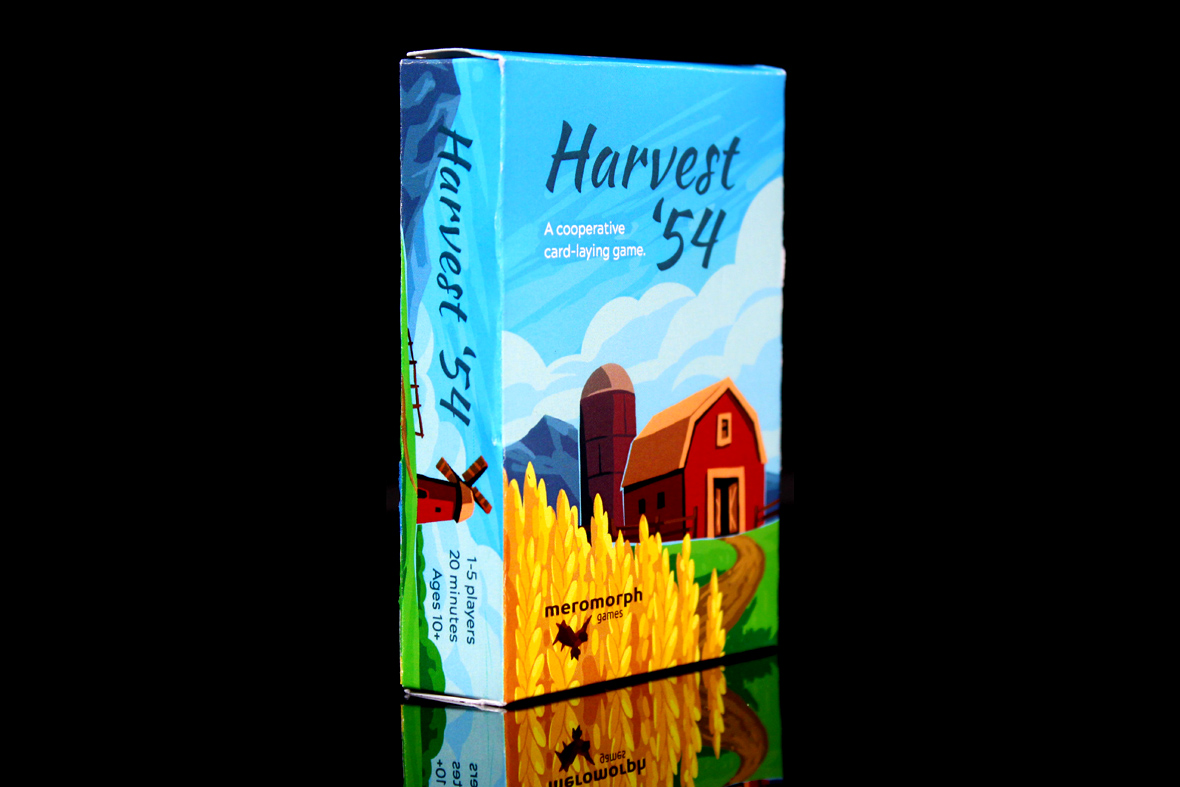
Base price: $12.
1 – 5 players.
Play time: 10 – 30 minutes.
BGG Link
Buy directly!
Logged plays: 2
Full disclosure: A review copy of Harvest ’54 was provided by Meromorph Games.
God, I hate Daylight Savings Time time changes. Even falling back messes me up for a week. It also gets dark at 6PM, but I actually like that? It’s part of why I moved up to Seattle; I wanted some bad weather and a near-total darkness for the winter. And now I’ve got it! The problem is the fatigue is killing my ability to actually get any writing done, so now I’m writing while my friends watch a musical. Having seen it before, the dialogue and music don’t distract me as much, so that’s nice. I’m making progress as well on this review, a new cooperative game from Meromorph (publishers of The Shipwreck Arcana, one of my all-timers). Let’s check out Harvest ’54!
In Harvest ’54, it’s time to build up the surrounding land for farms! But progress isn’t something you can do with no resources, so cultivate your farms and get what you need to build everything from beehives to treehouses! Just be careful: as with any harvest season, you never have as much time as you think you will to do everything that you need to do! How will you fare in the farms and how much progress can your group make?
Contents
Setup
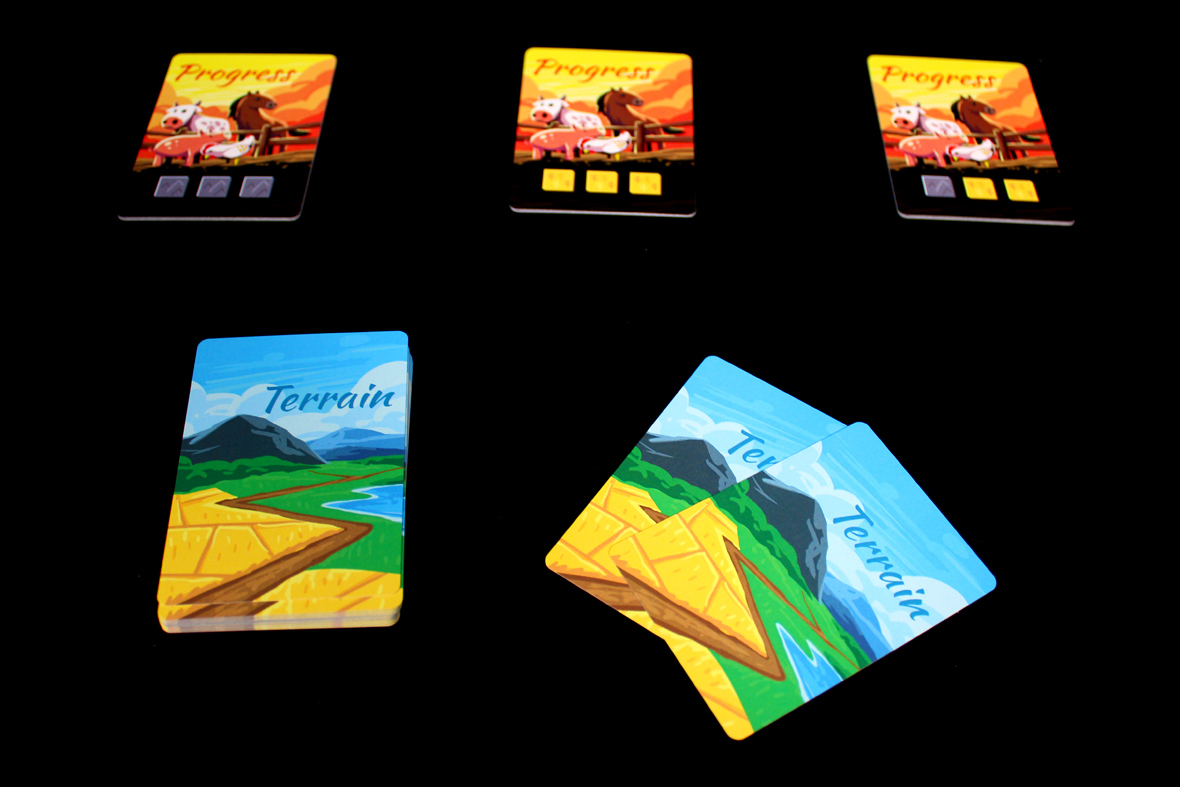
As you might guess for a single-deck game, there’s not a whole lot. Shuffle up the Terrain Cards and deal each player two:

Then, shuffle the Progress Cards. Make three stacks of four cards:
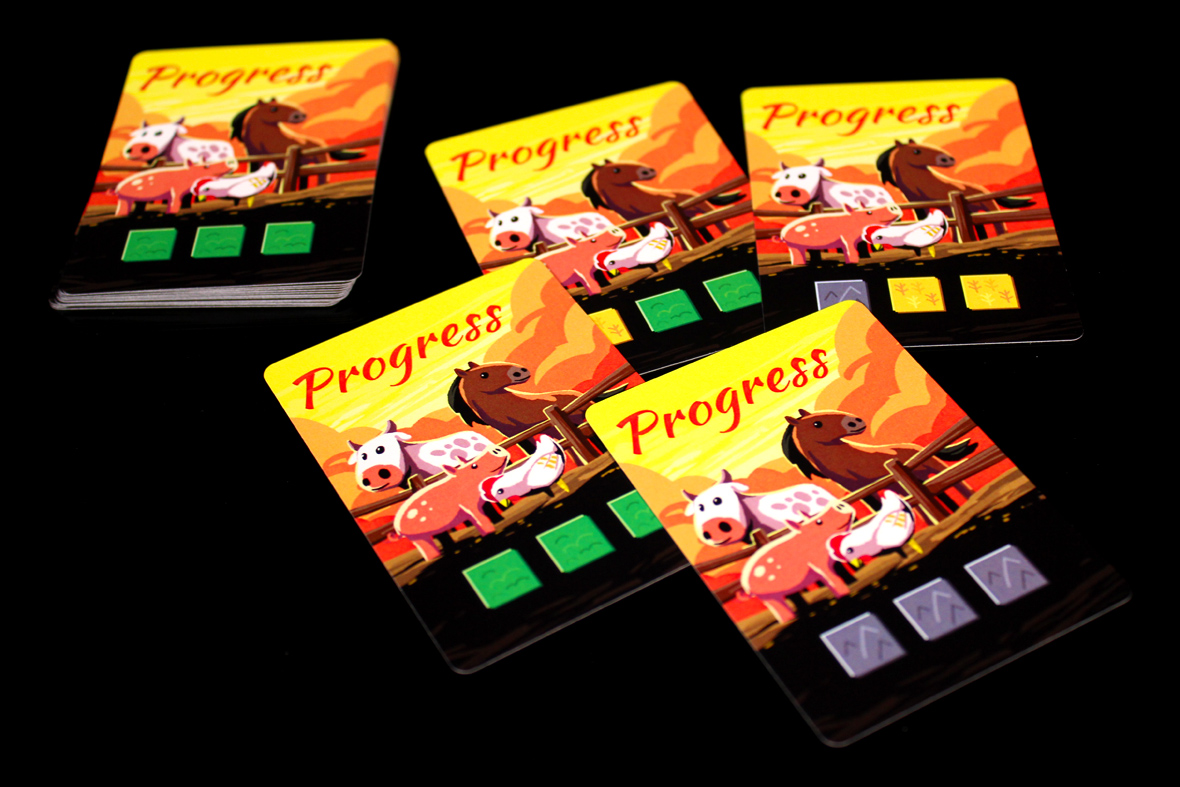
You can set the other Progress Cards aside. You’re good to start!
Gameplay

Harvest ’54 is all about farming and progress! There’s no player order, so any player can go. They can either place a Terrain Card or place an unlocked Progress Card. If they can’t do either of those, they can discard a Terrain Card and draw back up.
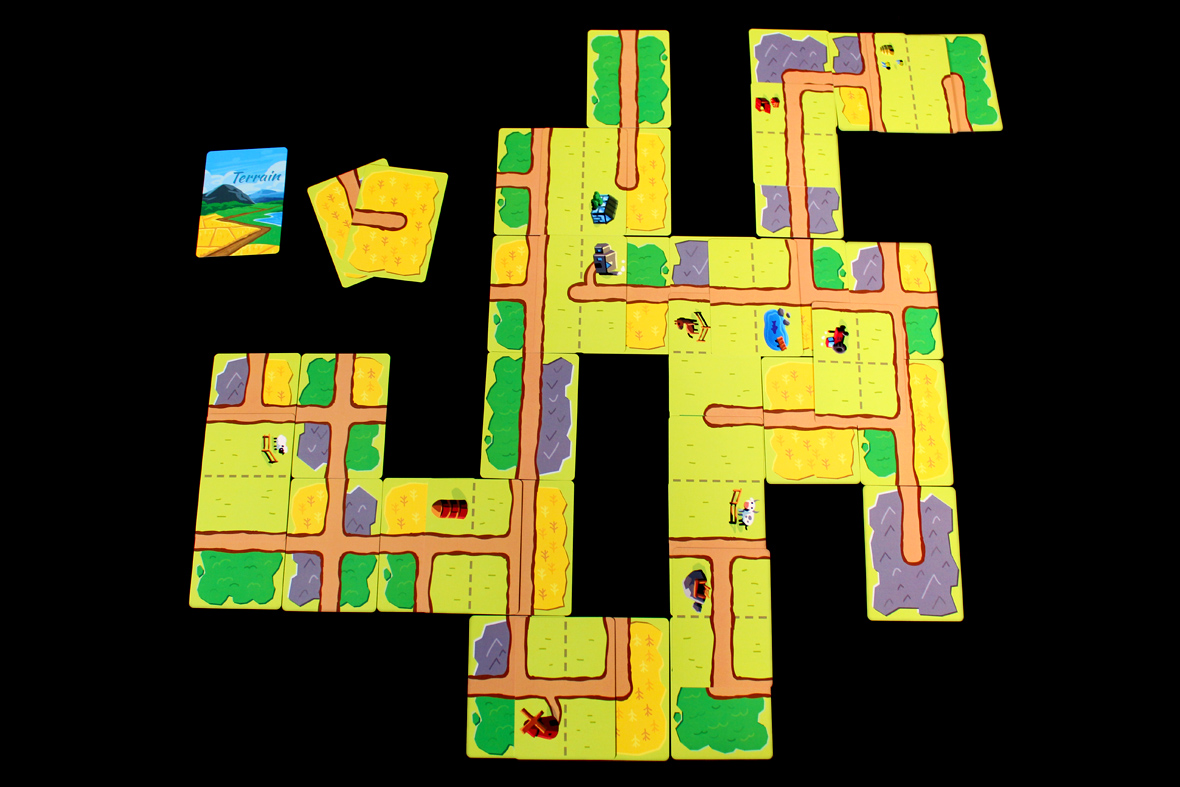
To place a Terrain Card, just take a card from your hand and place it adjacent to any already-placed card so there aren’t any dead-end roads. Standard games-with-roads placement rules. Once you’ve placed it, if the card you placed connects to other Terrain without crossing a road or an unrelated Terrain block, you can unlock the corresponding Progress Card!
When placing a Progress Card, it’s a little more complicated. Those cards can only be placed between two or four cards, which is fun. The dotted line on each card shows where it has to be placed, but you also can’t create partial roads or something. Notably, you can’t unlock another Progress Card in the stack until you play the unlocked one on top of the stack. You can also only unlock one Progress Card per turn. Last thing: you can’t cover any Progress Icons on the cards.

Play continues until you’ve placed all twelve Progress Icons. If you can, you win! Otherwise, if you’re unable to play a card, you lose!
Player Count Differences

Game’s easier with more players, which is always nice. The major differentiator is that any player can take a turn (there’s no explicit turn order), so you’ve really got access to more cards. The counter to this is that you cannot talk to your co-players about the cards that you have in your hand, so you can’t collectively plan and strategize too much. You still, as a group, have more cards in your hand (10 across five players compared to just 2 at one player), so players may have more ideal placements at higher player counts. That said, not a huge preference here otherwise; it’s mostly just how much you want to strategize with other players when you play. It’s a perfectly pleasant solo experience, though.
Strategy

- You should pretty much always prioritize playing Progress Cards as quickly as possible. They’re the way you clear the game and they’re pretty easily blocked up if you’re not careful (since you can only reveal one at a time per stack). If you clear one then you have the ability to unlock the next one on a subsequent turn, which is helpful.
- Try not to build dead-end or unplayable spots if you can avoid it. There are ways you can make essentially dead spots in your Terrain if you’re not careful. You can place cards such that the roads make it very difficult to place another card in the empty space, which will make your life annoying.
- You can use Progress Cards to your advantage, at times. They’re usually on a big empty field, which lets you legally connect terrain types on either side of them, which is helpful!
- Use unlocked Progress Cards to plan your Terrain placements. There are a lot that specifically interact with dead-ends or L-turns in a way that you might not expect or know what to do with. If you have them unlocked already, try to use them to at least get a sense of where you can place certain cards legally.
- The Terrain groups only need to be threes. There’s not a ton of benefit to making big groups of the same Terrain beyond having a spot handy to build off for the next card that you play. Focus on your road placement to some degree so that you’re not cutting yourself off or making it impossible to play other roads in the future.
- You can build double-ended Terrain groups but don’t forget the most important rule. The key here is that the Terrain you’re harvesting, one of those must have been placed this turn, so you can’t just make one of every possible Terrain group and be set.
- If you can double-stack your Progress Cards that’s even better. Progress Cards aren’t particularly helpful, so if you can place one overlapping another, you can kind of constrain the damage a bit.
Pros, Mehs, and Cons

Pros
- Ok, this was significantly trickier than I expected before I started playing. I think I didn’t expect the Progress Card placements to be particularly difficult or for there to be so few Terrain Cards, comparatively. by the time I had figured out what was going on and how badly I had messed the game up, I had lost. It was a particularly humorous and satisfying outcome, but I suppose the lesson here is never underestimate a Meromorph game.
- I like the blues a lot in the game’s art. It’s just a very pleasant color. I do wish there were more of that in the game itself, but oh well.
- Very portable, which is nice. I do hate a tuck box a little, but that’s more just because I can never open the boxes without damaging them. At the very least, though, it makes the game easy to take places. If you play with the higher-difficulty option of it being limited to a 5×5 grid it’s also easy to play in various places; otherwise it can be challenging since it tends to sprawl.
- The Progress card rules and placement are interesting. You have to play them at the intersection of two or four cards, which is a little weird and fun. It forces you to plan a lot since you can’t mess up any existing roads, and that’s pretty solidly the crux of the game. You can’t cover the Progress icons either, and they might break up existing groups of terrain, so, lots to think about.
- Low-complexity setup is always appreciated. You can basically take the game out, shuffle a couple decks, and you’re entirely ready to go.
Mehs
- I think the game would be a bit more appealing if the art were a bit more in-depth. I’d love to see more detail on the various terrain types or little variations, kind of what the Sprawlopolis series from Button Shy does. Just something to break up the various beats of similar terrain.
Cons
- Boy howdy if you find spatial puzzles challenging this game is going to mess you up. It’s not just the cards and their relative placement as much as it is the partial placements and split cards on the back of the Progress Cards. I have several friends I’ve already assumed will get goofed by this game.
- There can be some mildly frustrating moments where you’re blocked on unplayable Progress cards but can’t get the right Terrain to play, which can feel like your time is being wasted. If you get stuck early and can’t advance the Progress Cards or place them anywhere you’re just ticking the clock away (and you don’t have a ton of time). You can discard cards, but it’s still not a particularly satisfying loop. It helps if there are more players so you have, collectively, more options. Solo makes it tough!
Overall: 7.75 / 10
Harvest ’54 surprised me! When I first picked it up I thought it was, to be fair to me, an expanded Sprawlopolis-type game. And there are certainly some similarities! You’re playing cards into a card grid to accomplish goals, but that’s about where it stops. Here, instead of being able to play cards overlapping, you’re trying to group sets of three Terrain types to get Progress Cards, extra-challenging placements that are required to notch a win for the team. I think that’s neat, especially for a small and portable game! I just wish there were ways to better cycle Progress Cards so you don’t get stuck if you draw cards that aren’t as useful. As I mention in similar games, though, there’s also a group of players who are just completely taken out by games with a heavy emphasis on spatial reasoning, and I think of the small-and-quick card games, this is definitely on the harder end. Even I got turned around a couple times! I might be getting old or just tired, though, so your mileage may vary on that one. I do think that the folks who hate spatial reasoning games mostly know that they do, though. The challenge makes it interesting, so it’s a nice balance between the two. Plus, small-size games are on the cheaper side, which makes this a great gift for a quick-play gamer in your life. If you know someone, you love spatial reasoning, or you just want a small cooperative game with a little difficulty edge, I’d recommend Harvest ’54! I’m looking forward to my next play.
If you enjoyed this review and would like to support What’s Eric Playing? in the future, please check out my Patreon. Thanks for reading!
Discover more from What's Eric Playing?
Subscribe to get the latest posts sent to your email.