
Base price: $25.
2 – 6 players.
Play time: 20 – 30 minutes.
BGG Link
Buy on Amazon (via What’s Eric Playing?)
Logged plays: 3
Full disclosure: A review copy of Tricky Kids was provided by Pandasaurus Games.
I think the hardest part of travel is reviewing, to be honest. I actually play a fair number of board games when I travel (hence the travel games hub page), but I usually have to have the photography up and ready so that I can still post a review while I’m out and about. Unfortunately, given the way my trips are currently lined up, I have … six reviews that I need to get done in the next few days? I only realized this as I was typing this up, so that’s a fun extra layer of stress to my day. I should have realized, but I am bad at math, and that’s a great lead-in to our next game, Tricky Kids, from Pandasaurus!
Look, math is hard, especially when you’re a kid. Even more so if you don’t know any math. When you’re trading things back and forth on the playground, you just … have to kind of wing it and figure out what everything is worth. Or make it up! The best way to decide what something is worth is with your heart, after all. As you trade back and forth for the most valuable stuff, you’ll have to keep that in mind if you want to get the best outcomes. And maybe you’ll learn a little math along the way! So in this trick-taking game of imprecise values, anything goes and anything can happen. What will you end up with?
Contents
Setup
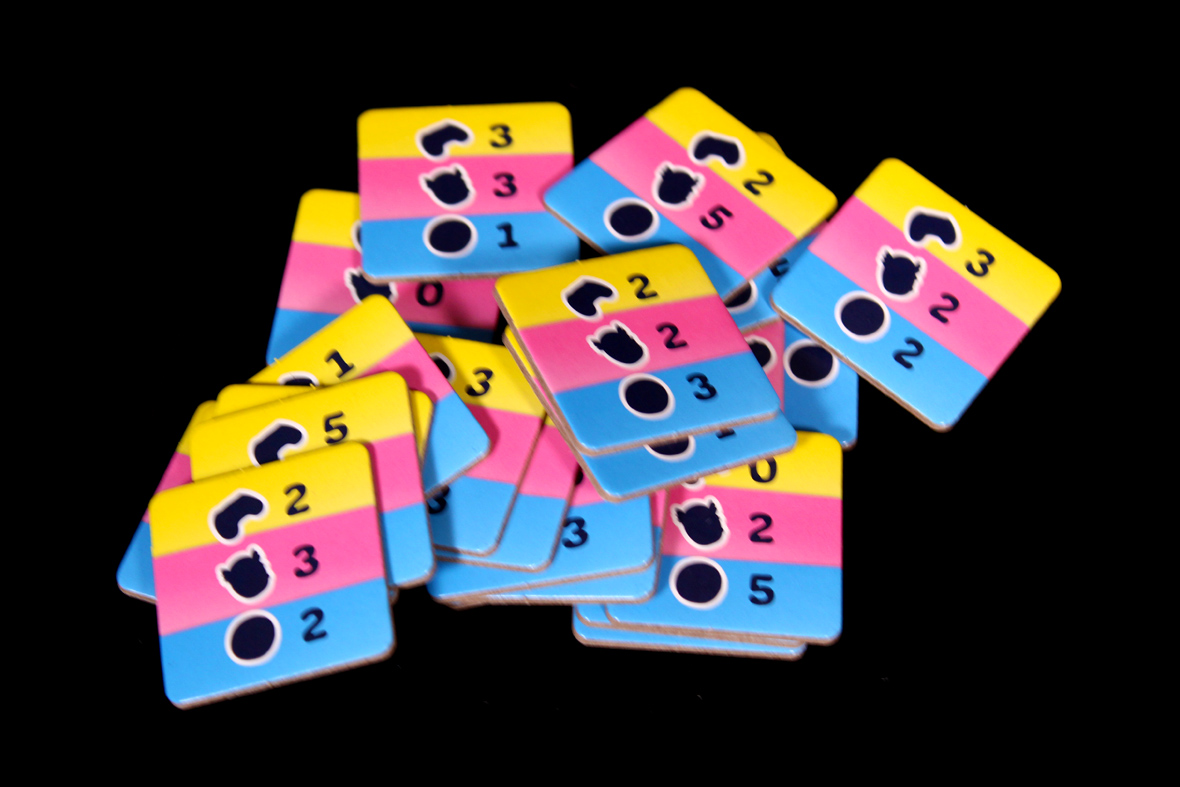
Each round’s setup is relatively similar. You start by placing seven random point tokens face-up in a line:
Then, deal each player nine random cards:

If you’re playing with the Tricky Rules, reveal a new one for the current round. To make the game less difficult, discard the previous one. To make it more difficult, don’t.

First, each player chooses two cards from their hand to discard face-down, out of play. Then, each player writes a number between 0 and 21 on each of their cards, with one rule: the total sum of your cards must be 21. No negative numbers, unfortunately. Once you’ve done that, you’re ready to start! Choose a start player for the round randomly.

Gameplay

Tricky Kids is on the lower end of the trick-taking complexity spectrum, which can be pretty helpful. To start a trick, the start player plays a card of their choice from their hand. All players must play a card of the same suit from their hand, if they can, and generally the highest card of the led suit wins the trick, and the player who won the trick starts the next one.
Where Tricky Kids gets tricky (this is an intentional joke) is that the cards are, by design, not unique, so ties are very possible. When that happens, they cancel each other out and the next highest card wins the trick. Problem is, it’s very possible for the entire led suit to get cancelled out, at which point the led suit changes. Pink becomes yellow becomes blue becomes pink, et cetera. In either case, the player who wins the trick takes the leftmost point token and circles the color of the card they played, saving that token for scoring later.
One other interesting outcome is if a 0 wins the trick. A 0 cannot score, so that point token just gets thrown away. Tough break. In any case, the trick winner starts the next trick. If the entire trick is cancelled out, reconsider your life choices, and then the next trick is led by the player to the left of the person who led this failure of a trick. They lost their privileges.
After seven tricks, the round ends and a new round is set up. You play three rounds and then the game ends; the player with the most points wins!
Player Count Differences

It’s trick-taking, so more players directly changes how each trick functions, especially because things can get really hectic as you add more folks. Essentially, with six players, every player can write 21 on one of their cards to absolutely crush a trick and then there will only be one trick left. That’s not exactly how it would shake out in practice, since, again, who leads the trick matters and how you play your cards and when matters, but trick-taking as a genre is a lot about timing. Even the “best hand” can lose tricks with reckless abandon if you misplay, after all. But there will be a lot more chaos with more players, which may be more of what you’re looking for if you crave the confusion that chaos brings. That’s not a joke; some people genuinely like that. With fewer players, trick control still matters a lot, but it’s significantly less challenging to keep track of what your opponents are playing. So, as is frequently the case with this section, your player count preference will largely come down to how comfortable you are with that increasing chaos. Me? I’m not as particular, but I think I’d lean slightly more towards the higher end of the player count spectrum just to keep things interesting.
Strategy
- One important thing you can control is not just the tricks themselves, but the lead suit. If you’ve got high cards in a certain color, making that the led suit can give you an easy win that’s pretty valuable. Naturally, you want to play cards that let you win, but specifically getting some control over the next trick is pretty good as well.
- If you’re already in the lead, throw off! One particularly fun thing to do is to force a suit that’s worthless when you’re already in the lead. You can play a worthless-value card to force the suit and then your opponents have to follow. If they didn’t keep any 0s in their hand, then they’ve gotta burn a card that they probably didn’t want to waste. It’s pretty useful.
- Similarly, watch out for being forced to play certain cards. The challenge with having a bunch of cards in each color is that you don’t have a lot of cards in each color, so whenever a suit comes up you have to follow suit. If your opponent is playing like I suggested above, they’re going to try to force you to play cards that you don’t want to play to get rid of your high cards, so maybe have a few worthless ones in hand.
- How you lay out your hand matters. You get two cards to discard each round, and you may want to either throw out cards of a suit you have very little of or throw out cards of a suit that won’t end up being that valuable or that you have too many cards of. Prediction and planning matter a lot.
- The numbers you choose matter as well, quite a bit. Yes, I understand that that’s fairly obvious. But, take a look at what the various point values are going to be for each suit and try to decide when you want to have high cards and when you want to have low cards, keeping in mind that (generally) 21 is the limit. A few 0s is never a bad idea though.
- Sometimes you only need two high-value cards, for instance. If you have your heart set on taking two 5-point tricks, just give yourself a 10, an 11, and a bunch of 0s. Use the 0s to evade being forced to play your high cards at inopportune times, then strike when you can to beat your opponents and take the most valuable tricks!
- The Tricky Rules can significantly change up your plans. Keep an eye on the various rules affecting each round. For instance, one round lets you pass cards to your opponent, so perhaps it’s worth boosting one card up to 14 and keeping the rest at 1? You give them a trick (potentially) but they lose almost all the others. Can you force them to play that 14 at an unintended time?
Pros, Mehs, and Cons

Pros
- It’s a fun conceit. Cat in the Box lets you mess with the cards’ suits; Tricky Kids lets you mess with the cards’ values. Pretty sure we’re finally ready for a The Emperor’s New Clothes Trick-Taking Game or something where the cards are just entirely blank. But giving players the ability to modify their cards allows for a specific layer of strategy around how and why you’re messing with the cards.
- Pretty portable. You can pretty solidly throw this into any portable card carrier and take it on the go. There’s not a lot to the game, component-wise, beyond a few markers and a lot of cards.
- Plays pretty quickly. It’s a straightforward trick-taking game, so it moves fast and doesn’t ask for a whole lot as you play, which is nice.
- It’s also easy to keep track of your score. You just keep the circled score tokens, so it’s super simple to calculate it at the end (as long as you don’t end up erasing anything by mistake).
- The Tricky Rules are a nice addition to the game. A lot of what I like in games is the ability to make individual rounds sillier or stranger, and the individual Tricky Rules do a lot to play around in the space that the game creates without making the game veer wildly off-course.
Mehs
- Use your best judgment if you’re playing with Tricky Rules. An advanced variant allows you to stack Tricky Rules cards, which is a pretty silly time. The rules specifically mention that you can discard a Tricky Rule if the new rule conflicts directly with an old one, but sometimes while it doesn’t explicitly conflict, it can make the subsequent round a little … boring. Use some judgment when playing and discard a rule if it would interfere with the round itself.
- I appreciate that there’re punishments for players whose cards sum to over 21. Like, that’s the entire point of the game. You gotta be able to do basic math to play. That said, it’s almost certainly going to annoy players for whom math isn’t their strongest point.
Cons
- Without the Tricky Rules, the game is a little more straightforward than I’d like. The Tricky Rules help albeit at the cost of round-to-round consistency, but your first few games, it’s a pretty basic trick-taking game with some alterable cards. I think a little more complexity in the core game would be nice, since otherwise Tricky Rules feels a bit grafted on otherwise.
Overall: 6.75 / 10

Tricky Kids falls a little short of being great for me, but I think there are some interesting ideas going on in the game from a design standpoint. It’s interesting to compare it to Cat in the Box, for instance, since they both tackle the “what if you could change your cards” idea from different angles; one focuses on changing the suit and the other on changing the number. Weirdly, I think the open-endedness of being able to select whatever numbers you want essentially without consequence (within a limited range) ends up removing some of the tension of any particular round, for me. Maybe it’s that the 21-value limit feels too low (which, to be fair, is lifted by some of the Tricky Rules), or maybe there’s not a ton of risk to what you’re playing, as it’s generally been players competing for the highest-value tokens and then trying to get lucky and pull the occasional other win. I think the most interesting thing that Tricky Kids does is explicitly penalize players for ties (the next-highest not-tied player wins the trick instead) and playing 0s (a 0 cannot win a trick, even if nobody else follows suit). Both of those can lead to some neat strategy outcomes, but ties don’t happen all that frequently, so you might see that once per game. I think if you’re playing Tricky Kids and you’ve got some trick-taking experience, I’d recommend starting with the Tricky Rules to add some more per-round depth (or the Advanced Variant where you add a new rule every round without discarding the previous rule). In the latter case, just make sure you’re curating what you draw so you don’t hit something that avoids a direct contradiction but still makes the game less interesting. Tricky Kids ends up being a neat spin on trick-taking, for me, but I think I’d like to see something more on the strategy side that elevates it beyond mostly a novelty. That said, I do love trick-taking games, so it’s not like I disliked playing it. If you’re getting into the genre and want to mix things up a bit, you’re trying to learn more about how cards and effects can change up strategy from trick-to-trick, or you just really want to have one card that’s better than everyone else’s, you might still check out Tricky Kids!
If you enjoyed this review and would like to support What’s Eric Playing? in the future, please check out my Patreon. Thanks for reading!
Discover more from What's Eric Playing?
Subscribe to get the latest posts sent to your email.