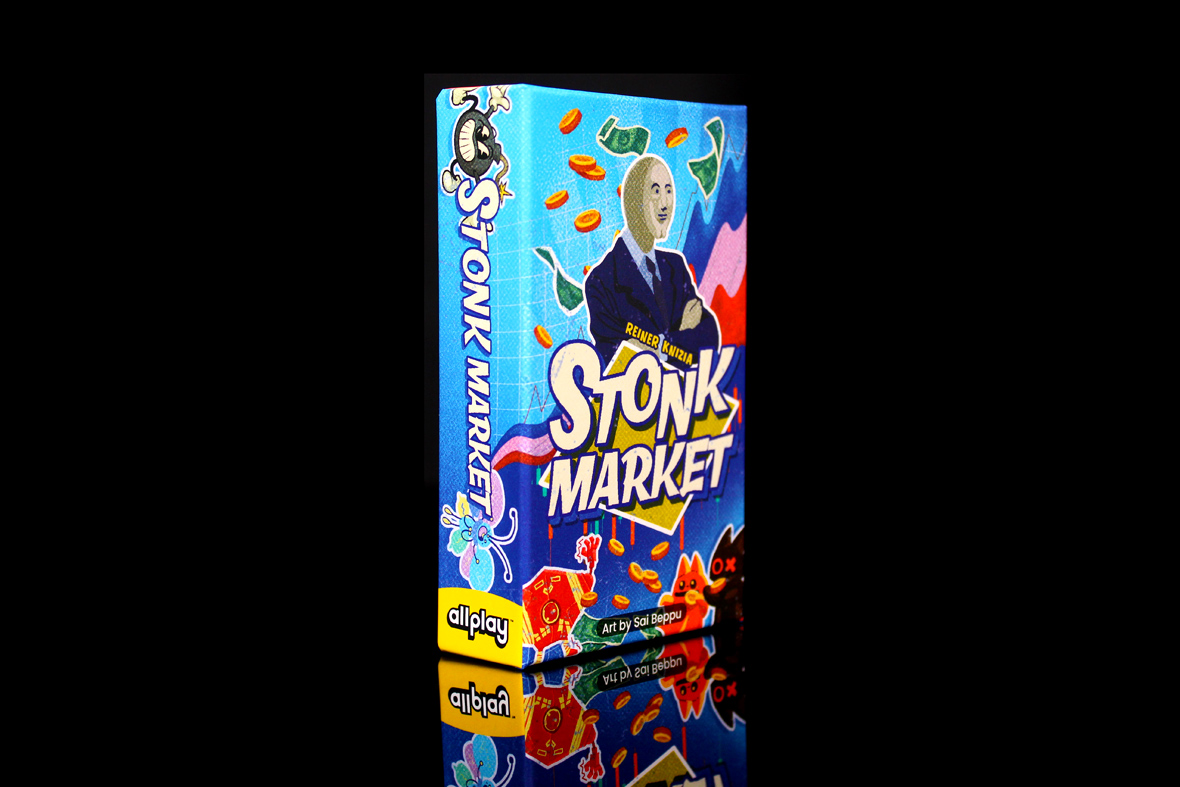
Base price: $14.
3 – 6 players.
Play time: ~20 minutes.
BGG Link
Buy on Amazon (via What’s Eric Playing?)
Logged plays: 3
Full disclosure: A review copy of Stonk Market was provided by Allplay.
Yes, small-box games are my go-to reviews when I’m severely behind the power curve, but that’s also partially because they’re the easiest to get to the table and get played. I think a lot of my friends are still not as keen on board games as I am, at this point, so getting them to commit to something on the lighter side is a lot easier. Naturally, that means that some of these physically-heavier games are going to be backburnered for a little while, but that’s more out of utility than lack of interest. I’ll get some regular game nights going in 2027, probably. In the meantime, it’s two small games this week, so let’s check out Stonk Market!
Just in time for Nvidia to crash and take most of the tech market with it, it’s Stonk Market! Here, your goal is real-time trading focusing on fake stocks for fake companies, which is probably better than using Pokemon Cards as a fiat currency or investing in meme stocks or whatever the Modern Dork is doing. Like the trading floor itself, however, everything is done in real time. That means fast-paced wheeling and dealing as well as trying to avoid taking a loss on your precious stocks. All trades are fair, so try to get controlling interests and majorities and don’t forget that STONKS is (roughly) the name of the game!
Contents
Setup
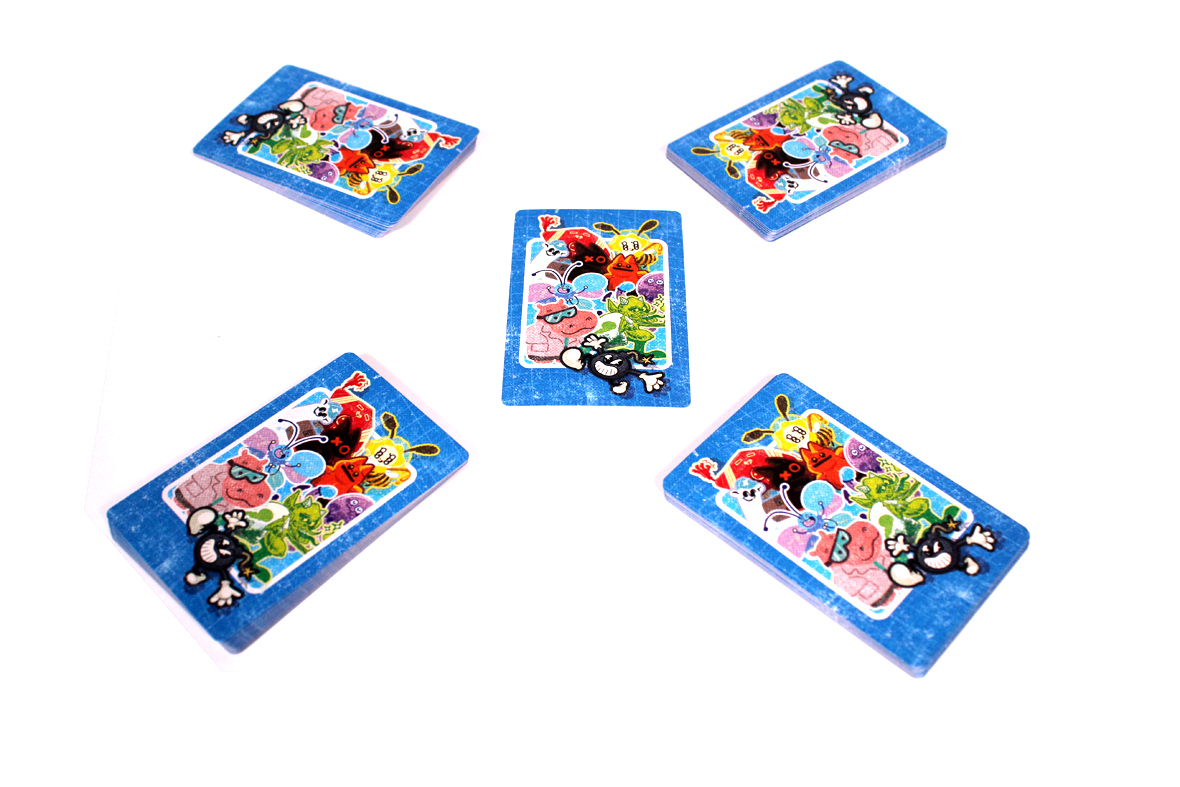
Deal out the cards equally, leaving the last card in the center:

You’re good to start! Was that the shortest Setup ever? Who knows.
Gameplay

Stonk Market is a simultaneous-play, real-time game of trading chaos. As soon as everyone’s ready, the start player flips over the Stonk Exchange Card in the center. All players can immediately take these two actions as many times as they want, as fast as they want:
- Trade with the center card: You may swap any card in your hand with the Stonk Exchange Card. Try not to annihilate it by trying to swipe it from an opponent; it lacks decorum.
- Make a deal: You can swap cards face-up with any player as long as you both agree to the exchange. Notably, the number of cards does not have to be equal on both sides of the trade, so be careful!
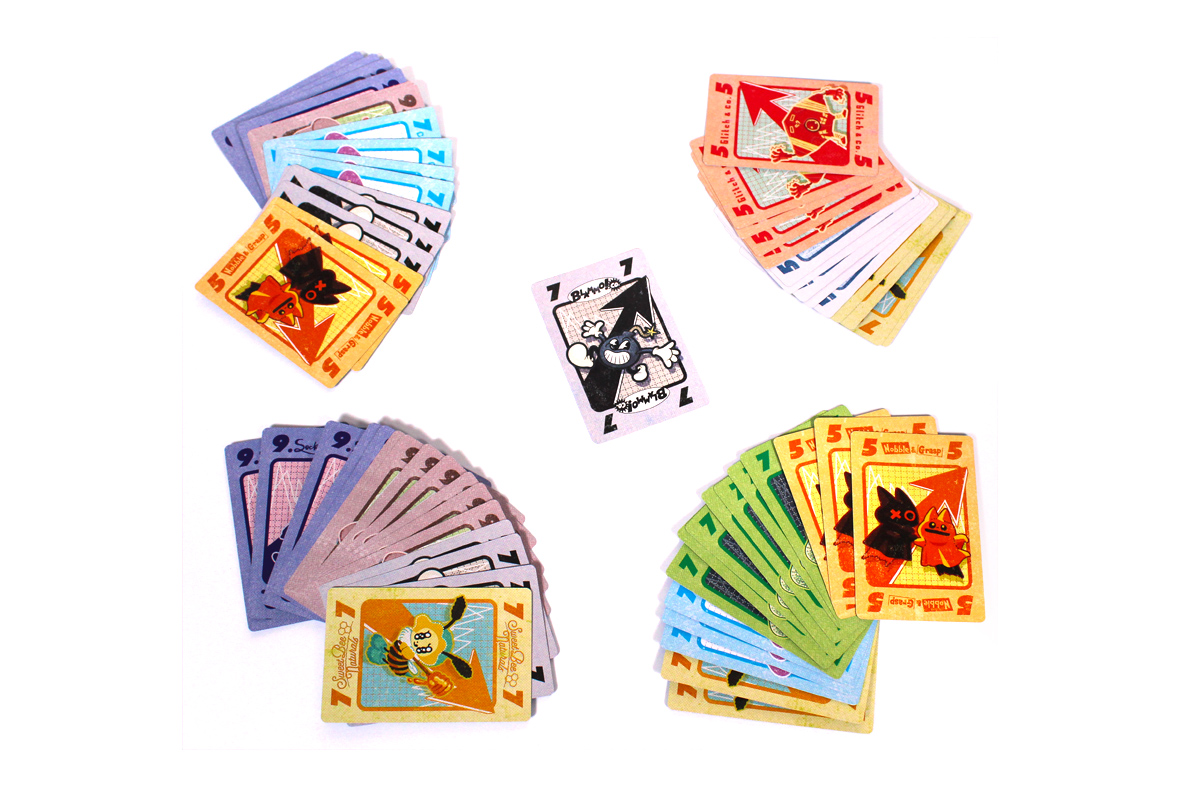
Once a player has a hand of cards where they only have majorities of each type of card in their hand (each card has the number of cards of its type printed on it), they can yell STONKS and end the round! Then scoring happens:
- If you called STONKS incorrectly: You get 0 points and the cruel jeering of your peers. Don’t do that.
- Each card in a majority: 1 point. 2 points if you instead have all the cards of that type.
- Each card matching the Stonk Exchange card: -1 point instead. Tough break.
- If you called STONKS correctly: 5 points. It pays to be first.

Record everyone’s scores and start a new round. The player with the most points after three rounds wins!
Player Count Differences

More players is really just more chaos here. There are fewer cards, yes, so the rounds can theoretically be shorter, but there are also side-deals happening and trades with the center happening faster than you can keep track of them, which fundamentally makes the game more chaotic. For a quick-trading party game, though, that’s hardly a bad thing. With fewer players you’re likely going to see more active and thoughtful trading, since everyone has a lot of cards in their starting hands and they’re going to try to see what they can do about it. With more players it’s a free-for-all. I kind of like the high-chaos play at higher player counts, though, so I’d probably recommend it most towards the higher end of the spectrum, there. I think there’s something fundamentally entertaining about the absolutely high-chaos play with five or six people that’s a core part of this game.
Strategy

- Having all the cards of a type earns you double points. That’s great! You should always strive to do that.
- For your player count, there are definitely Ideal Plays, sometimes. If the hand size is 12 or 10, for instance, there’s an optimal move: you want a full set of 5 and a full set of 7 for 12, and two full sets of 5 for 10. That’s much easier said than done, of course, but it’s generally a good thing to have. It’s worth thinking about before you start!
- Sometimes just suggesting you’re looking for something is enough to get players to dump it to the center, which is great. The game moves quickly enough that even the mention of a card type can be enough to spook investors, which I suppose is uncomfortably close to how the actual stock market works. That’s bad for us in general but good for you during the game! See if you can get other players to dump their cards.
- You really can just throw a card into the center and whatever happens happens, but you’re potentially giving it away to a player collecting a full set. Timing matters a lot, there. If you can keep track of what anyone else is doing (good luck) then you might be able to figure out when someone’s about to end the round and you can ditch a card you don’t want to make it worth negative points. Or, you can do that when you’re about to end the round just to dunk on someone else.
- Try not to split your focus. If you’re trying to get too many different majorities without focusing on at least one, if you don’t end up ending the round yourself you’re going to get a 0 (or worse). Getting at least one good majority keeps you on the board.
- Naturally, don’t say STONKS if you don’t have the majorities. Someone was asking if you’re worried about getting a negative score, can you end the round prematurely so you just zero out, and while I understand where they’re coming from, I’d still give you the negative points, personally. I think it’s just good praxis. Either way, make sure your hand is exclusively majorities before you call STONKS and end the round, otherwise you’re just screwing yourself over.
- When trading, there’s usually a loser. People aren’t generally inclined to make equal trades in games; they really only want to get something that they feel benefits themselves more than the other person. As the old poker adage goes, if you’re not sure who the sucker at the table is, it’s you. If you’re not sure who’s benefitting from the trade you’re making, it’s the other person. Be careful about that.
Pros, Mehs, and Cons

Pros
- I like the STONKS guy. The meme makes me laugh, and that’s pretty much the only stock market-related meme that makes me laugh. Everything else was kind of Reddit at its worst.
- Sai Beppu’s art continues to shine. I think Allplay basically has them on retainer at this point and that’s a wise move.
- I love that Allplay continues to make these small-box games. I think it’s kind of wild that they’re actually cheaper now than a Button Shy wallet, but that’s unfortunately a product of economies of scale, I think. Allplay just has an overall higher throughput on releases and manufacturing, so I’m sure they can both get things cheaper and survive on a thinner margin.
- The quick-play elements of this are a lot of fun! It’s chaotic in a great way as players are fighting for the center card while trying to trade cards. Stealing a card from another player is definitely funny.
- I appreciate how easy this is to learn. There’s not much in the way of setup complexity or even much math at the end. You can pretty much guess who’s winning the round by just looking at players’ hands. That said, it’s still pretty interesting when the round is close!
Mehs
- Some of the publisher-driven text is trying awfully hard. Maybe I’m just turned off by the meme stock economy. I like the STONKS meme, but that’s about it? It also doesn’t feel like that whole societal … thing is reflected in the game itself. If anything, the game feels more like a real-time Startups.
- There’s going to be some fights about the round-ending finish. This isn’t because I think anyone is actively trying to cheat (in my game group, at least) but more of a function of how games work. If you’re in the middle of performing an action, like swapping the center card with a card in your hand, and someone ends the round, do you get to complete the action or are you forced to revert it? Does it depend on how far into the action you’ve progressed? Just a weird edge case we’ve noticed a few times. I’m inclined to say if you haven’t completed the action it gets reverted, but that can be up for debate.
Cons
- The game is very grabby, since it’s real-time card trading, so be careful with the cards. I can definitely see two people going for the same card and the card getting wrecked, which would not be ideal.
- You’re going to get punished if you’re the kind of Type A person who organizes their cards before they play anything. You don’t have time for it! The most I’ll do is let everyone fix the backs of their cards so that they’re all facing the same way, which feels generous. There’s not a way to fix this, but you’ll likely see a few players who just can’t gel with this because they crave organization in an otherwise-chaotic game.
Overall: 7.75 / 10
Stonk Market is weird, but in a way that I like a pretty good amount. I think I probably would like the game more if it didn’t lean into the memey wallstreetbets kind of subculture of it all, but Sai Beppu’s art (as always) calms me down a bit on that front, so I think it’s more a marketing / product framing thing than an art thing. The game looks great, so my issue isn’t there. Plus all my other issues are largely nitpicks or things I worry about from real play experiences, like card wear and tear or my personal predilection to sort all my cards whenever I play a game (at one point I had to start alternating which order I organized my cards in because some players were using that to determine what cards I had, which was … cool of them). I think part of where Stonk Market really tries to sell the player on the experience is by encouraging them to lean into it by making the cards impossible to organize, though. The game wants you to live in the discomfort of not always knowing what you have, only knowing what you want. It ends up being a neat little commentary on our own stock market system, I guess, but this review isn’t about that. I think Allplay’s tiny games line has been great for just exploring different game types and styles, and compacting some fun party games or silly concepts down to an approachable minimum. Stonk Market works because it lines up there; the synergy between product and game is pretty good! It’s, granted, not an all-time favorite of mine, but it was a pretty fun and quick party game that my group enjoyed. I’d be most interested to see how different groups play and how those changes affect the round, since I think this game is intensely group-dependent. The balance of trading versus using the Stonk Exchange, in particular, seems interesting. But if you like trading games, you’re looking for a quick game for a small group, or you just love stonks as a concept, I’d recommend checking Stonk Market out! It’s a neat little game.
If you enjoyed this review and would like to support What’s Eric Playing? in the future, please check out my Patreon. Thanks for reading!
Discover more from What's Eric Playing?
Subscribe to get the latest posts sent to your email.