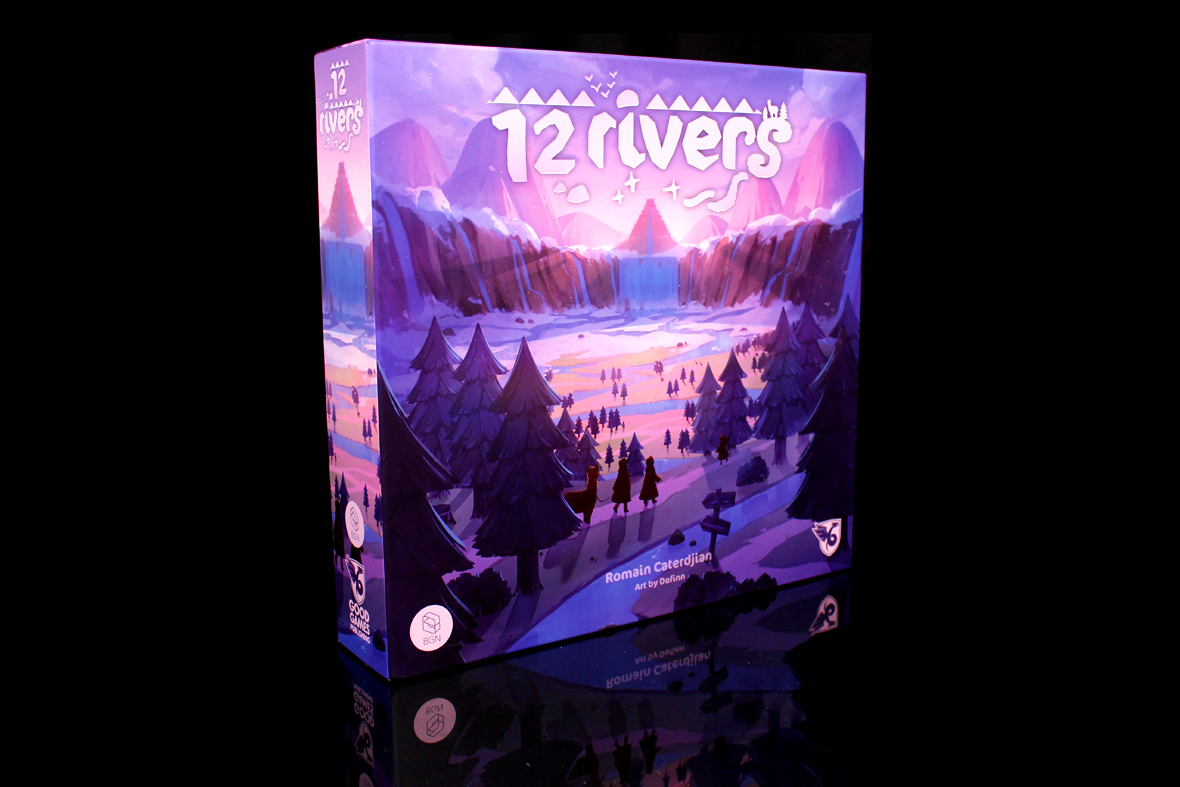
Base price: $50.
2 – 4 players.
Play time: 45 – 75 minutes.
BGG Link
Buy on Amazon (via What’s Eric Playing?)
Logged plays: 2
Full disclosure: A review copy of 12 Rivers was provided by Good Games Publishing.
It’s essentially Gen Con time, which is the busiest possible time of the season. That said, a lot of the games I’ll be reviewing are games to check out if you’re at Gen Con. We’ve got a great mix of things, though! Temple Twist last week was a great time, and DVC is bringing some amazing stuff with Rosetta, Here Lies, and more! Good Games Publishing has been releasing cool games for a while now, and I usually cover something of theirs every year. This time, I’m leading into Gen Con with 12 Rivers! Let’s see what’s going on.
In 12 Rivers, players take on the role of leaders of tribes who all gather resources from the eponymous rivers that flow from a sacred lake high up the mountain. The rivers produce magical pearls that you can gather for all sorts of things! They’re valuable! They’re sacred! They’re shiny! You crave them. Over five rounds, you’ll leverage your tribal power and authority to claim them as far upriver as you can, recruit new villagers, and use camp abilities to grab pearls as they roll down the river. Will you pull the most valuable haul from the banks of the rivers?
Contents
Setup
Lots to do here, which isn’t my usual but it’s still fun. First, set up the board. You’re going to want to bend it so it ends up looking like this, and then adding the feet:

There’s a floodgate that goes into that long, top groove as well. Place it in there; it’ll hold back the marbles. Marbles, you say? Yes; set those aside for now.

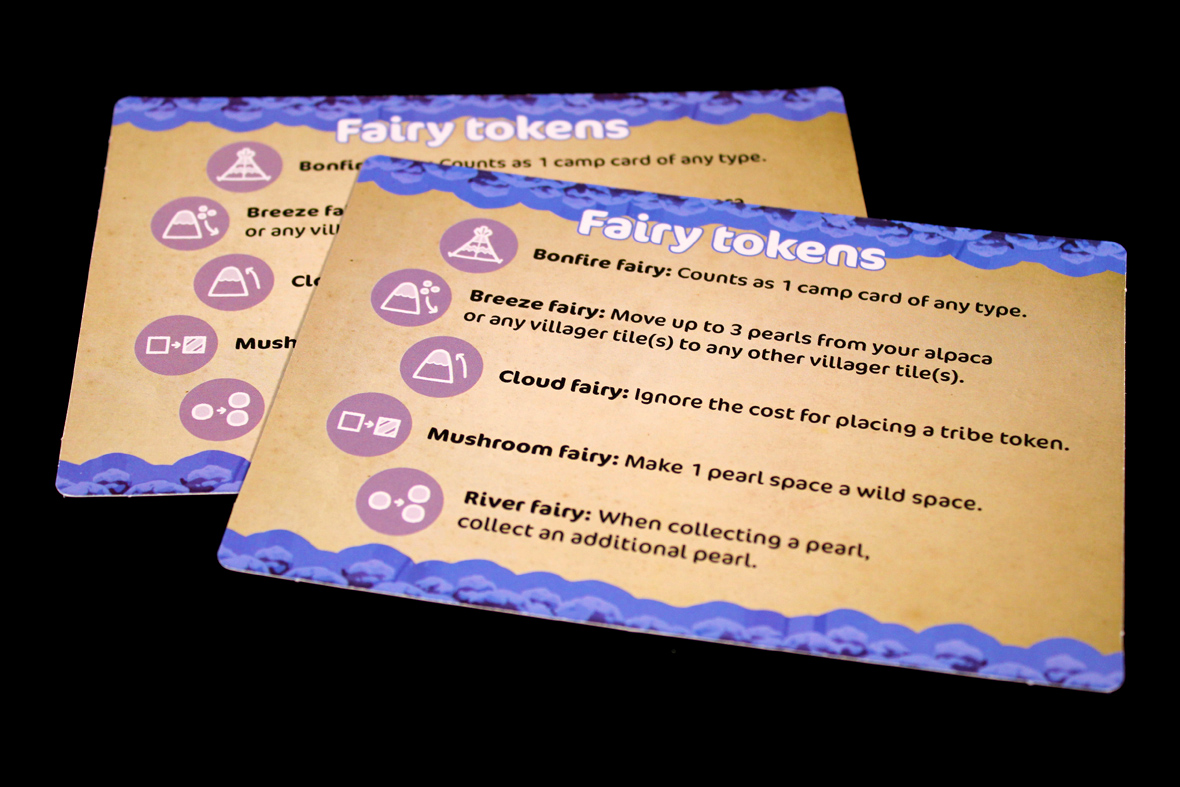
Place the Fairy Tokens nearby and shuffle them face-down.

Place the Fairy Token Summaries nearby, so players can see them.
Give each player an alpaca board in the color of their choice, and set the alpaca goal cards in a row at the bottom of the board:

Also deal each player a random Starting Villager tile to determine play order for the first round:

You’ll use Tribe Tokens for this. Each player places one, in turn order, on the turn track until everyone has placed all of their tokens.

Shuffle the remaining Villager Tiles and set them aside, for now:

Shuffle the Camp Cards and deal six to each player, and reveal three and place them face-up by the deck.

You should be ready to start!
Gameplay

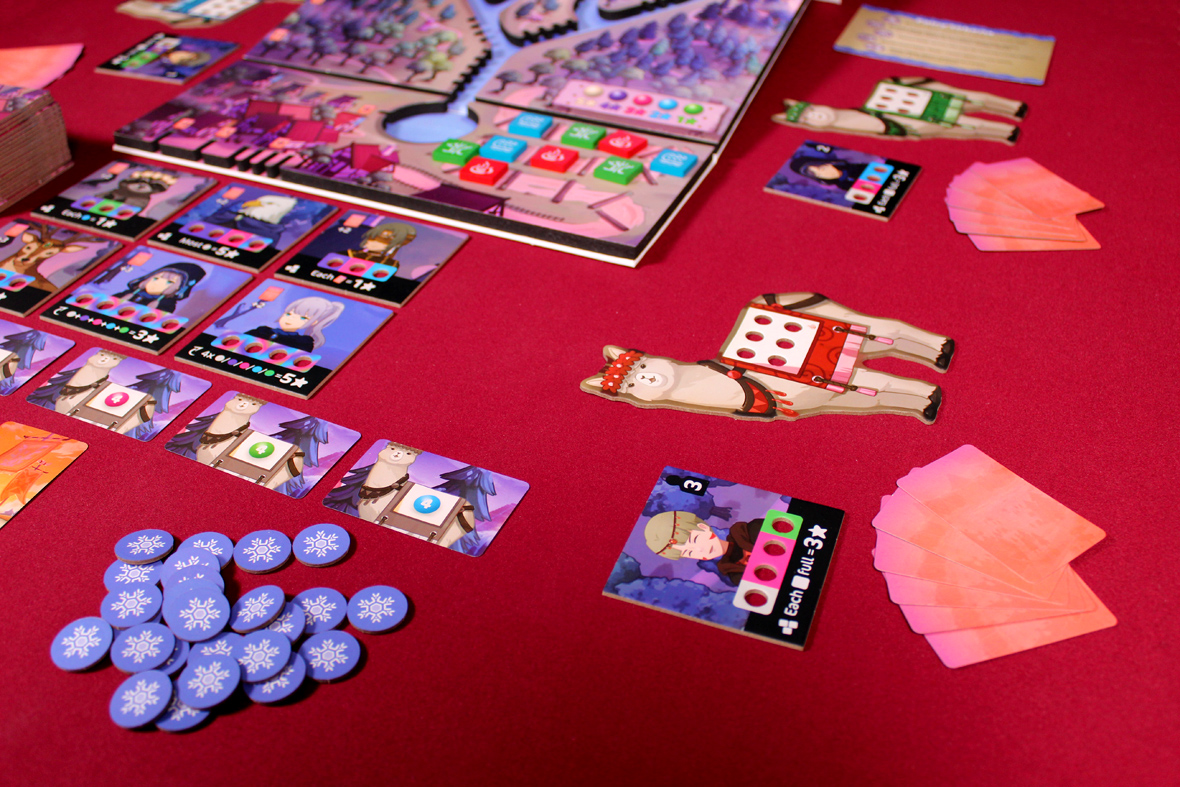
Despite setup being fairly in-depth, the actual game of 12 Rivers is pretty straightforward. Over five rounds, you’ll block the river to potentially gain magical pearls and use them to score points. Gathering Villagers is critical as well, as your alpaca can only take so many pearls before it’s full up. Camp Cards and Fairy Tokens can provide abilities, but spend them wisely!
To start a round, add marbles to rivers from left to right based on your player count. Use three rivers per player and ignore any others. Then, add Fairy Tokens to every stump (odd-umbered rounds) or every fox statue (even-numbered rounds) based on how many rivers are in play. You won’t add a Fairy Token next to any river that’s not in play. If there’s already a Fairy Token on that space, add another; it’ll just also be there. Finally, if there are any villager tiles remaining, place them on the bottom of the deck, then reveal six more. The first player takes their turn after.

On your turn, you’ll pull your frontmost Tribe Token and place it anywhere on the board. To place a token, choose a slot and slot your token in there, taking all adjacent Fairy Tokens connected to that slot and paying the cost in Camp Cards (usually -3 to +1). If there’s a +1 there, draw a Camp Card instead. When gaining Camp Cards, you can draw them from the top of the deck or the row of three next to it. You may also play Camp Cards during this phase, where relevant.
After all players have taken their turns, remove the floodgate and release the pearls! You’ll note that several of the Tribe Tokens stop the pearls from moving, which is by design! Starting at the top and moving left to right, if your Tribe Token is blocking any pearls, choose one and add it to your alpaca board, then remove the Tribe Token and place it at the front of the turn order path. Continue doing this until all Tribe Tokens are removed. If any player placed their Tribe Token on the lake at the bottom of the board, they collect all the pearls that end up there at the end of this phase. Note, however, you can only have six pearls on your alpaca board at a time; if you need to take more, you must discard either the pearl you’re placing or a pearl on your board.
If you ever have a certain number of pearls of the same color on your alpaca board at once, claim the corresponding Alpaca Goal Card.
Any players who placed their Tribe Tokens in the Village may now recruit villagers, from left to right. Remove your Tribe Token and place it on the turn order path and then take a Villager Tile of your choice, adding it to your play area and then drawing the indicated number of Camp Cards. Most Villager Tiles have an end-game scoring effect, so keep an eye on that.

After all players have claimed all of the Tribe Tokens and taken their actions, you can move pearls to villagers! Just be careful; once a pearl is placed on a Villager Tile, it’s not super easy to move.

Play continues until all five rounds have occurred. Then, total your scores and the player with the most points wins! Note that certain pearls are worth certain amounts of points, but only if they’re on Villager Tiles. Pearls left on your alpaca board don’t count for points on their own (but they might be worth points based on certain Villager Tile effects).
Player Count Differences

The game is very different based on your player count, as while the board doesn’t change, the number of players interacting with it does. This means that high-value pearls are going to be snatched up very quickly, for instance, so you may want to use your Camp Cards more liberally. There’s also the fact that at lower player counts, you’re going back and forth with pretty regular frequency, but with more players, a lot can happen between your turns if you’re not careful, especially based on placement and the modified turn order. If you play lazily, you can end up with ten turns between two of yours, and you might be locked out of good pearls and good placement, which sucks. It’s especially difficult to compete with other players for the Lake, but that’s neither here nor there. That said, it’s still very interesting to play with two, three, and four players, just different every time. I think I like two the best because it’s still predictable, but getting ahead in a four-player game is an interesting challenge for the tactically-minded.
Strategy

- Use your Camp Cards! They’re extremely helpful for basically everything, to the point that I might have extra lines for specific cards later in this section. It’s still worth mentioning that it doesn’t usually pay to hold on to them (unless you’re getting endgame points for them, which is a possibility).
- Don’t forget that each villager you recruit comes with an ability, one that usually scores you points at the end of the game. Towards the end of the game, if you can, recruit a bunch! You never know, even an extra two points here or there might not be a bad idea.
- It can be difficult to explicitly plan on what marbles you’re going to get, so stay flexible. Unless you’re placing at the very top of the river (expensive), you’re potentially going to get scooped by an opponent, and that’s okay.
- Don’t pay exorbitant fees to place up the river! Use cards and Fairy Tokens to ignore the cost. This lets you place on a spot, get a Camp Card or a Fairy Token, and then use a pair of Provisions to move you Tribe Token up to grab the white pearl you want (or something).
- Keep an eye on what you can place. Villager Tiles have limits on certain types of pearls, and you may end up screwing yourself over if you take a bunch of pearls you can’t place, as any unplaced pearls just stay on your alpaca board until you can place them. Prioritize either getting more Villager Tiles or hoarding them in pursuit of an Alpaca Goal, I guess?
- Fishing Nets are a great way to irritate your opponents. This Camp Card is how you punish players for playing cautiously. If they’re looking for a certain pearl you also want, play a pair of these to take two pearls, snatching the one they wanted before they have a chance to get it. That’ll make them think before placing so low on the river next time.
- Turn order matters. The first player in turn order has access to the Lake before anyone else and gets to place after seeing the new Fairy Tokens and the new pearl options. If you have extra cards (or Provisions), it may not be a bad idea to aim high and try to go first in the next round.
Pros, Mehs, and Cons

Pros
- The click-clack of the marbles is the game’s main selling point, and rightly so. I was kind of hoping this would be a bit more pachinko than it ended up being (or maybe more marble run-influenced), but I’m still happy with it. The marbles make a great noise, even if I’ve now gotten to spelling marble “marbel” because I’ve either typed that or Marvel too much recently. Driving me nuts.
- I appreciate that there’s still a good amount of strategy in what you pull when. Giving players the ability to pull from farther upstream at an added cost adds a ton of interesting trade-offs around timing, especially since placing farther upstream gives you an edge next round.
- I didn’t realize this was a Romain Caterdjian game! He’s designed a bunch of games I’ve enjoyed, like Look at the Stars and the deeply-underrated Geometric Art. It weirdly feels like those games in some way, as though there’s some inheritance or style between them. Either way, neat.
- I like this purple-heavy color scheme. Dofinn did an excellent job, and it makes the game striking.
- I do love multi-use cards, and having them here as both currency and ability makes the trade-offs exciting. Is it better to spend cards for placement or spend cards for ability? The answer is always going to be it depends, and that’s okay.
- This was lower-complexity than I was expecting. That’s not a bad thing, here; I think the game is more approachable than I thought it was going to be. You’re essentially just blocking rivers to take pearls and score, and the strategy comes from what Villager Tiles you’re taking and when you use them. It’s not too complicated, and I think some players (like me) are really going to like the whole conceit of the marbles.
- Oh, right; the board looks amazing. This is a game with table presence. It’s visually striking and extremely tactile, which is great.
Mehs
- What in the hell is up with the box size? It’s larger than a standard board game box, to the point where it doesn’t fit in my bag and that causes all kinds of problems. Very specific, person-who-board-games-too-much problems, but problems nonetheless. Diabolical.
- The marbles sometimes getting stuck is a little underwhelming. You just have to knock the board to get them to move and it doesn’t matter what order they go in, but it does kind of bum me out.
- Repeated art on the Villager tiles breaks my immersion a bit. It’s unfortunate but it happens.
Cons
- It does generally seem like it’s a good idea to “collect a ton of cards and play them all at once” for certain pairings, which can be kind of a bummer. Lantern, Fishing Net, and Shamisen all benefit from playing a bunch at once in certain contexts. Lantern can let you sweep Fairy Tokens, using them to potentially boost other plays. Fishing Net can be used (hilariously) to just drain a bunch of pearls that other players might have been counting on. Those are both fine, but Shamisen does seem to be most useful towards the end of the game when you can just get a bunch of extra Villager Tiles to gain extra endgame points. Yes, you need explicit spaces to do so, but it feels a little less interesting.
- The lack of an explicit round tracker is a real oversight. Yes, I can count to five just fine, but if you’re in the thick of strategizing and thinking and planning, you can sometimes forget what round you’re on. Having an explicit way to say “Round 1” versus “Round 3” seems like it should be in the game, and yet, it’s not.
Overall: 7.75 / 10

Yeah, 12 Rivers is pretty good! I think a bit more complexity would be an asset to it, though I appreciate the approachability. Maybe something like an advanced mode or an expansion that adds more uses for pearls? Right now, they are just kind of getting slotted into matching spaces on Villager Tiles, which isn’t bad but it feels like the board’s primary interaction mechanic has more that can be explored. Like I said elsewhere, the board is spectacular; top-tier stuff. The marbles flow pretty well (for the most part; they can get a little stuck sometimes), and the whole game looks great. Love the color scheme. All in all, 12 Rivers is a pretty approachable worker placement game; I kind of wish it was my first entry point into the mechanic. I’m not convinced if you’re used to deep and intricate worker placement games (you Lacerda weirdos) that you’re going to be enamored with this, just because the complexity isn’t there. But if you’re curious about worker placement, I do think this would be a great place to start! I’ll be interested in the meantime to see if there’s more they’re planning to do in this space. The world is interesting, the art is good, and I’m very engaged while I play! I do wish there were just a bit more depth and connection between the mechanics, though. All in all, a solidly fun time to play! Plus, who doesn’t like colorful marbles?
If you enjoyed this review and would like to support What’s Eric Playing? in the future, please check out my Patreon. Thanks for reading!
Discover more from What's Eric Playing?
Subscribe to get the latest posts sent to your email.