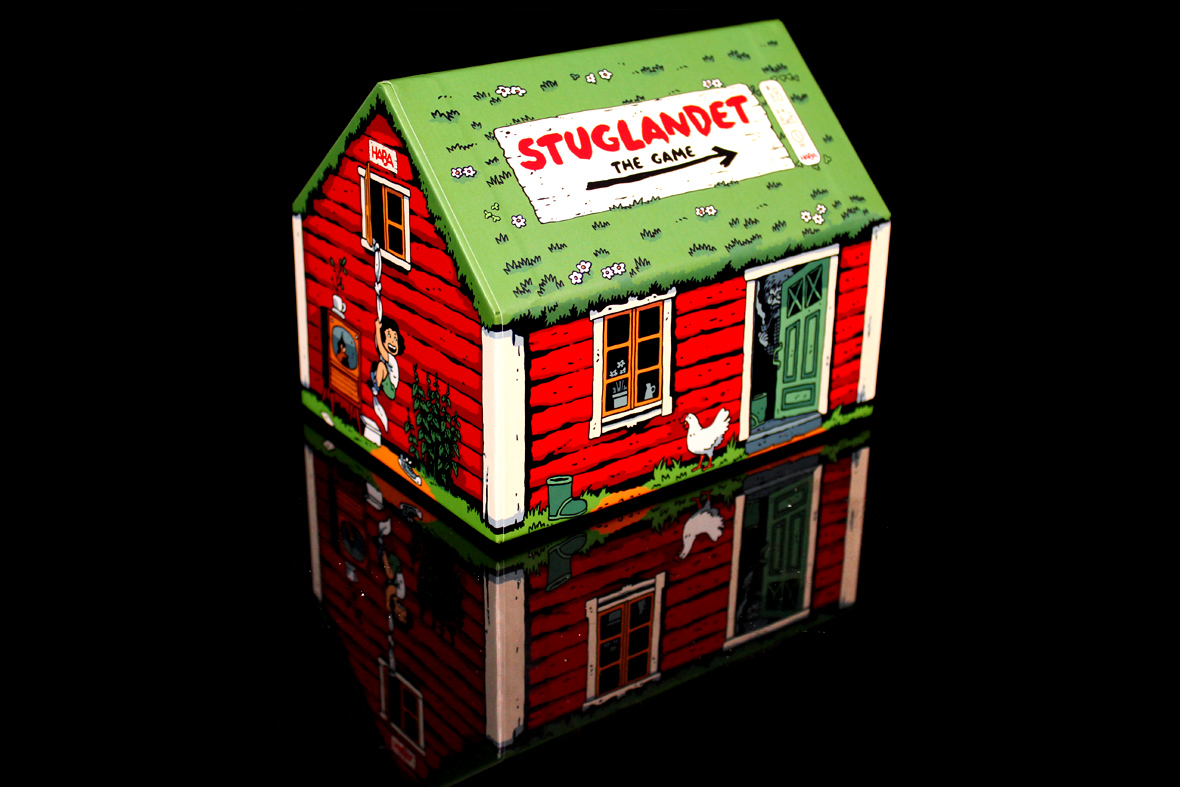
Base price: $25.
2 – 4 players.
Play time: 15 – 30 minutes.
BGG Link
Buy on Amazon (via What’s Eric Playing?)
Logged plays: 2
Royal Star Casino Burglary | Theft in Cliffrock Villa | Murder at the Oakdale Club | Sabotage at Lucky Llama Land
Animal Upon Animal | Animal Upon Animal: Crest Climbers | Rhino Hero: Super Battle | Flotsam Float | Hammer Time | Go Cuckoo! | Wobble King | Valley of the Vikings
Karuba | Karuba: The Card Game | Miyabi | Logic Labyrinth | 5er Finden | Dragon’s Breath | Mountains | Stuglandet
Full disclosure: A review copy of Stuglandet was provided by HABA.
I didn’t expect Stuglandet to be the first Gen Con game I reviewed, but Carcassonne Labyrinth doesn’t come out until September 1 and I figured gushing about it now before it’s purchasable would be annoying. Maybe this is annoying. Let’s move on. A lot of Gen Con releases were very exciting, even for those of us who don’t often play heavy games, so you’ll be seeing a bunch of those in the near future. But it was exciting to meet with HABA, a perennial favorite of mine, and here we are with Stuglandet! Let’s check it out!
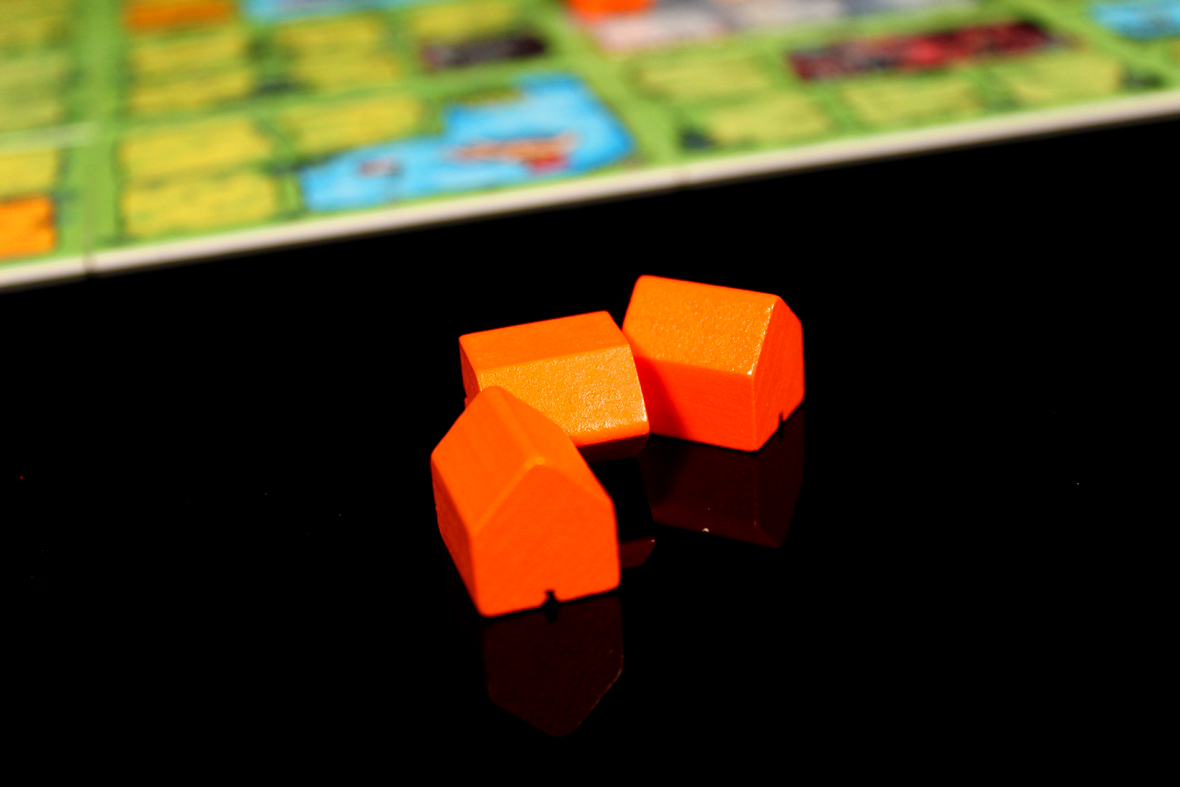
In Stuglandet, players vie to place their cabins in the best spots to enjoy their vacations. But how do you randomly decide how to do that? Well, you roll them! Cabins have … seven sides, so they’re kind of like dice, as long as you don’t think too hard about that. That means there’s opportunity! Everyone knows that the city and the lakeside are top tourist destinations, but sometimes even the dump needs someone living close by for zoning reasons. That’s probably how it’s zoned, anyways. So grab your cabins and roll away to set up your perfect vacation!
Contents
Setup
Not much for the standard game. Set aside the City and Island tiles:

Shuffle them in with 7 / 10 / 14 additional tiles for 2 / 3 / 4 players.
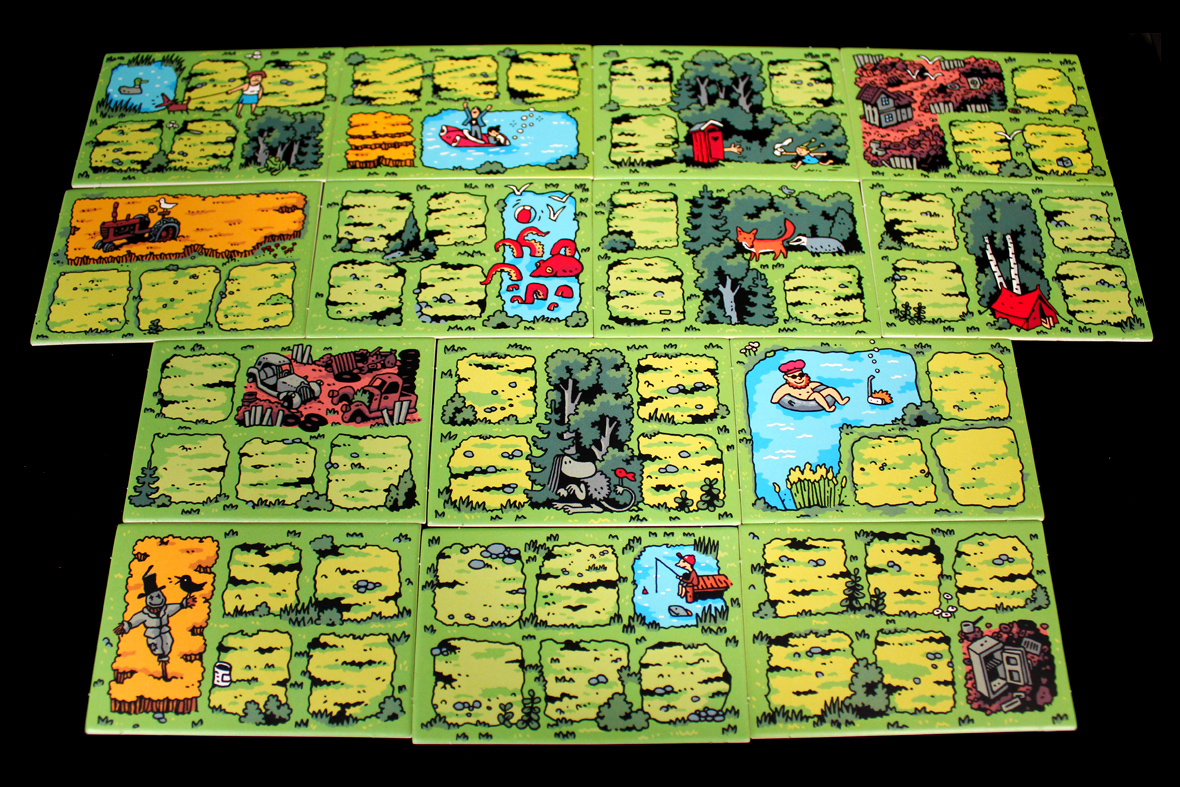
Make a grid for the standard game: 3×3, 4×3, or 4×4 for 2 / 3 / 4 players. Then, give each player a set of cabins in their color:

In player order, set a cabin on an unoccupied city space. You’re ready to start!
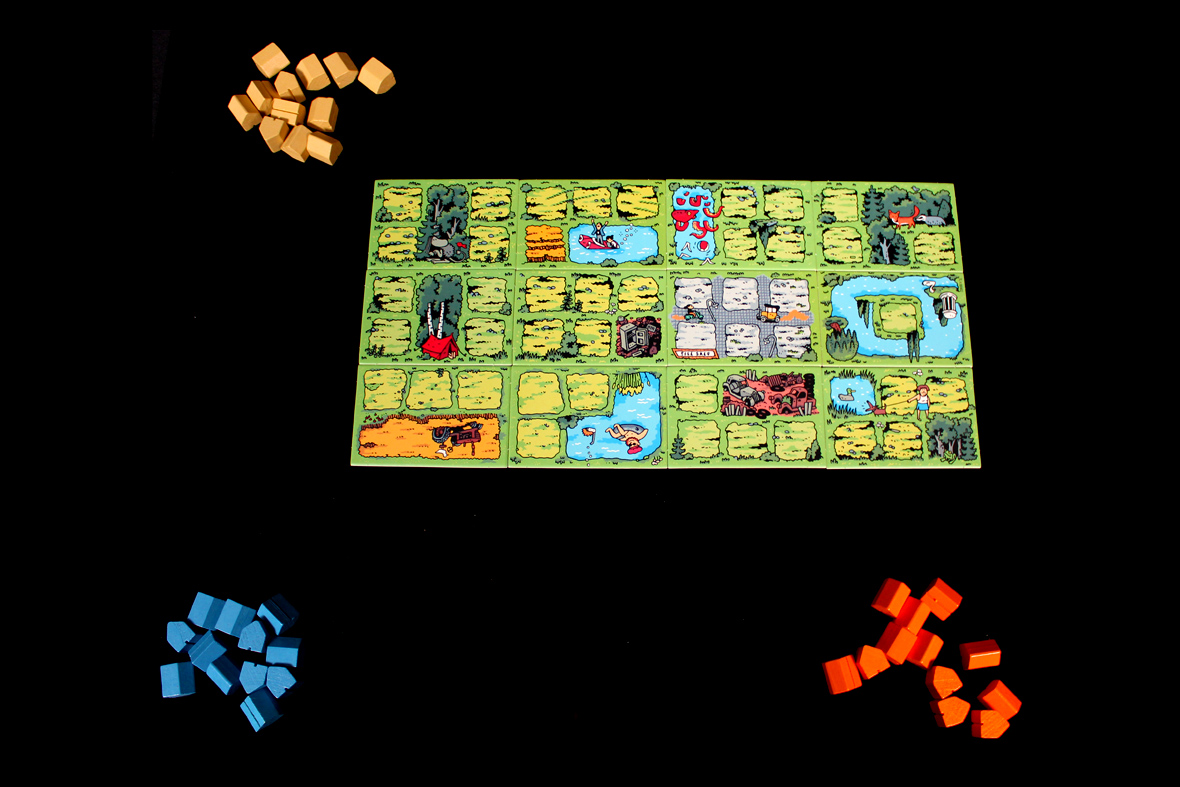
For the Advanced Game, instead shuffle up the tiles (including the City and the Island tile) and deal each player four. The player with the City Tile goes first.
Gameplay

On your turn, roll three of your cabins! (Or, if you have fewer than three, as many as you can.) You get two rerolls, but if you reroll, you have to reroll all cabins. Once you’re done rolling, resolve each cabin:
- Cabin on Short Side: Replace. Take any player’s cabin on the board and replace it with your own. You cannot Replace on Blocked Tiles.
- Cabin on Long Side: Move. Take any player’s cabin on the board and move it to another valid spot (any green or gray unoccupied spot). You cannot Move from Blocked Tiles.
- Cabin Upright: Place. Take one of your cabins and place it on any valid spot (any green or gray unoccupied spot).
If a tile is completely filled with your cabins (or any player’s cabins, for a quicker game) it becomes Blocked. Very exciting. And that’s pretty much the whole game. You go until one player runs out of cabins, and then you score:
- 1 point per cabin
- +1 point for each cabin orthogonally adjacent to a lake (including the island).
- +1 point for each cabin in the city.
- -1 point for each cabin orthogonally adjacent to a dump.
- +2 points for having the most cabins on a tile, except for the city. Nobody scores in the event of a tie.
- +3 points for having the most cabins on the city tile. Nobody scores in the event of a tie.
- +6 points for having the largest group of orthogonally-connected cabins on the board. Again, if there’s a tie, nobody scores.

Player with the most points wins!
For a more challenging game, try the Advanced Mode! Here, each player must place a tile on their turn and eventually form a 2×4 / 3×4 / 4×4 grid, depending on the player count.
Player Count Differences
There’s a lot more chaos in Stuglandet with more players. The board is larger, yes, but the “good” spots aren’t necessarily more numerous, so players who identify them quickly will be fighting a war of attrition against everyone who’s ever placed there or plans to in the future. That makes the game funny, don’t get me wrong; it also makes the game slower, as players get more obsessed with moves and replacements than they do with placing cabins. That said, if you see players all fighting over one small spot, place your cabins quickly and get a bunch of different tiles (potentially even blocked!). By the time they figure out what you’re doing, it might be too late. At two, the head-to-head becomes zero-sum, which ups the comedy stakes to some degree. If you have nothing to do with an extra Move action, just throw your opponent’s cabin near a dump! It’s silly and rude in a way that adds a certain petty flair to the game and I love that. No major preference! It’s a little different at different counts, but it’s still fun!
Strategy
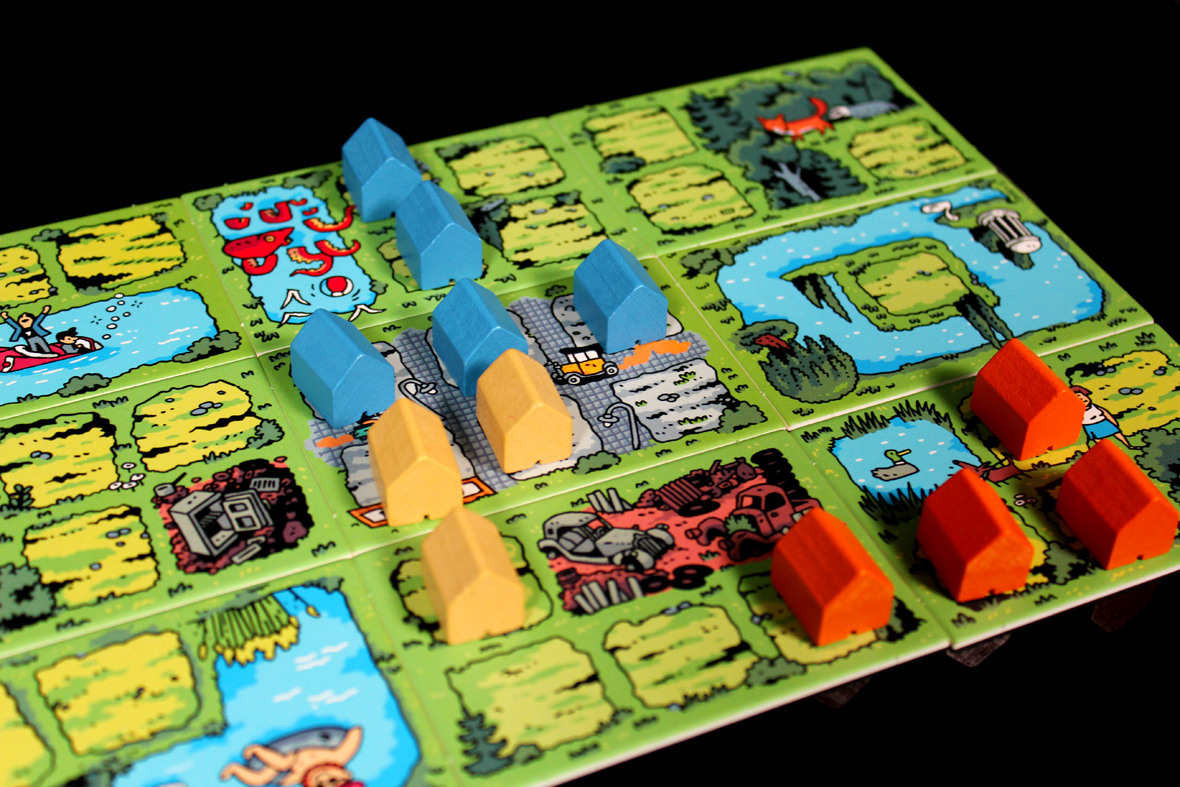
- I don’t think there’s a trick for rolling the cabins; just hope for the best. I could be wrong here, but the one thing I will recommend is that you toss them up and spin them a bit as you’re tossing them; if you just roll them cleanly out of your hand, you won’t necessarily get the rotation you want to potentially get the “Replace” action. Getting a Move versus a Place is mostly just up to the roll.
- Replace actions are great for both annoying your opponent and improving board position. Sometimes it’s fun to just replace an opponent’s cabin with your own; sometimes you can use it to break up a major chain of their cabins, and sometimes you can use it to put yourself in a good position (filling up the City Tile, the Island, or next to water).
- If you have nothing to do, just use a Move Action to move someone else’s cabin somewhere unhelpful or bad. Place them near the garbage! It’s a hoot and it forces them to spend time trying to get away from there. You don’t want to end the game near the dump; it’s worth negative points.
- Getting that bonus for the most connected cabins is good, but it’s better if it runs through a bunch of tiles. The bonus is pretty hefty, but if you use that and you get the bonus for having the most cabins on a bunch of different tiles, that’s fantastic.
- Blocking tiles is incredibly useful. You can essentially make it so that your cabins can’t be moved off of a tile or replaced anymore! If you do that on the City or on a tile with a big lake, you can line up a ton of points! Just make sure you can actually get away with that; most players won’t let you lock that in without a fight.
- When using the Quickplay rules, use other players’ cabins to block your preferred tiles. You can use them to lock in tiles where you have the most cabins, yes, but you can also use Move Actions to move opponents’ cabins to tiles where they will block and be tied with another opponent, so neither of them get points for it. Helping yourself is ideal, dunking on an opponent is good, but dunking on all opponents simultaneously is sublime. And optimal!
- Watch out when one player is down to three cabins. It’s unlikely, but they might be able to end the game on their turn and then the game just ends. No extra turns or nothing. Try to make sure you’re in the best possible position for the end of the game!
Pros, Mehs, and Cons

Pros
- I think the Travel Mat is a fantastic idea. I like that it makes the game super travel friendly and completely fit in that tiny bag. No tiles, no problem. You can even limit the board layout for player count by just not using certain rows or columns.
- I love rolling things that shouldn’t be rolled; it’s great. It feels great to just roll stuff that shouldn’t, practically, be rolled. It’s subversive and fun and a little stupid. I’m not sure if you play with a kid they’ll feel like it’s subversive, but I do, and that’s what matters here.
- There’s a lot of good player interaction, even if it’s slightly negative in nature. You’re constantly picking up and moving and replacing players’ cabins and they’re doing the same to you. You might find that you avoid picking on someone who’s taking their turn next or temporarily team up with another to block an opponent who’s getting too comfortable with their position. The game being quick makes this kind of dynamic, low-stakes alliance-building fun.
- The Advanced Game offers a lot of strategy as well! Do you place tiles to bait your opponent? Getting to place the tiles yourself is super interesting, especially as more cabins get onto the board. You can boost certain areas or block others, or drop a dump next to what your opponent has been building. A lot of ways to mess with people.
- The art style is very charming also. It’s cute and very “camp” vibes, from outhouses to people lounging on lakes to some other variety. It’s also got a lot of color and a lot of heart.
- The Quickplay rules are a great way to speed up the game and unlock additional strategies. I love that you can move other players’ tokens to block tiles; it adds a really nice layer of strategy and makes every tile feel like it’s in play even if you have a bad roll.
- Letting tiles become “blocked” is smart as well, just so the game doesn’t last forever. If you can get an entire tile completely filled with your cabins, it’s just locked in place. Some tiles only have two or three spaces, so it’s an easy way to force the game to move forward by limiting both what spaces can be placed on and how many cabins you’ll have left.
Mehs
- I wish the cabins were a bit more visually interesting. Just some details or something that would make them a bit more fun to roll? I don’t know.
- I’d also love having more tiles, just to make it so that the four-player game doesn’t use all of them every time. Maybe an expansion will add some more options at some point, just to mix things up.
Cons
- I appreciate the shape of the box within the narrative, but I also hate it in real life, for me. I don’t love when I have to put boxes on my special “this box doesn’t fit on my shelves” shelf, but I had to get one for the hits: Junk Orbit, Lacuna, others. Still annoying!
Overall: 8 / 10
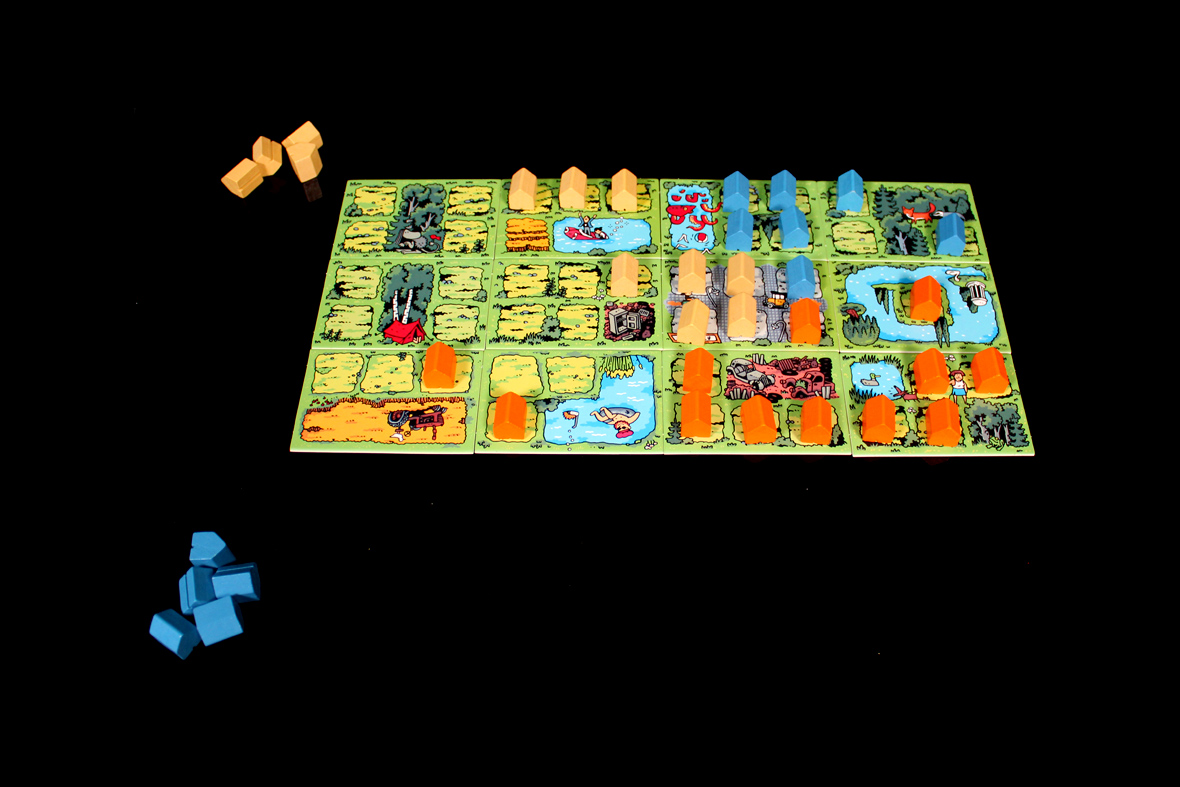
Overall, I think Stuglandet is a hoot! I was extremely pleasantly surprised, actually. It’s got a great initial hook with rolling the cabins, since they’re just such a weird shape and deeply unpleasant to roll. It grabs the player because it violates the idea of how we’re supposed to use a specific game component. I like that energy. Then, you’ve got a cute-but-basic family strategy game of placement, control, and contention. It could have been boring, even, but the design choice to make the board modular and varied for every game is fantastic. I think that having more tiles than needed to make sure some are always out would be an improvement, but I can’t be mad at this as-is. Plus, it adds expansion / retheme opportunities since it’s pretty straightforward conceptually, which I kind of always assume is HABA’s goal. I think there’s just a lot of very good design choices in the game, like adding a very simple and useful portable version to the back of the English rulebook. I do not love the box size or shape, but I always hate nontraditional boxes. I have too many and I have to put everything on shelves to make things work with my board gaming space. Stuglandet is a great example of the exact kind of game that sits at the top of HABA’s catalogue: well-designed games that are family-weight in concept but can still execute as a casual game because of something fun or interesting about them. It’s why they’re one of the biggest names in family gaming; they know how to pick ’em. Though I’m intrigued by the Ambrings pair of designers as well; would love to see more games from them. If you’re looking for something quick and quirky, you like a little bit of rough-and-tumble area control, or you just have always wanted to roll a cabin, Stuglandet is a lot of fun! I’d definitely recommend it.
If you enjoyed this review and would like to support What’s Eric Playing? in the future, please check out my Patreon. Thanks for reading!
Discover more from What's Eric Playing?
Subscribe to get the latest posts sent to your email.