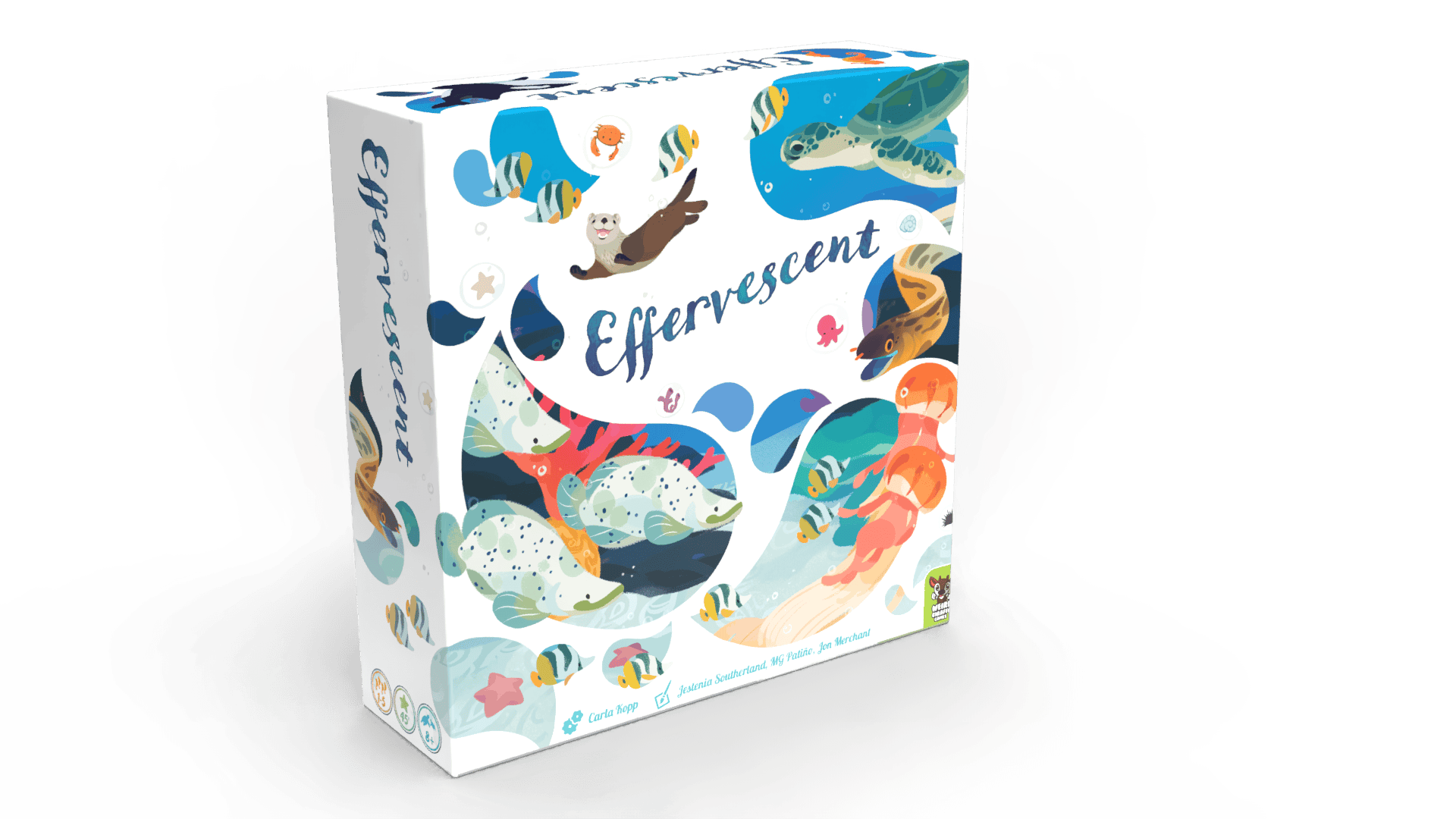
Base price: $XX.
1 – 5 players.
Play time: 45 – 60 minutes.
BGG Link
Check it out on Kickstarter!
Logged plays: 2
Full disclosure: A preview copy of Effervescent was provided by Weird Giraffe Games. Some art, gameplay, or other aspects of the game may change between this preview and the fulfillment of the Kickstarter, should it fund, as this is a preview of a currently unreleased game.
I definitely thought this game was called Effervescence, which is significantly harder to spell, so this is actually a huge relief. I really only look at the game box itself, say, one time before the review happens; most of the time the box top is elsewhere until I need it for the big featured photo, and even then I’m not looking at the box from a technical standpoint; I’m looking at it as a shape. Blessedly, not a huge deal, though I wish I had learned this before I put myself through my paces trying to get consistent at spelling “effervescence” because I was worried I’d have to type it a bunch. This is a digression, sure, but it still technically introduces the game, so this paragraph has done its job! Let’s get into the actual review.
In Effervescent, players are Effervescents: little guys who shimmer and live in harmony with other sea creatures. You can’t see them per se but you know in your heart that they’re real, which is just as good, legally. Your goal is to help manipulate undersea currents to send the bigger ocean creatures where they want to go, to help our tiny riders make their way around underwater to spread harmony. Surprisingly peaceful for an ocean-themed game, especially lately. So that’s nice. Place tiles, master the drift, and build your colony. Will you be able to bring peace to the seas?
Contents
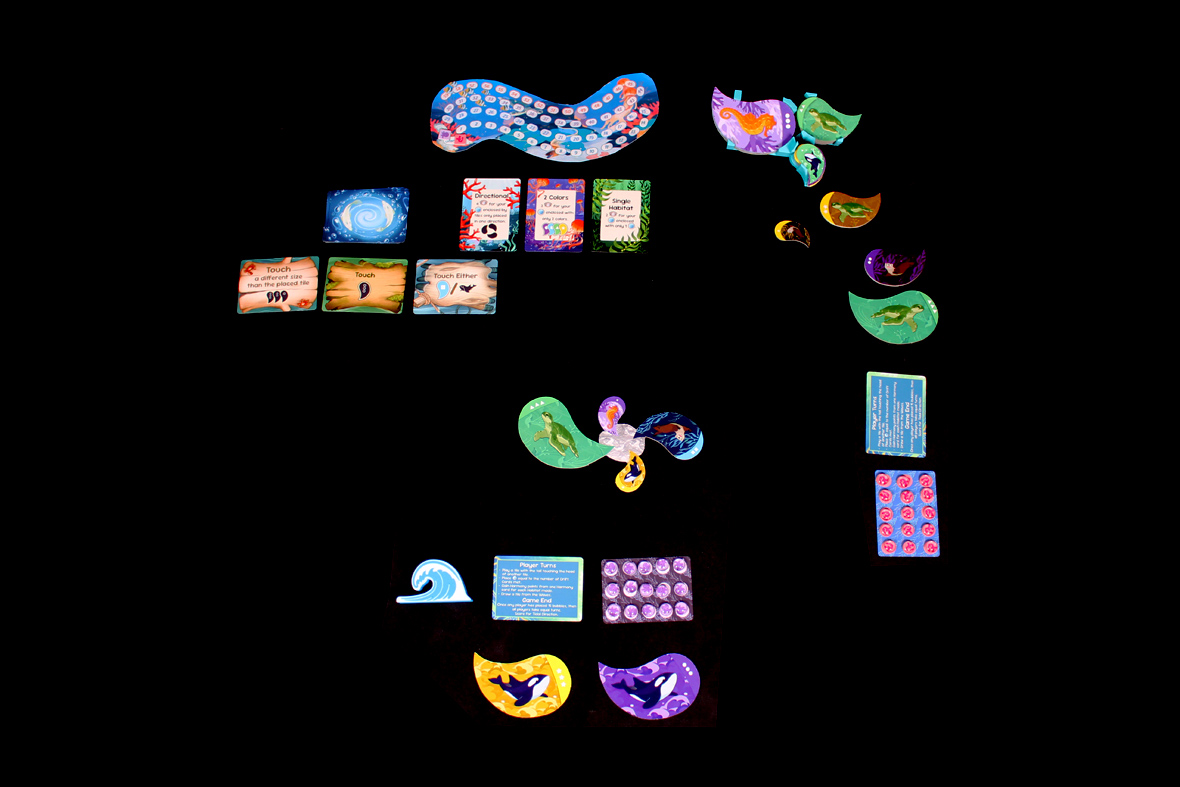
Setup
First up, each player is going to get a set of Effervescents and their matching Harbor Card. You should place 15 on there and set the other two nearby in case you need them.

Give each player a Private Scoring Card (Tidal Direction) as well. There’s a player reference on the other side.

Shuffle up the Harmony Cards. Use two types if you want a chiller game or three types if you want to play with more available points. Draw one of each type and order them from most- to least-valuable.

Set the Starting Tile in the center:
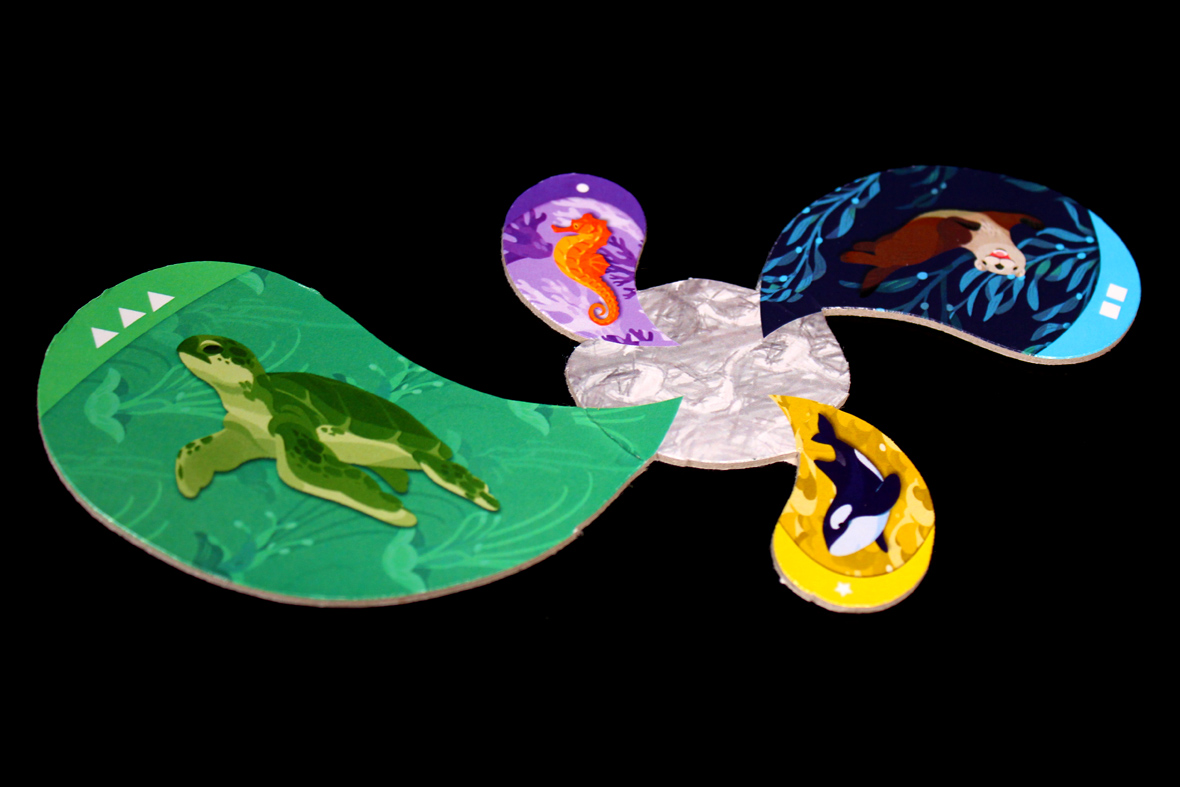
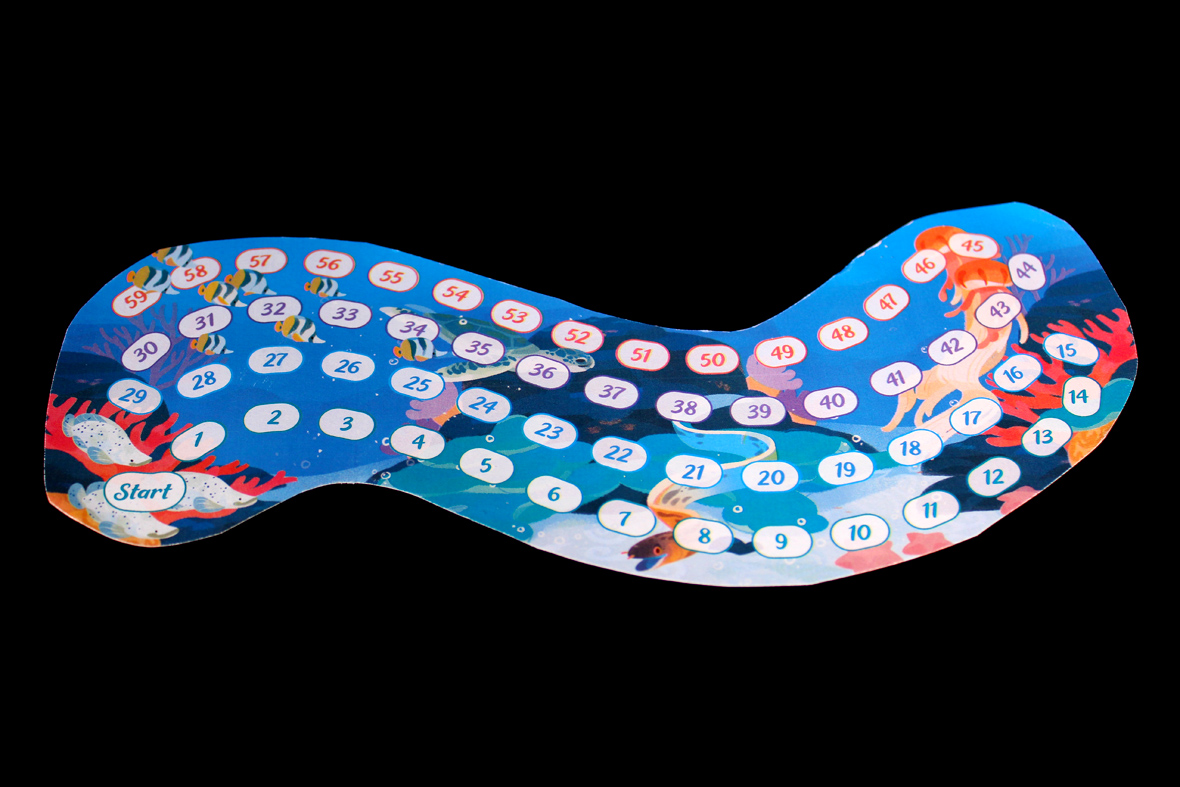
Set the scoreboard above or nearby:
Let each player choose two of the tiles; they should be shuffled by type. The top tile in each stack should be placed in front of it, as well.

Finally, shuffle the eighteen Drift Cards and reveal three near the Harmony Cards. You should be ready to start!
Gameplay

The core gameplay loop isn’t too complicated. Your goal is to make Habitats and score points! Let’s talk about how.
On a turn, you’ll place a tile such that the end of the tile is touching the head (the highlighted front area) of another tile. That’s the requirement, but the tiles can touch other tiles or be rotated / flipped to your liking. Just don’t move previously placed tiles and tokens. It may still happen a little, but do try to be mindful.
After you’ve placed a tile, check the Drift Cards. If you met any of those conditions, you must place one Effervescent per Drift Card completed. Don’t discard the Drift Cards, though! Note that even if you complete a Drift Card multiple times in a turn, you only place one Effervescent per card. Effervescents must be placed touching the tile you just played, as well. If you run out, use the set-aside extras (but the end of the game is triggered; more on that later).
Then, check to see if a Habitat was formed! A Habitat is a fully-enclosed space on the board completely surrounded by tiles. If so, all players with Effervescents in that Habitat can score a Harmony Card if the relevant card condition was fulfilled. Note, only one Harmony Card per player per Habitat, though! Unless otherwise stated, the number of Effervescents doesn’t affect the points scored either. If you split a big Habitat into two smaller ones, both of those Habitats would then score.
Finally, take a tile from either its stack or the available three in front of each stack, and refill if necessary.
Once every player has taken a turn, the round ends. Discard the rightmost Drift Card, slide the others to the right, and place a new one face-up on the left.

Continue play until any one player has placed 15 Effervescents or until there are fewer than two of each type of tile remaining. Finish the round so all players play the same number of turns and then move on to final scoring! For this, every player should reveal their Tidal Direction card and remove any Effervescents from the play area of theirs that don’t meet that criteria, and then count the remainder and add that many points. The player with the most points wins! If there’s a tie, all tied players win, so that’s nice.
Player Count Differences
More players is going to mean more Habitats, more Effervescents, and a slightly longer game! The game always goes until either the tiles run out or there are 15+ Effervescents from one player on the field, so with more people there are more things to place (and more tiles being taken, so it will equalize out with more players). There’s some natural slowdown as a result, just because players will take some time to figure out what they want to place and where. With any game that has some tendency towards analysis paralysis, the game length can balloon with more players. There are also more opportunities to score, since more players are going to be playing more tiles and creating more habitats. Like I said, it mostly balances out from a score and strategy standpoint (though I might prioritize getting into other players’ habitats at higher player counts), but I think the game will skew a bit longer with more players than I’d necessarily prefer. I’d stick to 2-3 players with this one, personally.
Strategy

- Let the Draft Cards determine your playstyle! The Draft Cards determine how you get to play Effervescents, so try to play according to those. Whether or not it’s worth placing three Effervescents or scoring points based on a Harmony Card is going to come down to what you’re able to do on your turn, though.
- The Harmony Cards are how you score, so, lean into that. They’ll usually give 2 / 3 / 4 points for a variety of tasks, and those tasks are always the same for the whole game. While the Draft Cards set how you place your Effervescents, the Harmony Cards dictate when and how you score. They’re both important! Some reward Habitats with multiple players’ pieces inside, others reward you for completely empty ones. Think and plan based on what you see.
- You likely shouldn’t always take the biggest tiles available. Big tiles are great for making huge Habitats, which is a double-edged sword. With larger Habitats, you can include more of your Effervescents and score more points down the line, but you also run the risk of your opponents trying to get in there and you not being able to keep them out. Smaller tiles let you be more flexible on size and shape, but you have the alternate issue of not necessarily being able to close up a Habitat.
- Placing Effervescents can let you lock down Habitats or jump into someone else’s! The more you place the more options you have, hence why meeting a lot of Drift Cards can be advantageous.
- Watch out for accelerating the end of the game, though. If you play all three Effervescents every turn, you’ll get five turns before the game ends. That might not be what you want, precisely. You should more likely expect to have ten or so turns, ideally? Granted, if placing three per turn works for you and you can actually score Habitats that way, great; keep rushing the end of the game. I’d just recommend being more careful than that.
- If you keep other players’ Effervescents inside of Habitats you create, you run the risk of giving them points as well. Habitats score where relevant for all players, even if it’s not your turn. Try to shut other players out and make them make their own points.
- Look to your final private scoring criteria; try to get as many of your Effervescents in matching Habitats as possible. It’s somewhat easy to prioritize that if you can get the right tiles, but the real challenge is whether or not to prioritize that over a Harmony Card. I lean towards the latter, but there are different reasons for everything, I suppose.
Pros, Mehs, and Cons

Pros
- This is a really novel spin on tile-laying games. Real-space games are always interesting, but Effervescent’s fixation on negative space as a form of game progression is really novel and I like it a lot. It justifies the weird shape of the tiles, for one thing, and I think that having weirdly-shaped tiles makes a game more visually unique and interesting.
- The Drift / Harmony card overlaps allow for a lot of flexibility within play. There’s a lot of variability in how you play Effervescents and why / where you want to play them from game to game, and I imagine it’s probably easier to add more of those cards to the same if Carla wants to change things up with an expansion (as she usually does).
- The game makes for a nice tableau by the end. I think it certainly helps that Jon Merchant‘s art shines here (though I wish I had cleaned my table off enough to use my Secret Blue Photography Background), but by the end of the game there’s an elegant shape to the noisy random tile placement and the negative space Habitats on the table and it’s satisfying to look at. It’s nice when things work out.
- There are a lot of mini-expansions and modules included if you want to mix things up there. There’s some talk of this eventually becoming a campaign or a process by which you can experience all of them, so that’s hopefully something to look forward to in the future. It’s really important to me to let you know that one of the mini-expansion modules has Eels and they can fall in love and swim off. Is that relevant to my review? Not really, but it’s important to me.
- This is less inherently adversarial than other tile-laying games I’ve played. Someone may close off a habitat that you had designs for, but you can still potentially score in those circumstances depending on how you played previously. There are even Harmony Cards that reward that kind of communal play, for instance. I don”t usually feel like players are taking things away from me; instead, it’s like random tiles are being constantly added based on criteria that I’m not aware of and I need to plan around that for my own strategies and schemes. It’s surprisingly pleasant. I imagine that the majority scoring Harmony card would be less pleasant, though.
Mehs
- A few spots where the rulebook and game could be clearer, overall. This is mostly “preview level stuff”, but the rulebook layout has some holes that confused us, specifically around indicating certain sizes or types of symbols. I think they use a not-filled circle to indicate “any size” or “any color” but it might be helpful to use a star or a not-already used symbol to make that clearer (as filled circles are used elsewhere). Further clarifying the difference between Drift and Harmony cards in initial setup may make the first game easier, as well as noting that the Harmony Cards are double-sided. These are, on the whole, relatively minor things, but still worth mentioning. I’m also not totally sure why there are two different sets of player reference cards.
Cons
- There’s a lot of opportunity for analysis paralysis, given the real-space nature of the game. You aren’t just dealing with tiles that can be turned or flipped; the rotation angle can matter with what tile you’re playing and where, insofar as it pertains to the size of a Habitat or how likely that one can be formed later. Some folks are going to be driven completely out of their minds by this, so try to consider those players before this one hits the table.
- Unsurprisingly, the game is somewhat inherently fiddly. Look, you’re playing a real-space game with tiles and their position, relative placement, and connection to other tiles and tiny bubbles matters a lot. You’re going to jostle the table or push the tiles accidentally and that can sometimes change the structure of the play area a bit more. Naturally, don’t do that purposefully to try and give yourself an edge; that sucks. But also accept that it’s going to happen if you play? Some folks don’t like that fiddly feeling
Overall: 8 / 10
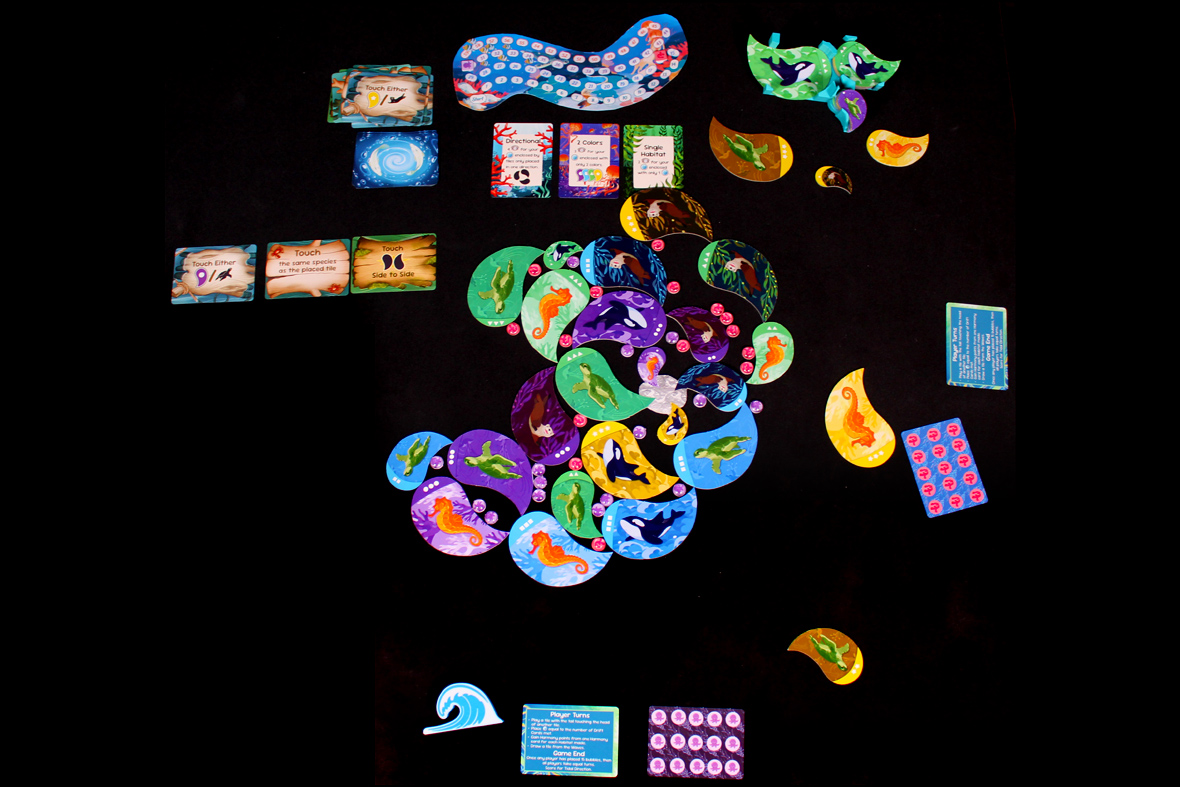
I think Effervescent is unlike most other tile-laying games that I’ve played, and that’s good! Previews are always a mixed bag, just from an overall build-quality standpoint, but I’m liking what I’m seeing so far quite a bit! The core of the game is solid, which is nice, and the additional content is exciting and fun and whimsical, which seems like it fits the vibe. It’s also not too much, which is kind of a relief. Extra content is always a little stressful with previews because you’re not necessarily sure how or where to start; things just are. I’ve also just been a little more critical of Kickstarter previews lately because there are so many games that a game really needs to justify why it exists. Effervescent does that quite resoundingly, which is nice. I don’t think a lot of places would take a risk on a deeply weird and quirky tile-laying game right now, but, I mean, it’s in the name for Weird Giraffes. Complexity-wise, Effervescent sits on the upper edge of a casual game or the lower edge of a more strategy-focused game. There’s plenty of strategy elements to it, but it’s also fiddly enough that one could pitch it more casual and chill by stripping out some of the more complex parts (and the game allows you to do so). You can’t make it much faster than it already is, just because the real-space placement of tiles is inherently vulnerable to player decision paralysis, and I think that’s the major thing to watch out for. Some players are going to get stuck here and agonize over the angle between two tiles or where to place or flip or rotate. If you can avoid that you’re probably golden, though. If this sounds like a quirky game that’s worth your time, I think Effervescent is a lot of fun! I’ll be interested in seeing how it develops further.
If you enjoyed this review and would like to support What’s Eric Playing? in the future, please check out my Patreon. Thanks for reading!
Discover more from What's Eric Playing?
Subscribe to get the latest posts sent to your email.