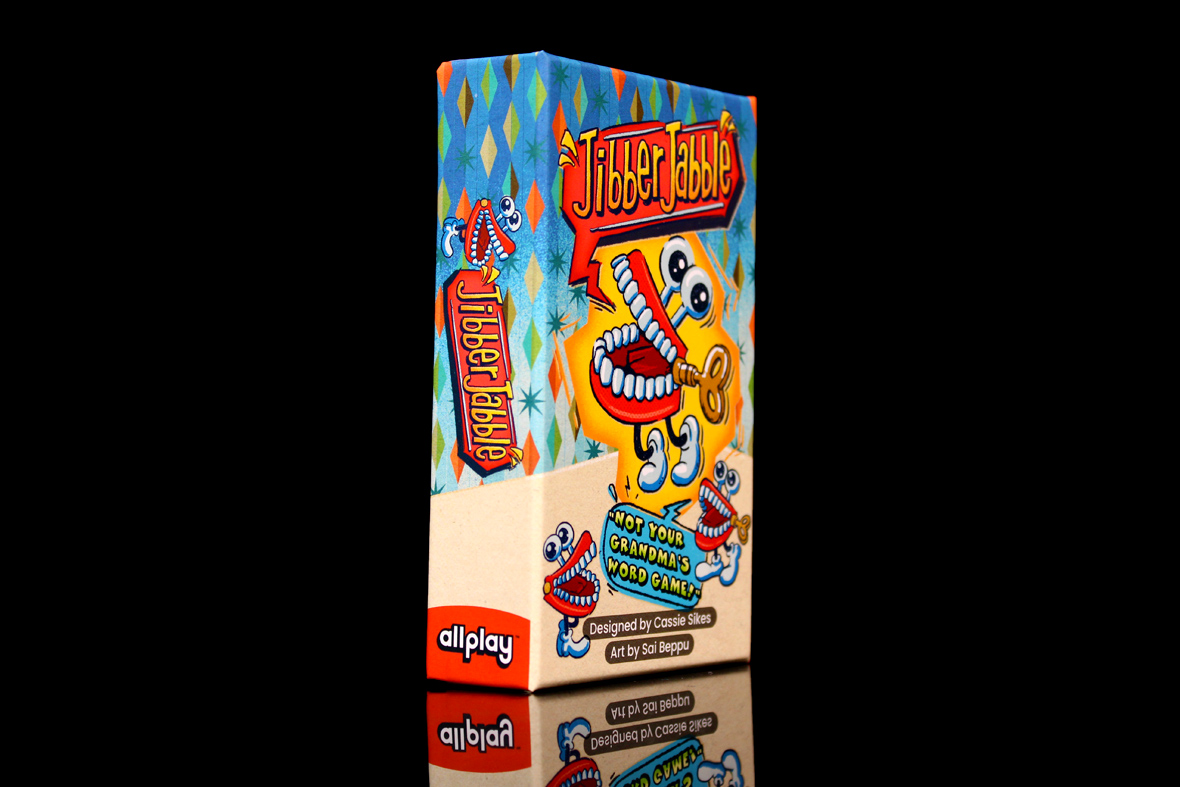
Base price: $9.
3 – 10 players.
Play time: ~15 minutes.
BGG Link
Buy directly!
Logged plays: 5
Full disclosure: A review copy of Jibber Jabble was provided by Allplay.
It’s rare for me to start reviews at midnight, but, you know, it’s a holiday weekend and I’ve been busy with a number of things. I think it’s just one of those weeks, to be honest, with PAX West and everything taking up my entire weekend. It was a great show, partially because of how good the artist alley was (maybe mostly?), but that means less time for board gaming, so here we are. I’m hustling through a few party games I was able to play this week, so exciting times to talk about that! Let’s dive in with a recent Gen Con hit, Jibber Jabble!
In Jibber Jabble, you’ve got an easy goal. Give a friend some clues and they’ll guess a word! It’s just like Just One. You love Just One. Unfortunately, you’ve got a restriction: you can only give a clue one letter at a time. That would be easy enough if your friends weren’t all trying to help you! They’ll give a letter right after you do, but they only aspirationally know what word you’re trying to spell! So it’s going to be a mess. Can you get this jibble jamber to form some words?
Contents
Setup
Easy! Just shuffle up the Word Cards:

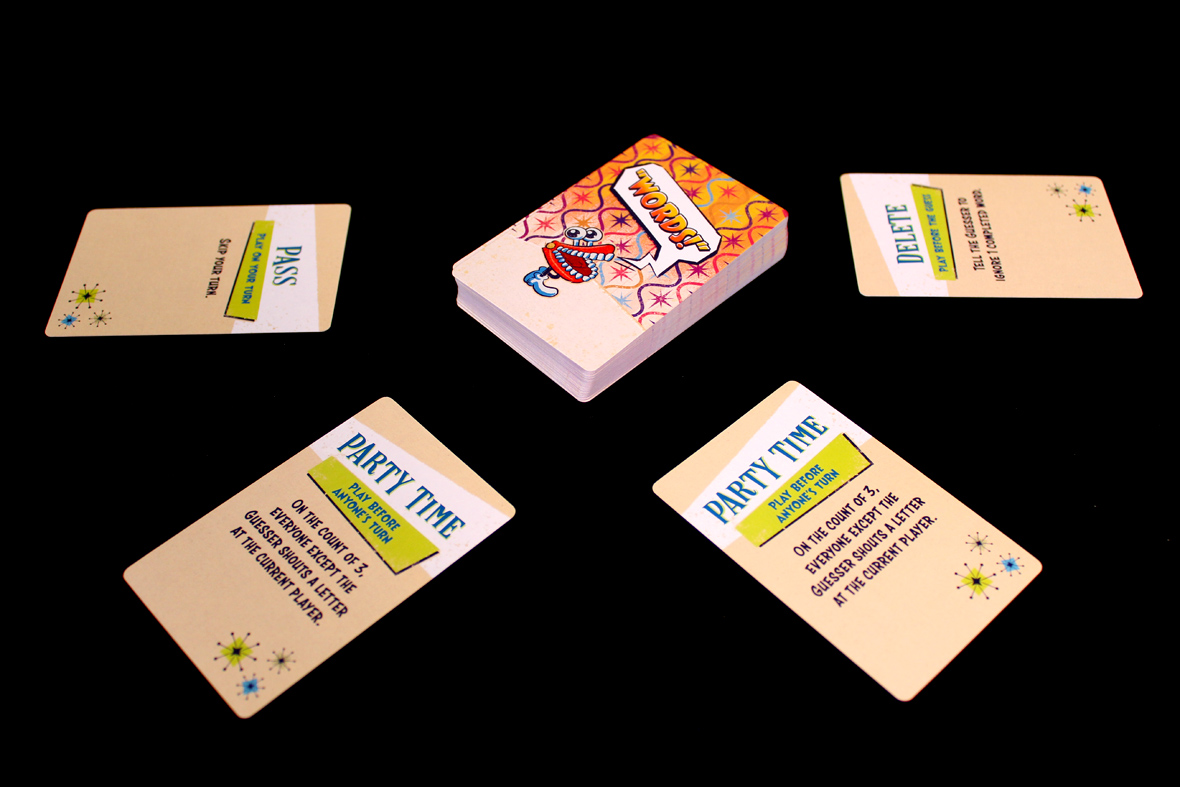
Also shuffle and deal each player one Hint Card:

You’re ready to go! Choose a player to be the first guesser.

Gameplay

Easy in concept! Each round, one player will be the Guesser. The player to their left draws a card and chooses a word for them to guess, saying a number between 1 and 6 (inclusive). The higher the number, the harder the word (generally) is to guess.
Now, starting with that same player, each player says a letter to add to the current Clue Word, in player order. Note that you cannot communicate the word you’re trying to spell. You can say “Jibber” if you understand, and “Jabble” if you do not. The Guesser does not add a new letter, and at any point the current player can say STOP to stop the current word and start a new one with a new letter. The rules about making a word? Basically none. You just can’t spell the word that’s supposed to be guessed or any forms of that word, which makes sense. Words might not be spelled “correctly”, but that’s okay. Language is fluid. A player can also play their Hint Card, once per game, to use its effect.
Once three clue words have been given, the Guesser has to give their best shot at guessing the word! If they’re right, great! That’s a point. If they’re wrong, too bad! No points. Play six rounds and see how you did!
Player Count Differences
Are you familiar with the modulo (%) operator? If not, it’s essentially the “remainder” operator when you do division. So, for instance, eight divided by five is one remainder three, yeah? Or 1.6. If you did eight modulo five, you’d get 8 % 5 = 3. All this preamble is to say that with fewer players, that modulo operator matters more. A lot of words are four or five letters, meaning in four- or five-player groups, you’ll end up with one player starting and stopping the word more frequently, which may or may not be good (see Strategy). With more players, well, you’re not exactly going to try and spell a ten-letter word (please don’t do that), so the starting speller will move around more frequently in a given round. That said, with more players, you individually have less to do, which may feel less fun. More hints, though! I’d probably say the five to seven range is my personal pick, but outside of that isn’t bad, per se; it’s just going to be a little different. I do side-eye the game a bit at three, though; it feels a bit low for the game to actually show why it shines.
Strategy

- As with basically every word game I review, I impart this advice: give at least one “narrower” clue and one “confirmer” clue. Narrowers help clue what category or general group the word is part of (say, “GAME” for Pokemon). Confirmers help differentiate a guess from other, similar guesses in that same category (say, “PIKACHU” for Pokemon). If you only get “GAME”, you’re going to have trouble actually guessing the word; if you only get “PIKACHU”, Pokemon is a valid option, but Nintendo might also be creeping around in there. “PIKACHU” and “GAME”, together, well, that kind of locks it in.
- Lots of word games have particular cultural signifiers that not all players might get; be careful with that. Everyone’s brain works differently. Some people might find that “PLANES” works better for cluing Airport than “SFO” / “ORD”. Others might just not get the reference if you give the clue “FOREVER” for Stamp. That’s the risk of the game!
- Keep an eye on how quickly your group spells the clue, as the Guesser. For instance, one game I got Pinocchio because the first clue, “NOSE”, was spelled immediately by all players. This meant that “NOSE” was not only a good clue, but an extremely obvious one that everyone agreed on, so I should pay more attention to it. Now, what happened next wasn’t great, but it’s outside the scope of the review.
- Look at your clues as a group and separately. Some clues work well with the word (though I still think cluing “LIBERTY” for Statue isn’t terribly helpful on its own) and some work well in conjunction with the other words (maybe “SITCOM”, “FAMILY”, “TITLE” for Modern). Try to read into the intent as well as the clues themselves.
- Know when your Hint is best used. You only get one shot per game! Try not to waste it. You may not have a clue that works particularly well for you, but there’s usually a time that it works out.
- Try to stick to one definition of the target word. If you have PARK, for instance, you might have “GREEN” or “CAR” as clue words. Helpful together? Not really. That said, there are counterexamples. If you get the clues “VAMPIRE” and “BASEBALL”, the word is probably BAT. As with all What’s Eric Playing? strategy advice, ignore it when it’s convenient. I won’t blame you.
Pros, Mehs, and Cons
Pros
- This one’s pretty easy to pick up. As it should be for a $9 tiny box game. You just need to explain the three-clue system and how each player spells a word and you’re set. You can hit the ground running pretty easily.
- I really like a party game where you basically need hold nothing and touch almost nothing. You basically need to touch two cards, maximum, per game. It’s great. I didn’t realize how much I wanted to play a party game with almost no cards to have to deal with.
- Word games are a lot of fun. I just really like the entire genre! We’re working on trying to give people clues that get them to guess certain words and it goes badly, most of the time. The twist here being that people have to spell words right after each other a la Bullseye is also good.
- The high portability of Allplay’s tiny line is still a favorite of mine. There’s just a lot to be said for taking tiny games on the road or on travel with you.
- Nice and quick. You can get through a few rounds in no time flat, and the entire game is sub-20 minutes, which is awesome for a party game.
- I like the Challenges a lot! It’s a nice way to spice up a game without having to go through the trouble of an expansion or something. Plus, once you’ve gotten good at the game, having some ways to add difficulty is appealing for some players.
Mehs
- I truly have yet to be able to say the name of this game correctly. I’ve said everything from “Jibble Jabber” to “Jambly Jombles” and I think intellectually understand it’s “Jibber Jabble” but my brain won’t put those noises together in the right way. Thankfully, that tiny bit of stupid that I have is infectious, so, it works for most games.
- I have some accessibility concerns. Mostly around holding specific letters in memory and keeping track of what’s already been spelled from an auditory / memory standpoint, but I likely imagine people affected by this know that better than I would.
Cons
- The Hints are just okay. They’re nice sometimes, but I don’t feel like they get enough utility for being one-use-per-game. It seems like some of them would be better to use once per game, granted, or maybe twice? Not sure. It’s also a bit frustrating that certain Hints are more situational (letting another player take your turn for you, for instance) and can rely on a specific player getting a specific Hint.
- If you’re a purist you’re going to have to fight your group to get them to not cheat. There’s so much temptation! People trying desperately to clue letters or to express that they have no idea what letter to pick next or to suggest that the clue is “guessable” or “easy” or even “helpful”. You’re really only supposed to say “Jibber” and “Jabble” during the game, but I’ve yet to see that happen.
Overall: 8 / 10
Sometimes I think I hate Jibber Jabble. I can’t decide if that’s because I wish everyone understood my perfect clues which are always obvious and intelligent or if that’s because my friends give me garbage clues that are impossible to guess, but it’s probably one of those. I remain unimpeachable, but Jibber Jabble is a very fun time. I’d probably recommend, as I have, to start at an easier level for your first game, as when it’s frustrating it’s frustrating, but I’d be willing to wager you’ll laugh more than you’ll be upset as your friends aggressively misspell words to the point of making you question if they graduated from any sort of program that required reading or spelling. And that’s okay. As with any good word association game, you’re going to see some truly appalling connections from your friends, and they’ll get made fun of for the foreseeable future. I do kind of miss Letter Jam‘s more structured spelling, but this is a very different game. I think the Hints are a little underwhelming, is probably my one major complaint? I’d like to see lower-power hints with more utility so that you can actively play them more and increase the player engagement. As it stands, players don’t do a lot when it’s not their turn (unless they’re cheating and getting mad at each other for not figuring out the word), so I’d love to see more engagement. I’ll be interested to see what happens with this game in the future, though; it seems easy enough to expand and definitely pleasantly surprised me, so I imagine it’ll be pretty popular. If you’re a fan of word games or party games or mispronouncing game titles, though, you’ll probably enjoy Jibber Jabble!
If you enjoyed this review and would like to support What’s Eric Playing? in the future, please check out my Patreon. Thanks for reading!
Discover more from What's Eric Playing?
Subscribe to get the latest posts sent to your email.