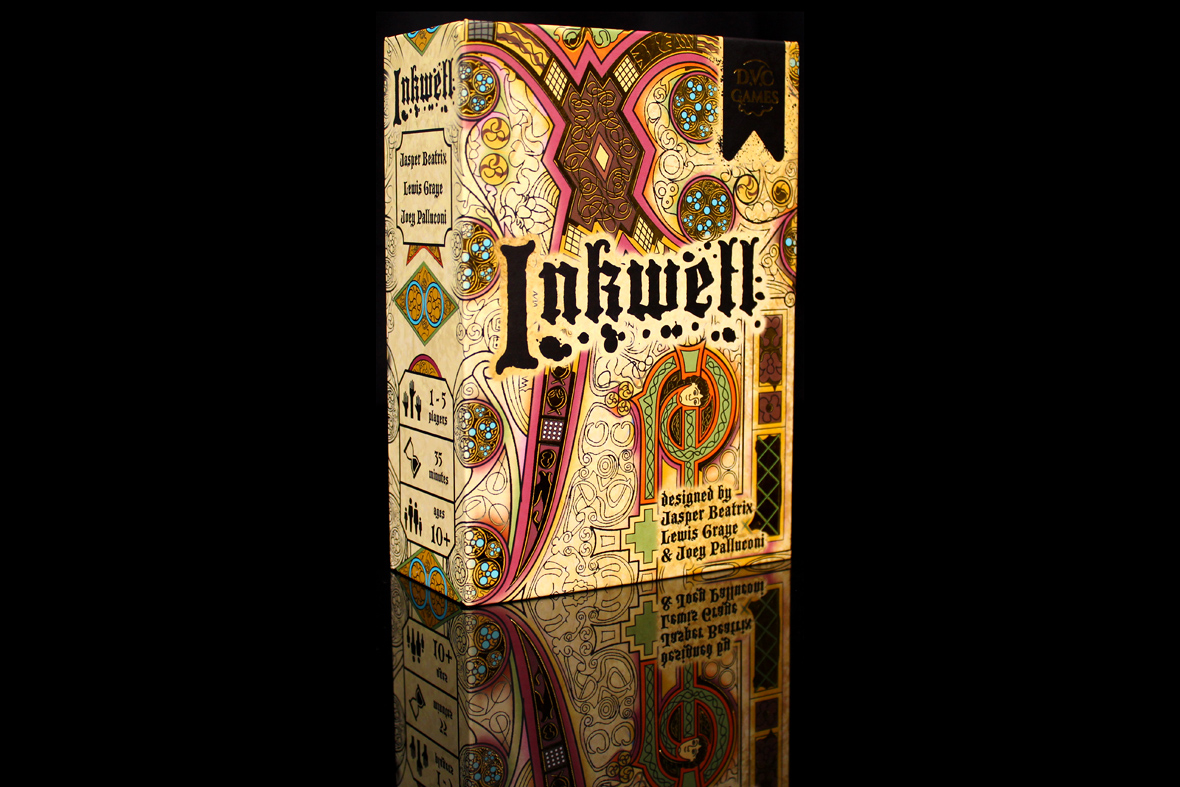
Base price: $30.
1 – 5 players.
Play time: 30 – 40 minutes.
BGG Link
Buy on Amazon (via What’s Eric Playing?)
Logged plays: 2
Pacts | Inkwell | Scream Park
Corvids | Playthings
Full disclosure: A review copy of Inkwell was provided by DVC Games.
We’re finally leaving the summer behind! I’m very excited as a known Summer Hater. It’s too hot, it’s very sweaty, and it’s so bright all the time. Literally moved to the Pacific Northwest to escape the intense California summer. But as the seasons change, I get what I want; it’ll soon be cold and rainy forever. The dream, and incidentally, perfect board game weather. Some people play board games outside when it’s nice and I do not understand that. They’re bold and fearless and their cards never fly away. Plus, there are two PAXes coming up! We’ll likely hear about some games coming down the pipeline from that. In the meantime, let’s check out a newish game from our friends at DVC!
In Inkwell, you and your friends have gotten together for the ultimate party activity … of the 1300s? Yes, you’re going to be doing medieval manuscript creation under the Abbott’s watchful eye! Can you think of anything more exciting? Can you specifically think of anything more exciting that would have been available at that time? Probably not, so pictures for the Lord it is! Draft some cubes to create beautiful, artistic pages that some tech jerk would have tried to steal with AI if he had been around at the time. Do you have what it takes to create the most meticulous manuscripts around?
Contents
Setup
This one’s an easy one! Set up the board in the center of the play area:
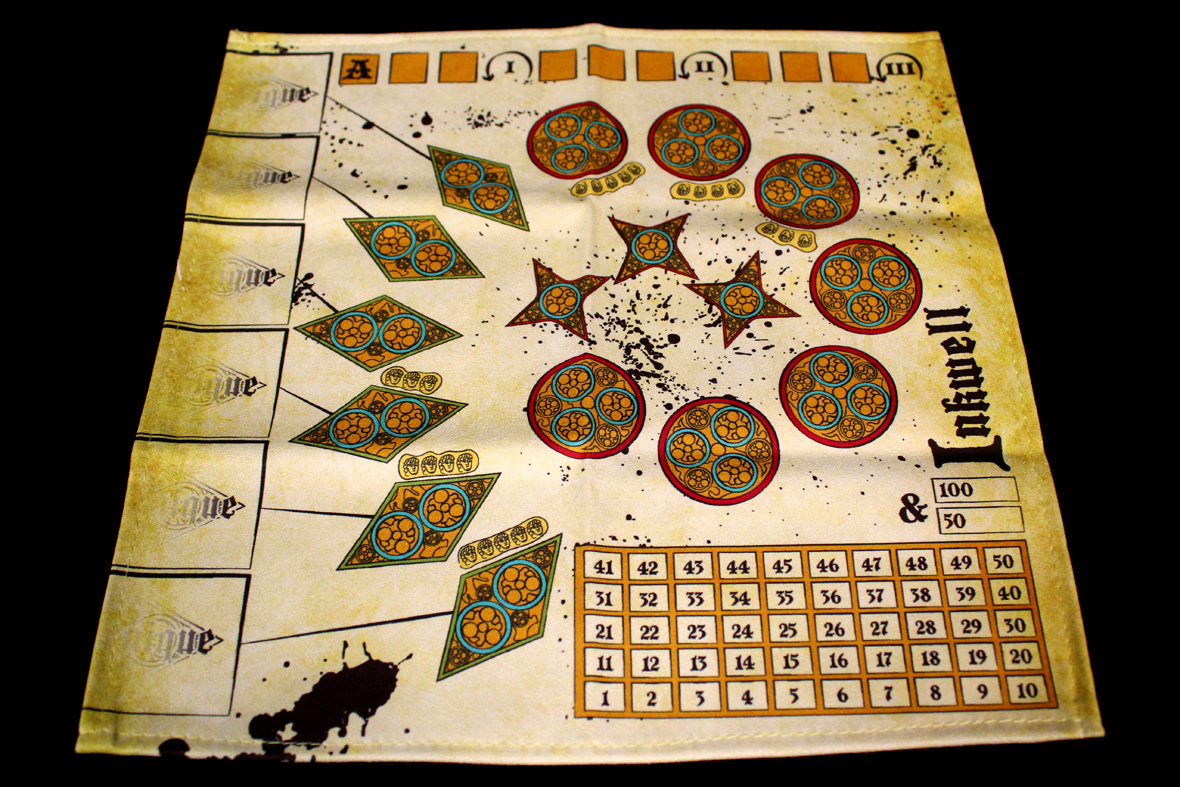
Place the Abbott on the first box at the top of the board. You can set the die aside; it’s for the solo mode.

Give each player a Technique Board; the color at the top will be their player color.

Take one cube of each player’s color and place it near the scoreboard.
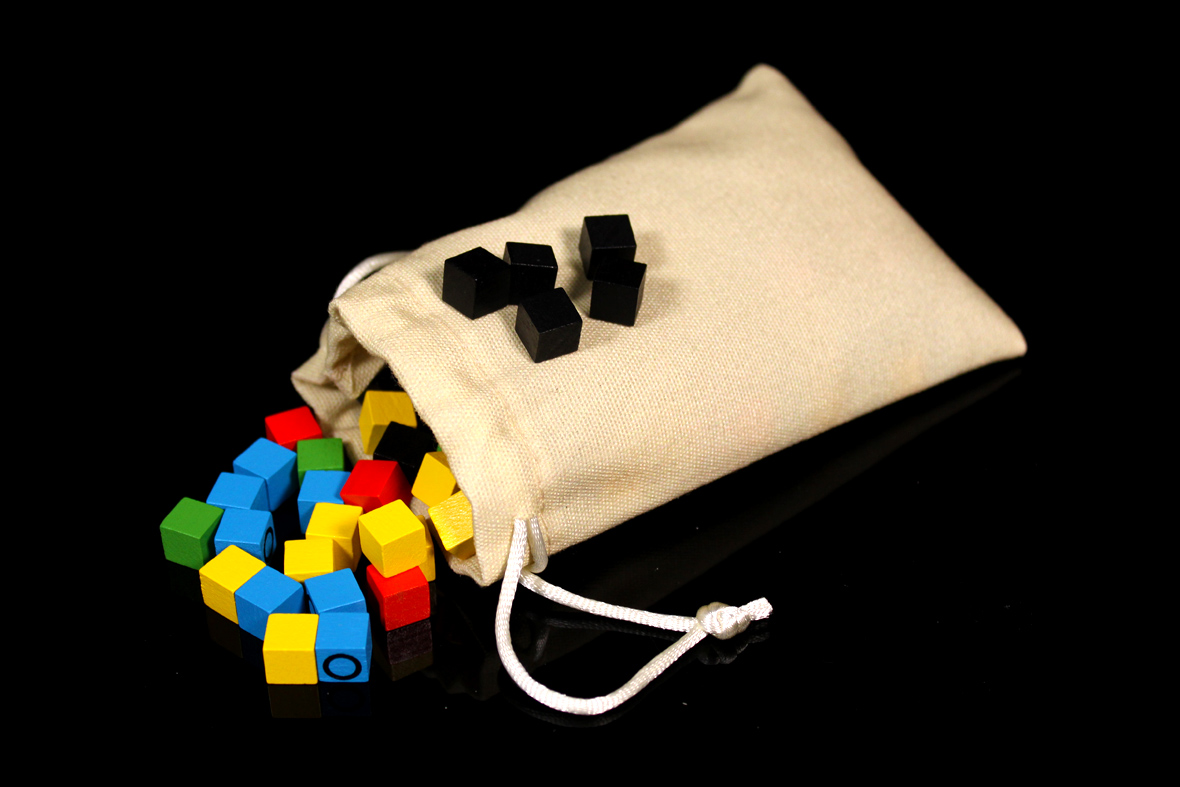
The gold cubes can be set aside for now; don’t put them in the bag.

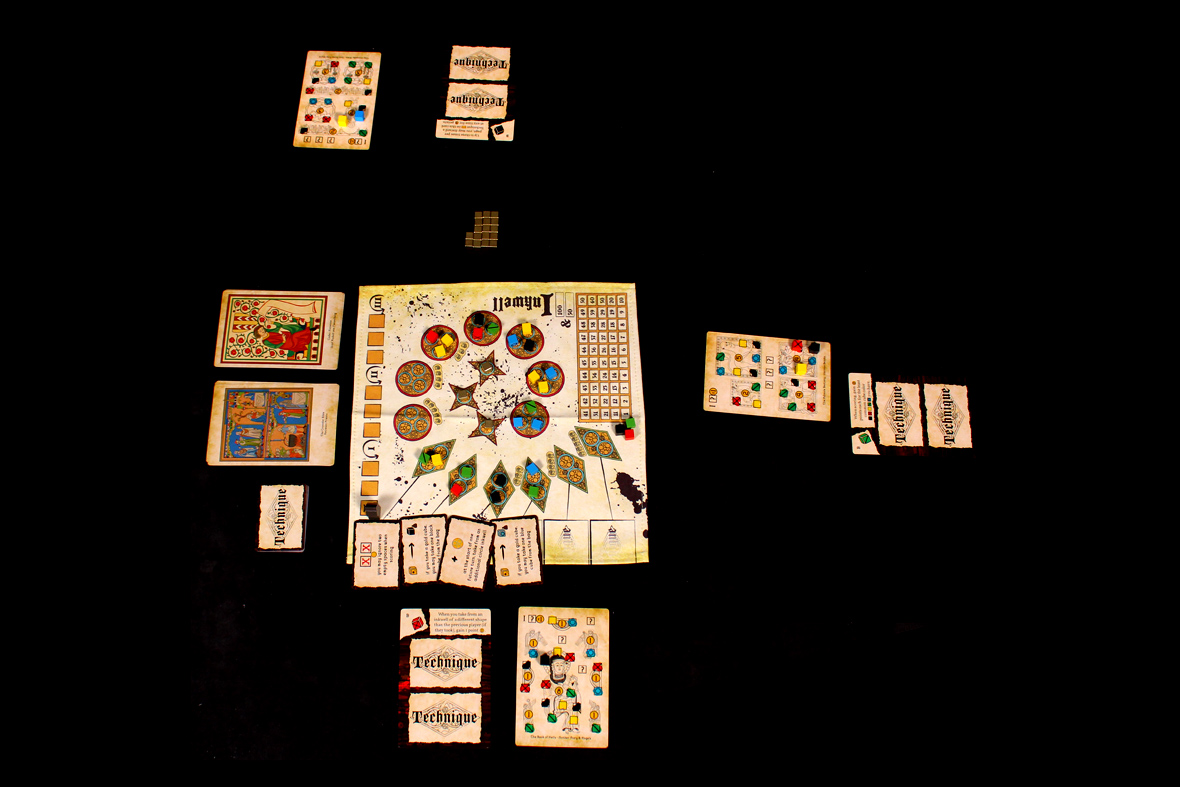
Fill the board with cubes from the bag (based on player count)! Each of the circles you’re using gets 3 cubes, each of the diamonds you’re using gets 2 cubes, and each star gets one gold cube. Also add a Technique Card to each diamond that has cubes in it:

The pages come next! Each player gets randomly dealt a Page I, and then make a stack of Page II and a stack of Page IIIs (one per player) and set those aside.
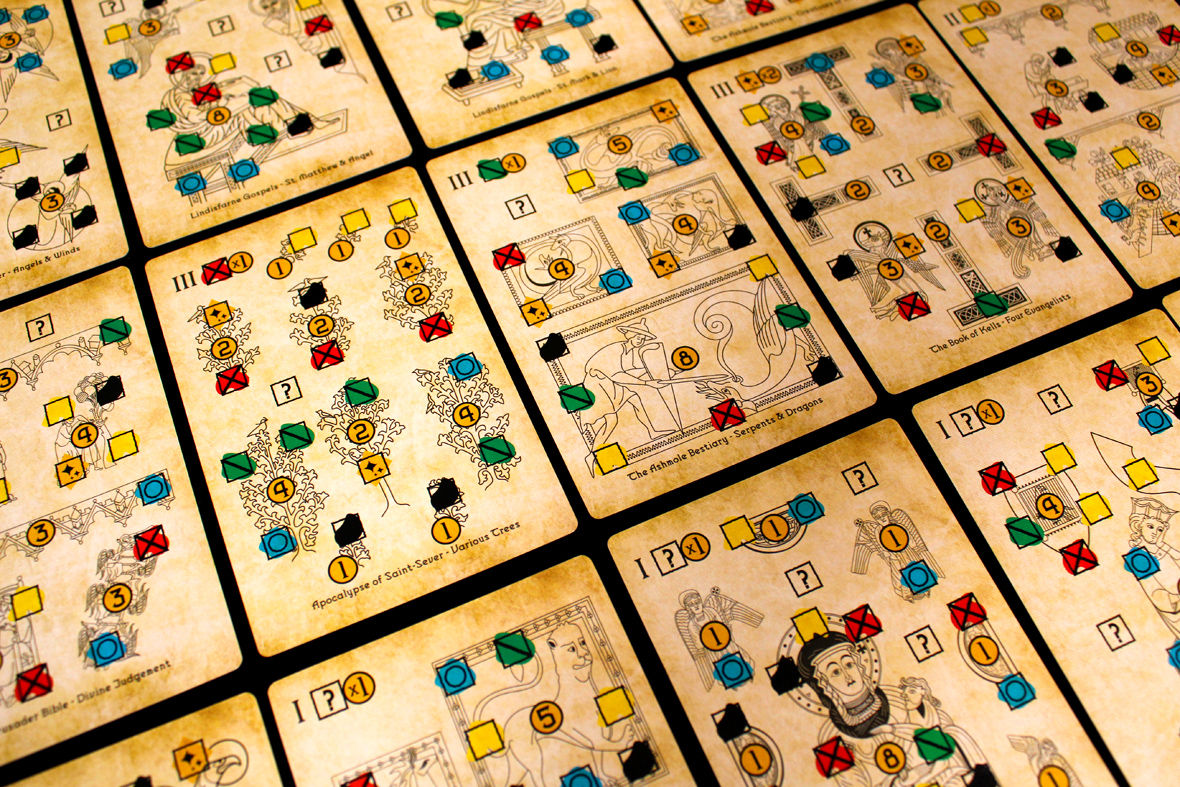
You should be ready to start! Give the first player a random cube, the second player two random cubes, and so on.
Gameplay

Inkwell! It’s about drafting cubes to make medieval manuscripts look good. I assume people might have been illiterate, but it was a different time then, pre-AC and formalized plumbing, so I’d rather not think about it.
Each turn is simple! You take or you Turn. To take, pick any circle, diamond, or star and take the cubes inside. Do not refill them. You then add the cubes to your current Page. Note that you cannot take from a space if you cannot place all the cubes that space gives you. That said, ? spots are wild and will take any color cube. If you take from a Diamond, take the corresponding Technique as well. You can hold up to two techniques per Page.

If, after taking from a space, all spaces of that type are now empty, you refill the entire board! Completely refill empty spaces and add one cube to any partially-empty spaces (usually the result of a Technique). Refill the techniques as well, and move the Abbott one space forward. If this moves the Abbott over an arrow, all players still on the indicated page must immediately Turn, in turn order.
To Turn, you score your current page by gaining points for all completed images and for whatever bonus your Page has (usually 1 or 2 points per cube of a specific color). You then set it aside and grab the next Page option: a new Page II or Page III (depending on which page you Turned). If you chose to Turn as your turn action, you gain a gold cube for free. If you were forced to turn, you gain nothing. Also, move your Techniques below the Technique Board; they’re still in play, but now you can gain two more. If you Turn Page III, you end your participation in the game; all subsequent turns of yours, you gain 3 points and advance the Abbott one space.

Play continues until the Abbott advances to the Page III arrow, forcing all players still on Page III to Turn. Do any final scoring, and the player with the most points wins!
Player Count Differences

I didn’t really notice a ton when I played, though I like Inkwell just fine at various player counts. I think to keep the game moving at a reasonable pace, they really don’t add too many additional circles as the player count increases, which means you’ll likely see lower scores and a need to prioritize well. With more refills, players will be forced to Turn more frequently, which might lead to more incomplete manuscripts. That’s mostly fine, again, if you’re paying attention to the state of the board and who’s taking what. That pacing may feel fast for you at higher player counts, and if that’s the case stick to the lower end of the player count spectrum. I don’t mind it, but I think it changes a bit of how I would strategize.
There’s also a solo mode! If you’re into that.
Strategy

- Forcing other players to turn their pages is good, but don’t neglect yours in the process. You can bum rush the end of the game and potentially force the Abbott to move forward, or you can keep grabbing gold cubes to try and force the Abbott towards a Turn, but if you do, you might run the risk of neglecting your board as other players actually take cubes that they need? It’s clearly suboptimal to only do that.
- Use Techniques to lock in on what you can do with what you have. If you do want to grab only gold cubes, for some reason, get Techniques that let you take other cubes along with the golds. If you’re constantly in need of red cubes, there’s Techniques that let you get additional reds every time you pull one. There are a lot of options based on what you think you might be trying to do, so focus on those in conjunction with your player ability.
- Techniques reap diminishing returns as the game goes on, though; you won’t get to use later ones as much as earlier ones. A Page III Technique is not going to get as much play as a Page I, so be mindful of what you’re pulling early in the game. Some of the better options as the game winds down might be the ones that give you instant abilities, rather than ones that give you the same thing for a prolonged period of time.
- Partial pulls from spots are fun as they can limit your opponents’ future options. Partial pulls don’t completely refill, and partially-filled spots still count as filled for refill purposes. You can put an opponent in a spot where they have to take from a partially-filled location in order to refill the board, and that truly sucks for them.
- Lean into your bonus scoring options as well. Your standard (side A) card gives you a bonus for each page based on a cube color, but the pages themselves also have a bonus scoring option. Try to collect as many of those cubes as possible! You can use the wild spaces on the card to give you more options. The late-game Gold x2 bonuses are even nicer since you can use gold cubes for anything.
- Certain Techniques can also expand your scoring opportunities. You can get more places to place cubes or more cubes or just a faster method for getting cubes to the board! Again, lots of options; you just have to think about what you want and what you can do.
- Try to avoid getting forced to Turn. Gold cubes are pretty high-utility since they’re both wild cubes and they specifically are required for certain spots in the later game. Missing out on a free one kind of sucks, even if you occasionally have to sacrifice some points to get them.
Pros, Mehs, and Cons

Pros
- Springing for the gold metal cubes was absolutely the right call. Careful with them when you’re playing on a standard wood table, just because they’re heavy enough to dent it, but they’re so nice and exciting to play with. Springing for metal cubes is always the right move.
- I like how approachable this drafting game is, especially around scoring. I could see this being a similar title in weight and gameplay style to Azul, but without the heavy scoring element that has traditionally frustrated a lot of folks who are newer to gaming.
- The portability is a big winner here. As is usually the case for this line of DVC titles. I really like the box size they’re working with. Small boxes but not tiny ones.
- I like that players are given the opportunity to Turn as a strategic play option; it adds in a big trade-off between advancing and staying with a bit of risk / reward thrown in. It’s definitely figuring out what the endpoint of the efficiency puzzle is. Do you essentially skip a turn to score your page and then move on? You might be missing out, but especially as you approach the end of the game you can force people into a bad spot. After the final Turn, every subsequent turn of yours advances the Abbott and gives you 3 bonus points. If you can’t do better than that, might as well go out early!
- I like the theme and the art a lot! Medieval manuscripts are super intricate and extra, likely because that was like one of the three things to do back then. So they went all out! Seeing that work in a board game is a lot of fun.
- The variety of Techniques available really do let you choose your preferred playstyle and shape how you want to play the game. You can lean into flexibility or getting a ton of cubes at once or just Techniques that constantly give you cubes; figuring out how these Techniques synergize with your player ability or the color cubes that you need to score the most points. There’s a lot of ways to carve your own path in Inkwell, and changing it up with different abilities each game makes for good replay opportunities.
Mehs
- As with all “cubes on a card” type games, there’s some inherent fiddliness around placement. Just don’t bump the table and you’ll be fine, I think. It’s just always a little frustrating that there’s no real stability with games like these.
- If you miss out on a big scoring opportunity there’s really no way to catch up, unfortunately. If you’re forced to turn before completing a 15-point structure, you’re just kind of stuck behind, I think. It would be nice if there were some sort of catch-up thing you got based on the value of your incomplete drawings or something.
- Space constraints are real, but I do wish that the cube bag were a little larger. It’s not the biggest box in the world, granted, but the cube bag doesn’t offer a lot of room for the cubes to get mixed up without getting your hand in there, which … I mean, it works, but it’s a whole process. A bigger, thinner bag might have had the same overall volume while still keeping things flexible.
Cons
- I do wish there were more of those impossibly-goofed medieval cats in the art. Just feels like a missed opportunity. Medieval cats are like, the foundational element of that art style in my opinion because it feels like nobody in that time period has ever seen a cat in their life before. I just want to see a deeply-cursed and terribly ugly cat. And I want to see a lot of them. Maybe a promo pack? Please?
Overall: 7.75 / 10
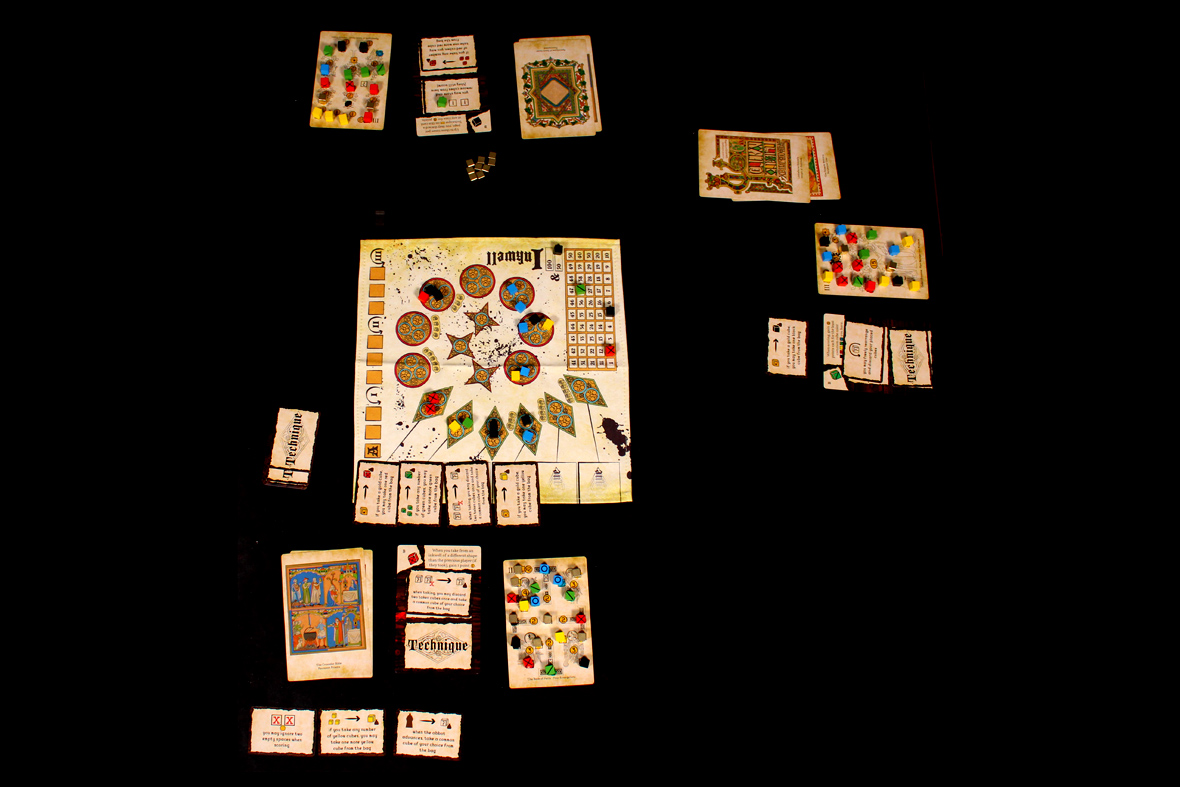
Overall, I think Inkwell is really nice! Part of it is just that I’ve been looking for an approachable drafting game that I can teach to folks really easily since some of my friends started rumbling against Azul years ago that they found the scoring very frustrating. Here, the points are the points. You fill out the diagram? You get the points. Plus, everything is pretty easy to spot, find, and figure out. They’ve double-coded all the cubes and the boxes so color differentiation isn’t an issue, which is the right move. Inkwell is designed to be pretty approachable and it works well. The one issue that comes up infrequently is strange interactions between the Techniques and / or the player powers, but they have an FAQ page that knocks out a few good questions. Beyond that, I just like the aesthetic! There’s a lot of gold foil and color work and weird drawings, which is everything I want from an old-timey medieval manuscript. This may be the least weird of their games (and I love a weird game), but it’s a solid entry point in a small package with some good competitive elements and some nice strategy. The intuitive aspects of Inkwell are where I think the game shines most, and if you’re looking for a great entry point into modern drafting games, Inkwell is certainly worth considering. If that’s your plan, you’re a big fan of tiny cubes, or you just love medieval manuscripts, I’d recommend checking Inkwell out! I’ve had a lot of fun with it.
If you enjoyed this review and would like to support What’s Eric Playing? in the future, please check out my Patreon. Thanks for reading!
Discover more from What's Eric Playing?
Subscribe to get the latest posts sent to your email.