
Base price: $15.
2 players.
Play time: ~15 minutes.
BGG Link
Buy directly!
Logged plays: 3
Full disclosure: A review copy of Why I Otter was provided by Button Shy Games.
I literally just had forgotten that I hadn’t reviewed this one until a while ago, while Button Shy was restocking and we discussed trying out some games that I hadn’t seen yet. I think I thought that I had gone through the whole set only to find that not only had I not played the original, there was another game since. I really liked An Otter Won, so naturally, we dug in and we’re here now. I’m working on the other review and it will be out in its season. But Button Shy has always been a favorite publisher of mine, so I’m always excited to try out some of their games. And PAX Unplugged is coming up, which means that we’ll get to see their booth! In the meantime, let’s see what Why I Otter has to offer.
In Why I Otter, the otters are hanging out by the river and making friends! As they do, they go back to their dens to hang out, unknowingly leaving the river unguarded. Sneakier folks would use that opportunity to steal from the river, but I’m emotionally resistant to larceny in all its forms, so I’m unburdened. Players will play a light trick-taking game where taking tricks is only half the battle. Setting up Scoring Cards to work in your favor is the difference between winning and getting otterly shut out. Will you be able to strategize your way to success?
Contents
Setup
This one’s dead simple. Shuffle the cards:

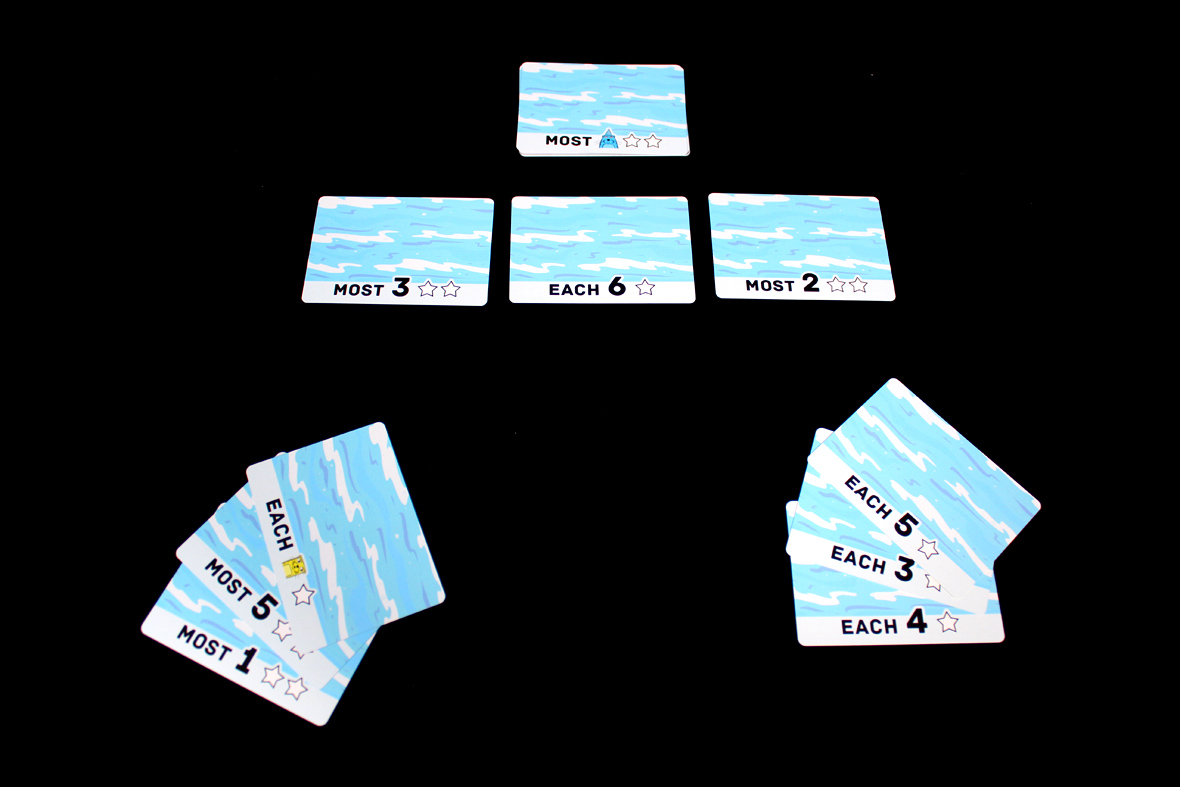
Deal each player three and make a stack, river-side up. Then place three cards river-side up below it to make the River, and you’re good to start!
Gameplay

So I reviewed these in a weird order and that’s on me. An Otter Won is the sequel game (not to be confused with Otter Chaos, which I haven’t gotten to … yet). That said, this is the original two-player otter-themed trick-taking game, so it’s going to play a little differently.
Each round (a trick) plays the same. The start player plays a card and their opponent plays a card in response. Then, a winner is decided. Squares beat circles beat triangles beat squares, but if two cards of the same suit are played, the higher card wins. The winner places both cards into their Den for later scoring (hopefully).
Once you have a winner, they pick one of the three River Cards to draw into their hand for the next trick. Then, the loser chooses. The remaining card is set aside, river-side up, as a Scoring Card for the end of the game. Start another round! Eventually, you’ll have set four Scoring Cards aside and be out of new cards to draw, at which point you finish out the round by continuing to play, just without drawing replacement cards.

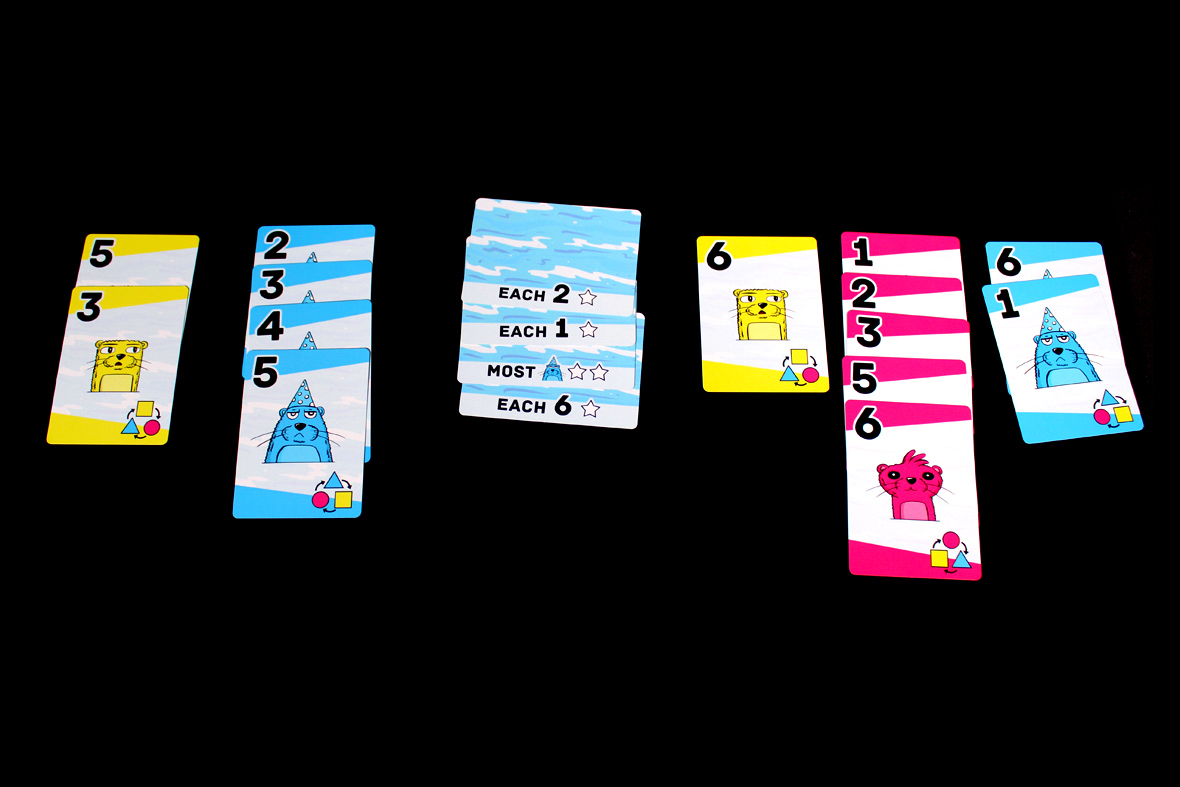
After both players have played all their cards, use the Scoring Cards and the cards in each player’s den to calculate points! In the event of a tie for a “Most” card, nobody has the “most” (since they have the same amount), so nobody gets it. The player with more points wins!
Player Count Differences
None! Two-player game.
Strategy

- You can’t necessarily choose what card your opponent sets as a scoring card, but you can sometimes leave them only cards that benefit you. If you just took a 3 and a 1, and the Scoring Cards for the round are points for 6s, 3s, or 1s, you can (and likely should) take the 6s card so that your opponent is stuck with the 3s or the 1s card. Either way, you’re going to earn points based on their decision; they just get to decide what card they end up with.
- Counting cards is usually your friend, here. There’s one of each number and color combination, so once you’ve seen a bunch of them, you can potentially even suss out what your opponent might still have in their hand. It’s actually even worse if they only have one suit remaining, as they might lose every subsequent trick if they’re not careful.
- You do need to win some cards so that you actually can score points. This is kind of what I meant earlier; even if the Scoring Cards were perfect, if you have nothing to score, well, then it’s kind of worthless. Don’t forget to actually win some tricks while you’re scheming.
- Watch out for ties! Ties are not your friend when it comes to scoring. It does make a certain amount of sense, but in the event of a tie, nobody gets anything. That is functionally the same as if both players got something, but, you know, it feels worse and I’m really a vibes-focused reviewer.
- The nice thing is that since everything is face-up, you can see what your opponent wants to score and how many cards they have so you can start dunking on them. Are they going for the Most 3s? Never let them have a 3 again. That’s the right move. I’m generally pro-dunking, but the major aspect of this is that you should always be paying attention to what your opponent has in their Den and what Scoring Cards are available.
- You should almost always look at the cards on the backside of the River Cards before you choose a scoring card. I generally don’t bother if it’s a card I need to take to block my opponent, but sometimes it’s worth knowing what cards are available to everyone, at least.
- Losing tricks is still strategy. Not only do you get to choose the Scoring Card, but you also get to play second in the next trick, which is sometimes a very good idea (since you can often choose whether or not you want to win the trick). Games are give and take!
Pros, Mehs, and Cons

Pros
- I really like these otters. They’ve got so much personality! And they’re fun to look at, so that’s two major wins. The art style of this game is lovely.
- Losing is a fundamental part of a winning strategy. I’m not sure it’s realistic to expect to win every trick, but even when you do lose there’s still interesting stuff to do, strategically. It ensures that losing never “feels bad”; it’s just another aspect of your overall game-winning strategy.
- I was worried that An Otter Won was going to be “explicitly better” or something, but they’re just very different games in the series. I had to reread my old review to familiarize myself with the game, but yeah they’re pretty different games that use similar mechanics. Otter Chaos looks to be the same in that regard (in that it’s different; that was a confusing way to write this).
- The wallet is a fun color. I’m glad the Otter series is going with this particularly intense blue; it makes the wallet pop and it’s fun to look at.
- This is pretty explicit two-player micro-trick-taking, which is super interesting. There’s always something interesting you can do, and having the cards be double-sided in their effects makes the choices feel more interesting as well. I like when Button Shy games try out a variety of genres, and this is a great way to make a trick-taking game that’s strategic, enjoyable, compact, but not particularly complex. A good combination for a starter game as well.
- Portability is a big win, as usual. That’s, as always, the Button Shy guarantee.
Mehs
- I do kind of wish the cards were a bit busier. I like them! They’re just a bit simple. The Scoring Side has most of it dedicated to the river vibe of the whole thing. I like the art style a lot so maybe I’m just being greedy.
Cons
- This is definitely on the simpler side, to the point that it might feel too simple to some. I’m not particularly burdened by it but I will say that this is less complex than An Otter Won and from a brief skim of the Otter Chaos rulebook looks to be less complex than that, as well. I’d probably lean towards playing this with younger players most frequently, though it’s a great way to teach the basic flow of trick-taking while still having some interesting strategy moves which distinctly elevate it for me. It’s a great example of the argument that a game doesn’t have to be inherently complex to be interesting or fun. It does end up being likely a better first trick-taking-style game than, say, a game you bring to play with your trick-taking experts group.
Overall: 8 / 10
Trick-taking remains a difficult genre to get new players into. There’s a lot of inherent nonobvious strategy and there’s frequently a nontrivial skill gap between new players and players who grew up playing Spades or Hearts or Euchre. Many publishers have been trying to bring games into their library that address that, like Gudetama or pivoting a bit to more ladder-climbing games like the ever-popular SCOUT. Two-player trick-taking ends up being even trickier since there’s a cadence you want to hit during the game that’s hard to establish at two. So Why I Otter being able to distill that essence down to a very approachable two-player introductory trick-taking game is extremely impressive, even if you’re looking for a game with more inherent, built-in complexity. I think that’s neat and I apologize for burying the lede a bit in that introduction. But you already saw I gave it an 8, so, bear with me. Naturally, it has a lot going for it on its own, both in terms of portability and general vibes, but I think the game is particularly well-designed in that the loser of the trick has to make a strategic determination that will drive the game forward. Now, you have a tension between winning cards to score points or losing cards to decide how the points will be scored. I suppose it’s a bit unfair writing this to hope that the series adds complexity given that it’s got two sequels and they both seem more complex, but that’s the benefit of being in the future. Great art, quick gameplay, and just a fun theme make Why I Otter a lot of fun, and if you’re trying to learn the flow / vibe of trick-taking, you love a wallet game, or you just want to see a few silly otters, I’d recommend checking it out! I’ve enjoyed playing it.
If you enjoyed this review and would like to support What’s Eric Playing? in the future, please check out my Patreon. Thanks for reading!
Discover more from What's Eric Playing?
Subscribe to get the latest posts sent to your email.