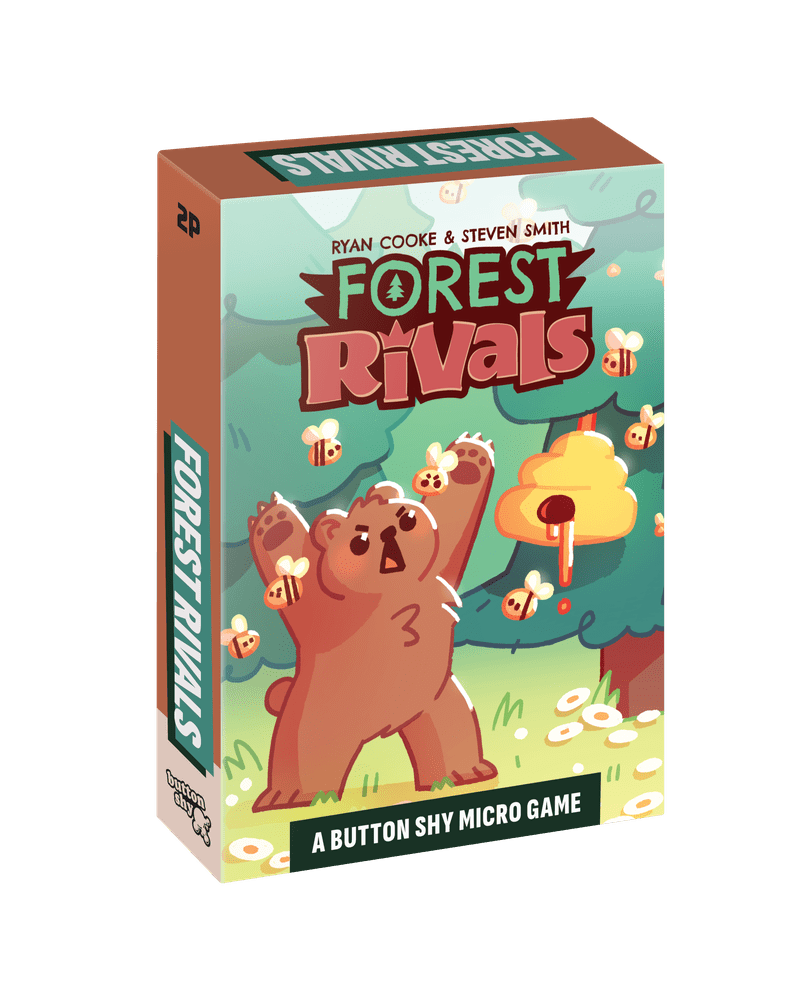
Base price: $25.
2 – 4 players.
Play time: 15 – 30 minutes.
BGG Link
Check it out on Kickstarter!
Logged plays: 3
Full disclosure: A preview copy of Forest Rivals was provided by Button Shy. Some art, gameplay, or other aspects of the game may change between this preview and the fulfillment of the Kickstarter, should it fund, as this is a preview of a currently unreleased game.
It’s a little wild how tired I am, today, but the Kickstarter grind continues. I guess this is my first weekend post-Gen Con, so expect more games from there to pop up around the various Kickstarter titles we have coming down the pipe in the near future. Button Shy’s latest summer Kickstarter is starting on Tuesday, and so in addition to The Cursed Cat I have a review of their latest, Forest Rivals, for y’all. Let’s see how it plays!
In Forest Rivals, it’s an all-out honey-powered conflict between the Bears and the Bees. Bees make honey and the Bears want it. Irreconcilable differences have led the two factions to blows, and now you need to pick a side and take control of as much of the forest as you can. Draw cards, play cards, and build up your presence in the forest to ward off your opponents and get as much of that delicious honey as you possibly can. Will you be able to bear the weight of this challenge, or will you suffer an unbeelieveable loss?
Contents
Setup
Easy. One player gets the Bears and their cards:
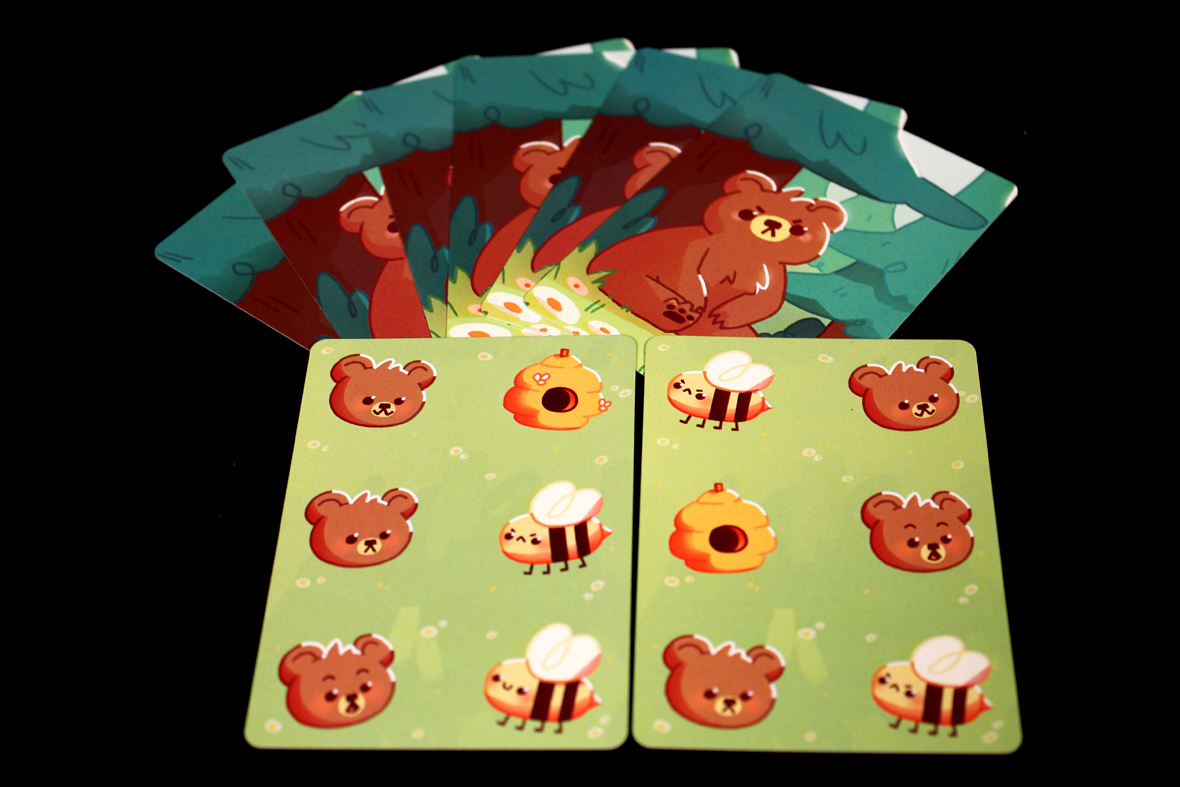
One player gets the Bees and their cards:

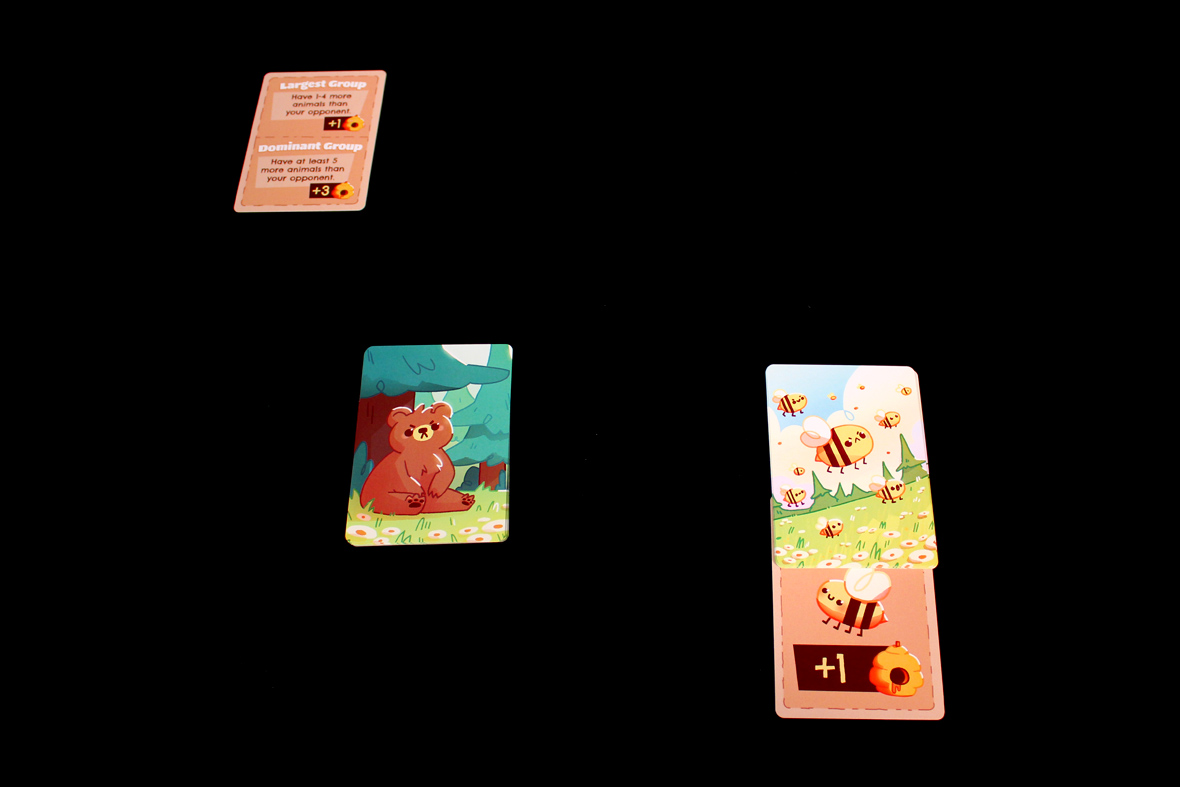
Shuffle both decks and choose a player to go first! They get this card, which indicates that the second player gets +1 Beehive at the end of the game.


You’re all ready to start!
Gameplay

Not a super-complex game this time. Must be one of those weeks. The bears and the bees want to control as many beehives as possible! You’re trying to bring this one home for your team.
On your turn, draw and place a card. You can rotate it as much as you want (in 90-degree increments). You can either place it adjacent to an existing card (matching up rows and columns) or you can stack it on another card; if you do that, you must cover 1 – 3 icons on the old card. Beehives can only be covered by another beehive, so play carefully.On your turn, draw and place a card. You can rotate it as much as you want (in 90-degree increments). You can either place it adjacent to an existing card (matching up rows and columns) or you can stack it on another card; if you do that, you must cover 1 – 3 icons on the old card. Beehives can only be covered by another beehive, so play carefully.
And that’s pretty much it! Once you’ve both played out all of your cards, score. The player with the larger group gets either the Largest Group Award (having a larger group by 1 – 4 icons) or the Dominant Group Award (having the larger group by 5+ icons). Tally up the scores for Beehives next; each one completely surrounded by icons gives one point to the player with more icons. If there’s a tie, nobody gets any.
The player with more points wins!
Player Count Differences
None for this one; it’s a two-player only game.
Strategy

- This is a very zero-sum game; building up your own group or taking down your opponent’s group is similar, in terms of outcome. You could ideally do both, but sometimes you may want to prioritize one or the other for certain advantages, like blocking your group or gaining certain Beehives.
- The one thing to watch out for is that while building up a big group of Bears or Bees is good. that alone won’t win you the game. It might get you +3 points, which is neat, but the real money is in Beehives. Don’t lose track of the goal when you play.
- Surround Beehives or steal them! Most of the points are going to come from your Beehives, so try to get sufficient control of enough to win. They only score at the end of the game if they’re completely surrounded, so sometimes you’re going to need to finish them out. Other times, you can just swoop one that your opponent is around and get those points at the end of the game. Don’t give them free points if you can help it!
- If you build away from your opponent, then you force them to decide between blocking your stuff or building up theirs, which sometimes means that you might get a reprieve. A tightly-interlocked board just means that they can cover your icons and build up theirs in the same move, which might not be what you want. Instead, if you start building a lengthy and large group away from the center, you force them to decide between augmenting their group or cutting down yours. Sometimes they choose the former. Just don’t build up your group in such a way that it’s easy to cut it in half.
- Certain cards you draw are going to be better suited to extending your group size or going after Beehives, so just keep that in mind. Big contiguous groups of Bears or Bees on the card might be what you need to extend groups or switch up plans or (sometimes) take a Beehive. Mixed groups are more useful in other situations.
- There’s a decent amount of power in taking the last turn. You could use that to break up an opponent’s group or capture a Beehive (or multiple) or something that you know your opponent can’t respond to, since the game is over. Your opponent should try to play in such a way that those moves aren’t as useful, if possible, to block you.
- You can place cards in such a way that it makes them hard to cover. Keeping in mind, for instance, that the Beehives can only be covered by other Beehives, you can use Beehives to insulate your group of animals from being covered by your opponent. You also can leverage that they can’t cover 4+ icons on a card at a time, for instance. It won’t work perfectly, but adding some defensive plays to your strategies can sometimes incentivize your opponent to look elsewhere.
Pros, Mehs, and Cons

Pros
- The art style here is fantastic. I really like the “generally cute animals with just ‘>’ eyebrows” as a vibe; it gives “angy” in a super engaging and comical way. The color choices are bright and pleasant as well; it’s a good-looking game. Oh, Manon Mergnat drew it? That makes sense. (Same artist as Rove Jr.)
- Plays quickly. Draw a card, play a card. Easy.
- I don’t normally love area control games, but this one is pretty snappy. I think it helps that you don’t really need to think about the scoring until the end of the game, and by then, there are only a handful of cards on the table and they’re partially-to-mostly covering each other up. So you can just play a card and try to quickly and locally optimize without having to worry about the big picture initially.
- I appreciate that scoring is pretty simple as well. You just compare group sizes and then score each completed Beehive. There’s not much past that, unless they add a mini-expansion of some kind (which they’ve definitely done before … frequently).
- It’s more compact than I expected. While you’re not required to necessarily cover up cards each time, it makes a lot of sense to, so players are kind of incentivized to try and make the game’s footprint smaller by covering up their opponent’s cards.
- The spatial play is pretty satisfying. You’re trying to make and solve a puzzle at the same time, to some degree, and I find that gratifying.
Mehs
- Shuffling eight cards is always a little weird. Just a casualty of playing 18-card microgames.
- It seems like making the Award Card double-sided was also weird. I assume there’s a cost to printing different fronts and backs, but just put the +1 version on one side and the +3 version on the other so it’s easier to see, read, and use.
Cons
- The First Player Card needs a rework. All it would take is putting a little icon of the opponent character next to the +1 Beehive, so that way you know what happens at the end of the game. It currently looks like the First Player gets the Beehive bonus, which seems weird. Even if the second player were to take it, it says First Player on it. Hopefully they’ll fix it for the final version, if they haven’t already.
- The lack of a formal grid on the cards can make placement a little weird sometimes. It’s not always clear what the bounding box for an icon is, so as you rotate them, you risk your grid getting a little sloppy unless you have someone looking for that and fixing it every time.
Overall: 7.75 / 10

Overall, I think Forest Rivals is delightful. I think what’s mostly selling me on it is the art style, since I’m not the biggest area control / majority fan, but it’s still a quick and pleasant game in the genre for someone who’s less keen on the genre as a whole. The art, though; that deserves another shoutout. They’ve gone for cute and fun, here, and it makes the game look great. I was just at a “Smol Art Fair” and I think this would have fit in perfectly, given the color scheme and general vibe of it all. On the graphic design side of things, I think Forest Rivals could use a couple tweaks. The First Player card conflates who’s going first with who gets the bonus; fix that. While I can appreciate the lack of a grid on the cards for visual aesthetics, it can make the grid seem unaligned at times, which isn’t ideal. The Award Card is also odd, since it has both awards on both sides facing the same way; just flip one upside down or make the back of the card the alternate reward? Not sure. These aren’t particularly intense blockers for an otherwise pleasant game, but they are points of frustration I was experiencing while I was setting up and playing. That said, Forest Rivals does do what I come to Button Shy for. It’s a pleasant entry point into a genre that I don’t necessarily love, but the game teaches me some things I could love about it or presents it in a format I find exciting. Spatial puzzles are always great for me, and Rivals has that in spades as you have to decide whether to attack or defend on a dime as you play. Players looking for something quick and cutthroat (but not too cutthroat) will likely enjoy this, as first and second player have different challenges and the game certainly evolves as you keep playing it with the same person. Part of the challenge is just figuring out how to win while only getting to play eight cards! It’s not easy, but it’s a fun experience. If you’re looking for that kind of challenge, or you just love games with bears or bees in them, you’ll probably enjoy Forest Rivals! I thought it was neat.
Looking for more portable games to play on the go? Check out my Travel and Wallet Games Hub for some great recommendations!
If you enjoyed this review and would like to support What’s Eric Playing? in the future, please check out my Patreon. Thanks for reading!
Discover more from What's Eric Playing?
Subscribe to get the latest posts sent to your email.